
Advertisement


Sections
NASA displays its experimental all-electric X-57 Maxwell aircraft for the first time
The aircraft has been under development since 2015 and is still a year away from its first test flight.

NASA, most prominent for its many Florida-launched exploits into space, showcased an early version of its first all-electric experimental aircraft, the X-57 “Maxwell,” on Friday at its lesser-known aeronautics lab in the California desert.Adapted from an Italian-made Tecnam P2006T twin-engine propeller plane, the X-57 has been under development since 2015 and remains at least a year away from its first test flight in the skies over Edward Air Force Base.But after attaching the two largest of 14 electric motors that will ultimately propel the plane — powered by specially designed lithium-ion batteries — NASA deemed the Maxwell ready for its first public preview.[caption id="attachment_7632371" align="alignnone" width="1280"]![NASA's all-electric X-57 Maxwell aircraft. Image credit: NASA]() NASA's all-electric X-57 Maxwell aircraft. Image credit: NASA[/caption]NASA also showed off a newly built simulator that allows engineers, and pilots, to get the feel of what it will be like to manoeuvre the finished version of the X-57 in flight, even as the plane remains under development.The Maxwell is the latest in a proud line of experimental aircraft the National Aeronautics and Space Administration has developed over many decades for many purposes, including the bullet-shaped Bell X-1 that first broke the sound barrier and the X-15 rocket plane flown by Neil Armstrong before he joined the Apollo moon team.The Maxwell will be the agency’s first crewed X-plane to be developed in two decades.While private companies have been developing all-electric planes and hover-craft for years, NASA’s X-57 venture is aimed at designing and proving technology according to standards that commercial manufacturers can adapt for government certification.Those will include standards for airworthiness and safety, as well as for energy efficiency and noise, Brent Cobleigh, a project manager for NASA’s Armstrong Flight Research Center at Edwards, about 100 miles (160 km) north of Los Angeles.“We’re focussing on things that can help the whole industry, not just one company,” he told Reuters in an interview at the research centre. “Our target right now is to fly this airplane in late 2020.”The final modification, or Mod IV, of the aircraft, will feature narrower, lighter-weight wings fitted with a total of 14 electric engines — six smaller “lift” props along the leading edge of each wing, plus two larger “cruise” props at the tip of each wing.[caption id="attachment_7632441" align="alignnone" width="1280"]
NASA's all-electric X-57 Maxwell aircraft. Image credit: NASA[/caption]NASA also showed off a newly built simulator that allows engineers, and pilots, to get the feel of what it will be like to manoeuvre the finished version of the X-57 in flight, even as the plane remains under development.The Maxwell is the latest in a proud line of experimental aircraft the National Aeronautics and Space Administration has developed over many decades for many purposes, including the bullet-shaped Bell X-1 that first broke the sound barrier and the X-15 rocket plane flown by Neil Armstrong before he joined the Apollo moon team.The Maxwell will be the agency’s first crewed X-plane to be developed in two decades.While private companies have been developing all-electric planes and hover-craft for years, NASA’s X-57 venture is aimed at designing and proving technology according to standards that commercial manufacturers can adapt for government certification.Those will include standards for airworthiness and safety, as well as for energy efficiency and noise, Brent Cobleigh, a project manager for NASA’s Armstrong Flight Research Center at Edwards, about 100 miles (160 km) north of Los Angeles.“We’re focussing on things that can help the whole industry, not just one company,” he told Reuters in an interview at the research centre. “Our target right now is to fly this airplane in late 2020.”The final modification, or Mod IV, of the aircraft, will feature narrower, lighter-weight wings fitted with a total of 14 electric engines — six smaller “lift” props along the leading edge of each wing, plus two larger “cruise” props at the tip of each wing.[caption id="attachment_7632441" align="alignnone" width="1280"]![The Aircraft has yet to be tested which might still be a year away. Image credit: NASA/Twitter]() The Aircraft has yet to be tested which might still be a year away. Image credit: NASA/Twitter[/caption]The lift propellers will be activated for take-off and landings, but retract during the flight’s cruise phase.Because electric motor systems are more compact with fewer moving parts than internal-combustion engines, they are simpler to maintain and weigh much less, requiring less energy to fly, Cobleigh explained. They also are quieter that conventional engines.ne challenge is improving battery technology to store more energy to extend the plane’s range, with faster re-charging.Due to current battery limitations, the Maxwell’s design is envisioned for use in short-haul flights as an air-taxi or commuter plane for a small number of passengers.
The Aircraft has yet to be tested which might still be a year away. Image credit: NASA/Twitter[/caption]The lift propellers will be activated for take-off and landings, but retract during the flight’s cruise phase.Because electric motor systems are more compact with fewer moving parts than internal-combustion engines, they are simpler to maintain and weigh much less, requiring less energy to fly, Cobleigh explained. They also are quieter that conventional engines.ne challenge is improving battery technology to store more energy to extend the plane’s range, with faster re-charging.Due to current battery limitations, the Maxwell’s design is envisioned for use in short-haul flights as an air-taxi or commuter plane for a small number of passengers.
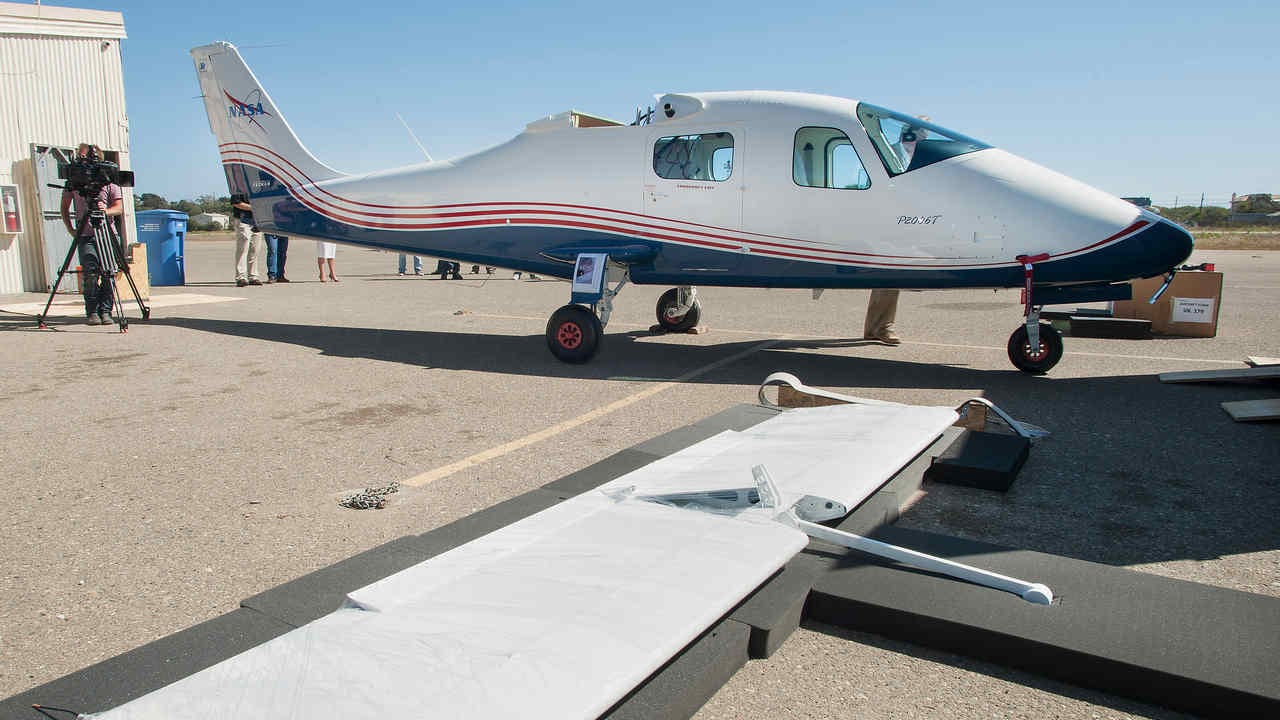 NASA's all-electric X-57 Maxwell aircraft. Image credit: NASA[/caption]NASA also showed off a newly built simulator that allows engineers, and pilots, to get the feel of what it will be like to manoeuvre the finished version of the X-57 in flight, even as the plane remains under development.The Maxwell is the latest in a proud line of experimental aircraft the National Aeronautics and Space Administration has developed over many decades for many purposes, including the bullet-shaped Bell X-1 that first broke the sound barrier and the X-15 rocket plane flown by Neil Armstrong before he joined the Apollo moon team.The Maxwell will be the agency’s first crewed X-plane to be developed in two decades.While private companies have been developing all-electric planes and hover-craft for years, NASA’s X-57 venture is aimed at designing and proving technology according to standards that commercial manufacturers can adapt for government certification.
 The Aircraft has yet to be tested which might still be a year away. Image credit: NASA/Twitter[/caption]The lift propellers will be activated for take-off and landings, but retract during the flight’s cruise phase.Because electric motor systems are more compact with fewer moving parts than internal-combustion engines, they are simpler to maintain and weigh much less, requiring less energy to fly, Cobleigh explained. They also are quieter that conventional engines.ne challenge is improving battery technology to store more energy to extend the plane’s range, with faster re-charging.Due to current battery limitations, the Maxwell’s design is envisioned for use in short-haul flights as an air-taxi or commuter plane for a small number of passengers.
First Published:Nov 11, 2019, 09:16:03 IST
Advertisement
Advertisement

Careless Whispers: Scientists discover that plants can 'talk' to each other using smells
Japanese scientists have recorded a video that shows plants, in certain conditions, communicate with each other using mists that carry smells. The discovery, reveals that plants release a fine mist of airborne compounds, to warn nearby plants of potential dangers
Life on Mars? European Space Agency’s Orbiter discovers ice water deposits at equator
European Space Agency's Mars Express Orbiter has identified massive ice and ice water deposits beneath the surface of Mars. The Mars Express orbiter was also the first to confirmed the presence of ice on Mars in 2004
Microsoft briefly overtakes Apple as the most valuable company, Apple back on top again
At its peak during the session, Microsoft's value reached $2.903 trillion, with a 2% surge. As of writing this article, Apple closed at $2.89 trillion, whereas Microsoft closed at $2.86 trillion
Even NASA is facing a tough time, starts layoffs following major budget cuts
NASA is facing some massive budget cuts, because of which, it has been forced to postpone some upcoming missions. NASA's Jet Propulsion Laboratory has been hit hard by recent federal budget cuts, resulting in the layoff of 100 contractors last week
ISRO, NASA's NISAR satellite to get ready by Jan-end, will monitor Earth's snow-covered regions
The NISAR satellite which has been developed jointly ISRO and NASA, should be ready for launch by the end of January 2024. The collaboration between NASA and ISRO on NISAR is the first time the two agencies have cooperated on hardware development for an Earth-observing mission
Advertisement
Advertisement