
Advertisement


Sections
NASA balloon captures electric blue clouds during weather forecasting mission
The balloon captured a thin group of electric blue clouds at the edge of our atmosphere.

The images of a thin group of seasonal electric blue clouds on the cusp of our atmosphere captured by a new NASA balloon mission may lead to improved weather forecasting, the US space agency has said.Data from these clouds, known as noctilucent clouds or polar mesospheric clouds (PMCs), may help scientists better understand turbulence in the atmosphere, as well as in oceans, lakes and other planetary atmospheres, NASA said in a statement on Thursday, 20 September.The NASA long-duration balloon mission observed these clouds over the course of five days at their home in the mesosphere.[caption id="attachment_5237511" align="alignnone" width="1280"]![Electric Blue Clouds_NASA]() The electric blue clouds captured by NASA's PMC Turbo balloon form when ice crystals in the mesosphere scatter light. They are only seen in summers, when temperatures in the mesosphere can dip to as low as -120ºC. Image courtesy: NASA[/caption]Scientists have just begun to analyse the photos captured by the mission, the statement added."From what we've seen so far, we expect to have a really spectacular dataset from this mission," said Dave Fritts, principal investigator of the PMC Turbo mission at Global Atmospheric Technologies and Sciences in Boulder, Colorado."Our cameras were likely able to capture some really interesting events that we hope will provide new insights into these complex dynamics," Fritts added.NASA's PMC Turbo mission launched a giant balloon on 8 July to study PMCs at a height of 50 miles above the surface.For five days, the balloon floated through the stratosphere from its launch at Esrange, Sweden, across the Arctic to Western Nunavut, Canada.During its flight, cameras on board the balloon captured six million high-resolution images filling up 120 terabytes of data storage – most of which included a variety of PMC displays, revealing the processes leading to turbulence, NASA said.Noctilucent clouds coalesce as ice crystals on tiny meteor remnants in the upper atmosphere.These clouds are affected by what is known as atmospheric gravity waves – caused by the convecting and uplifting of air masses, such as when air is pushed up by mountain ranges.The waves play major roles in transferring energy from the lower atmosphere to the mesosphere."This is the first time we've been able to visualise the flow of energy from larger gravity waves to smaller flow instabilities and turbulence in the upper atmosphere," Fritts said."At these altitudes you can literally see the gravity waves breaking – like ocean waves on the beach – and cascading to turbulence," Fritts added.
The electric blue clouds captured by NASA's PMC Turbo balloon form when ice crystals in the mesosphere scatter light. They are only seen in summers, when temperatures in the mesosphere can dip to as low as -120ºC. Image courtesy: NASA[/caption]Scientists have just begun to analyse the photos captured by the mission, the statement added."From what we've seen so far, we expect to have a really spectacular dataset from this mission," said Dave Fritts, principal investigator of the PMC Turbo mission at Global Atmospheric Technologies and Sciences in Boulder, Colorado."Our cameras were likely able to capture some really interesting events that we hope will provide new insights into these complex dynamics," Fritts added.NASA's PMC Turbo mission launched a giant balloon on 8 July to study PMCs at a height of 50 miles above the surface.For five days, the balloon floated through the stratosphere from its launch at Esrange, Sweden, across the Arctic to Western Nunavut, Canada.During its flight, cameras on board the balloon captured six million high-resolution images filling up 120 terabytes of data storage – most of which included a variety of PMC displays, revealing the processes leading to turbulence, NASA said.Noctilucent clouds coalesce as ice crystals on tiny meteor remnants in the upper atmosphere.These clouds are affected by what is known as atmospheric gravity waves – caused by the convecting and uplifting of air masses, such as when air is pushed up by mountain ranges.The waves play major roles in transferring energy from the lower atmosphere to the mesosphere."This is the first time we've been able to visualise the flow of energy from larger gravity waves to smaller flow instabilities and turbulence in the upper atmosphere," Fritts said."At these altitudes you can literally see the gravity waves breaking – like ocean waves on the beach – and cascading to turbulence," Fritts added.
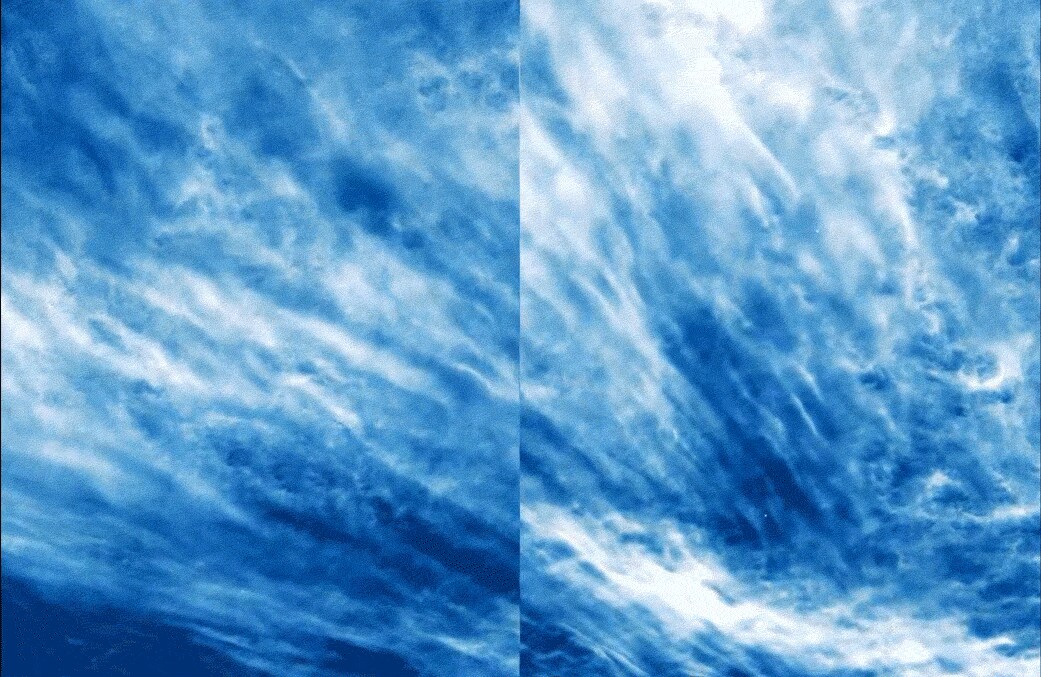 The electric blue clouds captured by NASA's PMC Turbo balloon form when ice crystals in the mesosphere scatter light. They are only seen in summers, when temperatures in the mesosphere can dip to as low as -120ºC. Image courtesy: NASA[/caption]Scientists have just begun to analyse the photos captured by the mission, the statement added."From what we've seen so far, we expect to have a really spectacular dataset from this mission," said Dave Fritts, principal investigator of the PMC Turbo mission at Global Atmospheric Technologies and Sciences in Boulder, Colorado."Our cameras were likely able to capture some really interesting events that we hope will provide new insights into these complex dynamics," Fritts added.NASA's PMC Turbo mission launched a giant balloon on 8 July to study PMCs at a height of 50 miles above the surface.For five days, the balloon floated through the stratosphere from its launch at Esrange, Sweden, across the Arctic to Western Nunavut, Canada.During its flight, cameras on board the balloon captured six million high-resolution images filling up 120 terabytes of data storage – most of which included a variety of PMC displays, revealing the processes leading to turbulence, NASA said.
First Published:Sep 22, 2018, 09:45:03 IST
Advertisement
Advertisement

Careless Whispers: Scientists discover that plants can 'talk' to each other using smells
Japanese scientists have recorded a video that shows plants, in certain conditions, communicate with each other using mists that carry smells. The discovery, reveals that plants release a fine mist of airborne compounds, to warn nearby plants of potential dangers
Life on Mars? European Space Agency’s Orbiter discovers ice water deposits at equator
European Space Agency's Mars Express Orbiter has identified massive ice and ice water deposits beneath the surface of Mars. The Mars Express orbiter was also the first to confirmed the presence of ice on Mars in 2004
Microsoft briefly overtakes Apple as the most valuable company, Apple back on top again
At its peak during the session, Microsoft's value reached $2.903 trillion, with a 2% surge. As of writing this article, Apple closed at $2.89 trillion, whereas Microsoft closed at $2.86 trillion
Even NASA is facing a tough time, starts layoffs following major budget cuts
NASA is facing some massive budget cuts, because of which, it has been forced to postpone some upcoming missions. NASA's Jet Propulsion Laboratory has been hit hard by recent federal budget cuts, resulting in the layoff of 100 contractors last week
ISRO, NASA's NISAR satellite to get ready by Jan-end, will monitor Earth's snow-covered regions
The NISAR satellite which has been developed jointly ISRO and NASA, should be ready for launch by the end of January 2024. The collaboration between NASA and ISRO on NISAR is the first time the two agencies have cooperated on hardware development for an Earth-observing mission
Advertisement
Advertisement