


Mystery of a massive neutron star merger in Milky Way explained by new astrophysics theory
The researchers explain both the massive mass of the object and why similar systems aren’t observed using traditional radio astronomy techniques.

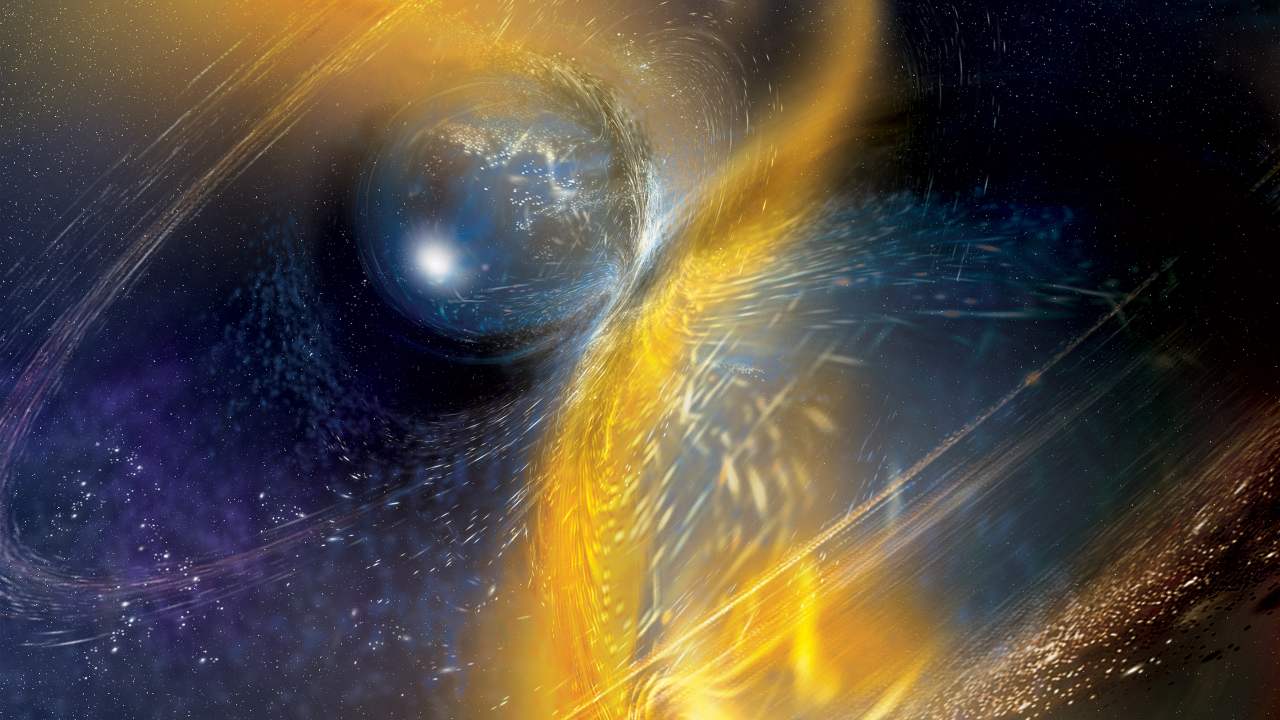
An artist's illustration of merging neutron stars. The rippling space-time grid represents gravitational waves that travel out from the collision, while the narrow beams show the bursts of gamma rays that are shot out just seconds after the gravitational waves. Image: NSf/LIGO/Sonoma State Uni/A Simonnet[/caption]The theory for its formation was put forward by researchers from Australia’s ARC Center of Excellence for Gravitational Wave Discovery (OzGrav), led by Isobel Romero-Shaw from Monash University. The researchers claim to have explained both the high mass of the binary object and why similar systems aren’t observed using traditional radio astronomy techniques.As per Romero-Shaw, GW190425 was formed through a process called ‘unstable case BB mass transfer’. It begins with a neutron star that has a stellar partner – a helium (He) star with a carbon-oxygen (CO) core. If the helium part of the star expands enough that it engulfs the neutron star, the helium cloud of the neutron star ends up pulling its stellar partner closer before the cloud dissipates and a binary object is formed from the two objects merging."The carbon-oxygen core of the star then explodes in a supernova and collapses to a neutron star,” Romero explains. The binary neutron stars that form in this manner can be significantly more massive than those that are observed through radio waves, he adds.

Careless Whispers: Scientists discover that plants can 'talk' to each other using smells
Life on Mars? European Space Agency’s Orbiter discovers ice water deposits at equator
Microsoft briefly overtakes Apple as the most valuable company, Apple back on top again
Even NASA is facing a tough time, starts layoffs following major budget cuts
ISRO, NASA's NISAR satellite to get ready by Jan-end, will monitor Earth's snow-covered regions