


Mars' moon Phobos got its strange signature grooves from rolling stones: Study
Some of these globe-trotting stones rolled all the way around & back to their source — a big crater.

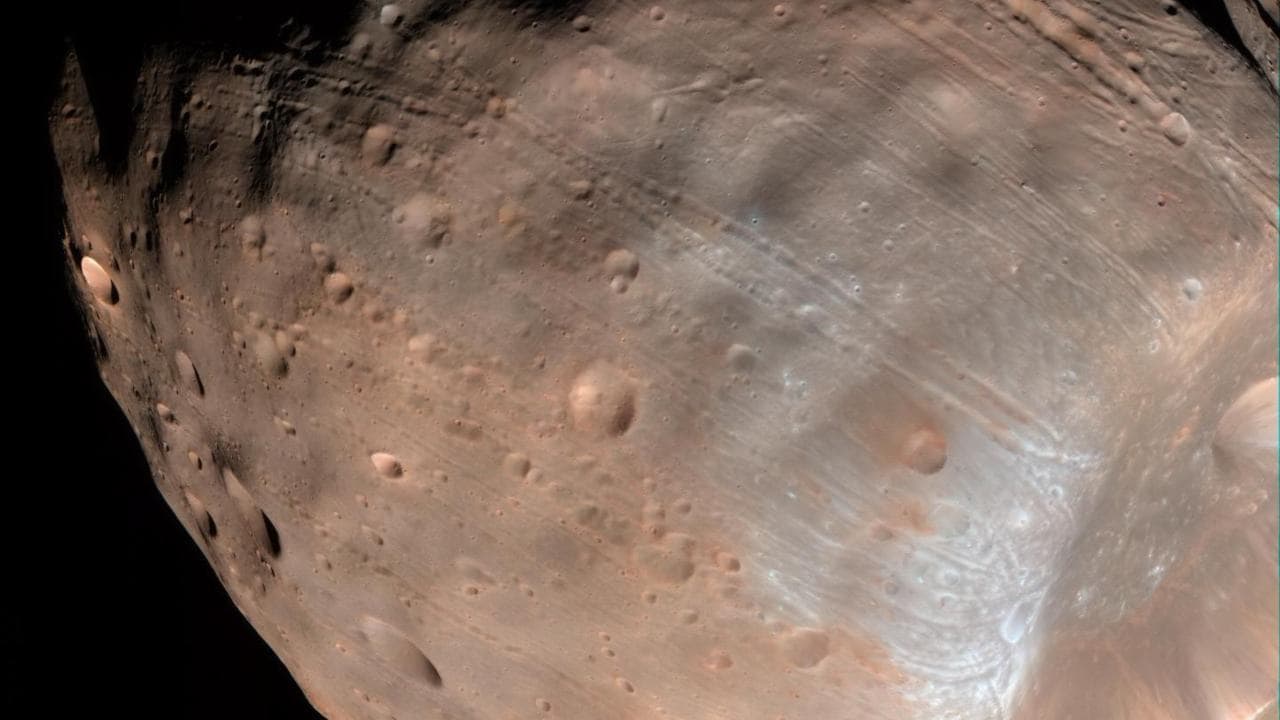
An image showing the grooves on Martian satellite Phobos as seen by the NASA's Viking 1. Image courtesy: NASA Goddard[/caption]The simulations show that because of Phobos' small size and relatively weak gravity, Stickney stones just keep on rolling rather than stopping after a kilometre or so, like they might on a larger body.In fact, some boulders would have rolled and bounded their way all the way around the tiny moon, explaining why some grooves are not radially aligned to the crater, the researchers noted in the paper published in the journal Planetary and Space Science.In some cases, the globe-trotting boulders rolled all the way back to where they started — Stickney, indicating why the crater itself has grooves.In addition, there are fairly low-elevation areas on Phobos surrounded by a higher-elevation lip, with no grooves at all."It's like a ski jump," Ramsley said. "The boulders keep going but suddenly there's no ground under them. They end up doing this suborbital flight over this zone.""We think this makes a pretty strong case that it was this rolling boulder model that accounts for most if not all the grooves on Phobos," Ramsley said.

Careless Whispers: Scientists discover that plants can 'talk' to each other using smells
Life on Mars? European Space Agency’s Orbiter discovers ice water deposits at equator
Microsoft briefly overtakes Apple as the most valuable company, Apple back on top again
Even NASA is facing a tough time, starts layoffs following major budget cuts
ISRO, NASA's NISAR satellite to get ready by Jan-end, will monitor Earth's snow-covered regions