


Mars' crust hardened too soon for life to flourish on Red Planet: Study
The crust that encases rocky planets and makes possible the emergence of life took shape on Mars earlier than thought

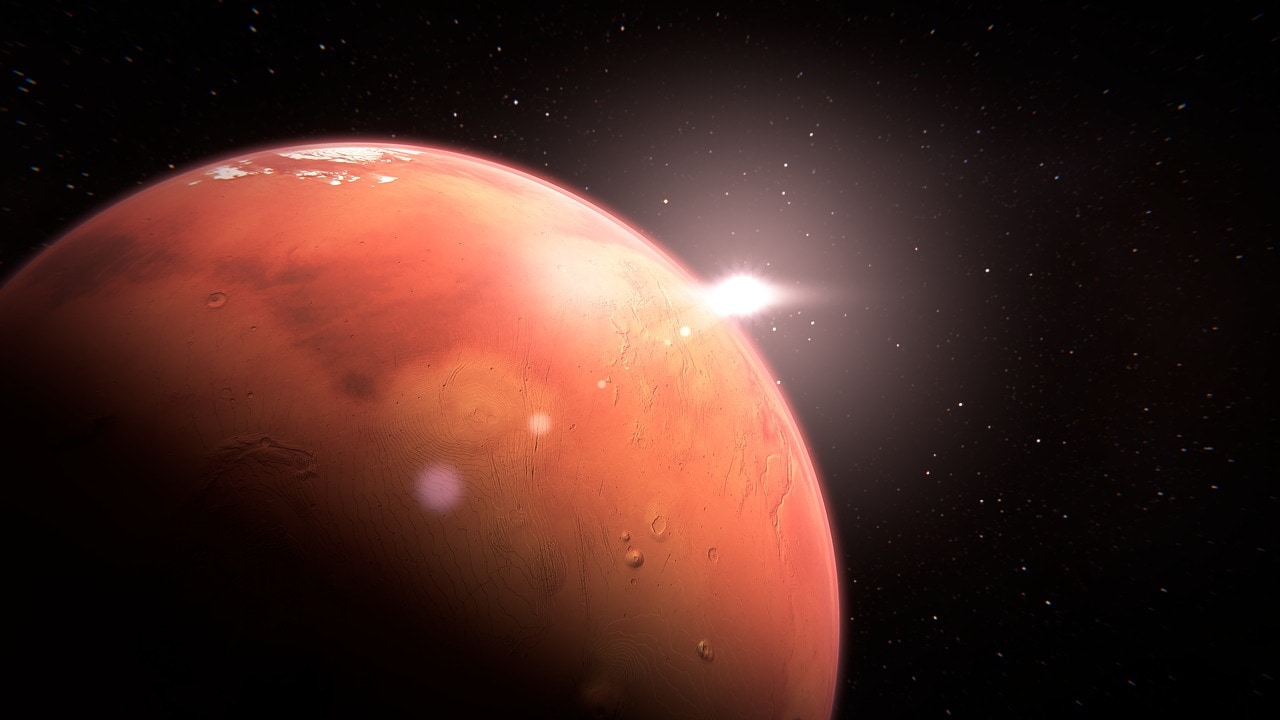
Mars was once much more Earth-like, with a thick atmosphere, abundant water and global oceans.Up to now, mathematical models have suggested that the solidification of the Red Planet took up to 100 million years.The new study tackles the question by examining a chunk of Mars that streaked into the Saharan Desert and was discovered in 2011.The Black Beauty meteorite weighed 320 grammes (11 ounces) when found. The researchers secured 44 grammes of the precious space rock, and crushed five — enough to extract seven bits of zircon that could be used in experiments.'Like a time capsule'By measuring the lead decaying from uranium that had been trapped in zircon as the young Mars's molten magma hardened, the scientists were able to precisely date the crust from which the zircon formed."I'm glad we chose that strategy," said Bizzarro. "Zircon is like a time capsule."There are two main models for the formation of planets.In one, it occurs in stages, with small dust particles coalescing into "planetesimals" — rock fragments ten to 100 kilometres in diameter — that collide to form planetary embryos, and then planets, over a time scale of 50 to 100 million years.According to a more recent model, planetary growth unfolds more quickly and is fuelled by so-called "pebble accretion", the layered accumulation of particles measured in centimetres and metres that are loosely bound with gases."Our data supports newer models indicating the very rapid formation of terrestrial planets," the authors said.The new timeline suggests that something similar may have happened on our planet, but only after Earth was "reset" by the giant impact that formed the Moon about 4.4 billion years ago, Bizzarro said.Mars is thought to have a dense metallic core with a radius of about 1,800 kilometres (1,100 miles), consisting primarily of iron, nickel and sulphur.The core is surrounded by a largely dormant mantle -- some 1,500 km thick -- made mainly of silicon, oxygen, iron and magnesium.Finally, the crust averages about 50 km in depth, with a maximum of about 125 km. Earth's crust averages 40 km, but is one-third the thickness of the Martian crust once planet size is taken into account.

Careless Whispers: Scientists discover that plants can 'talk' to each other using smells
Life on Mars? European Space Agency’s Orbiter discovers ice water deposits at equator
Microsoft briefly overtakes Apple as the most valuable company, Apple back on top again
Even NASA is facing a tough time, starts layoffs following major budget cuts
ISRO, NASA's NISAR satellite to get ready by Jan-end, will monitor Earth's snow-covered regions