
Advertisement

Life on Earth may have begun with an ancient, violent collision that made the Moon

A rain of meteorites was also crucial to life on Earth, but doesn't make a solid theory on its own.

Advertisement
Tech2 News Staff|Feb 06, 2019, 13:05:48 IST
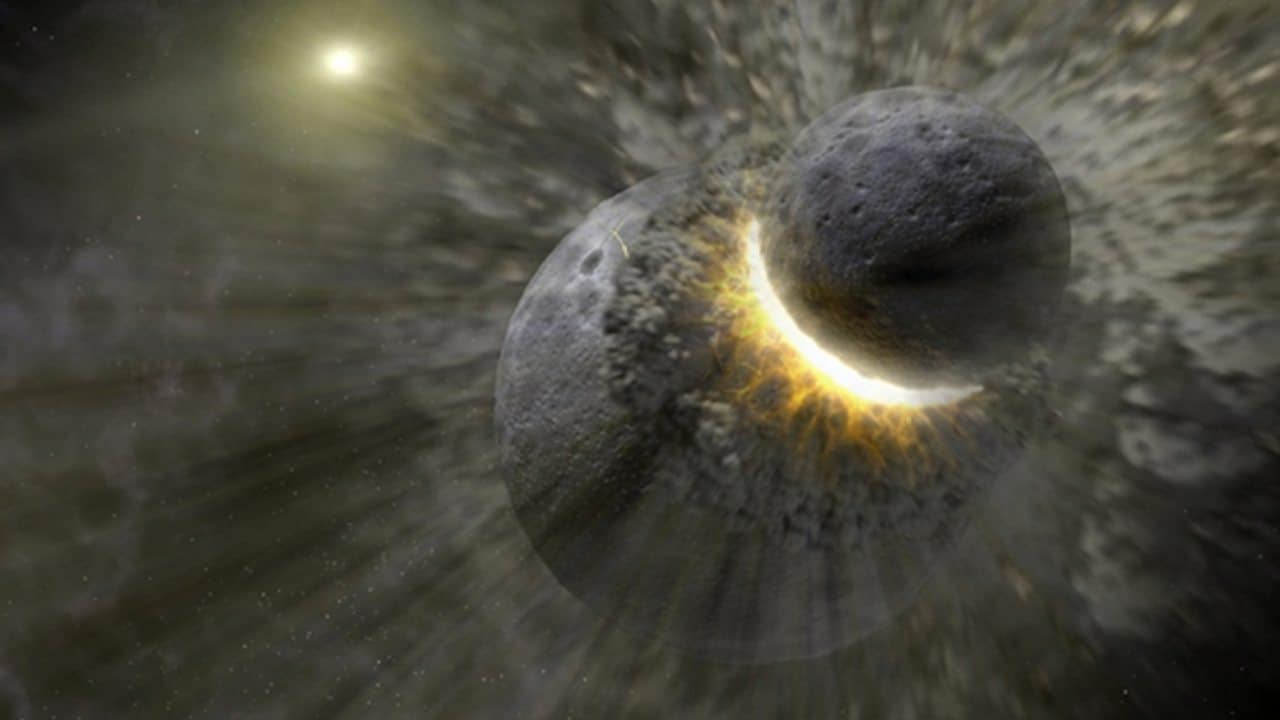
Was the ancient, violent collision that created the Moon also the reason for life on Earth? A new study suggests it might be.There are many different theories about how life began on Earth, many different ways by which our planet got the ingredients for life — elements like carbon and nitrogen, for instance.Meteorites ramming into the Earth and bringing life-giving elements with it is one theory. There's strong evidence for it — signature compounds found only in meteorites have been discovered before the earliest fossils of the life on Earth. And while these compounds were crucial to life existing, there's equally-strong evidence that only 50 percent of the carbon on Earth today came from meteorite impacts.[caption id="attachment_6036401" align="alignnone" width="1280"]This artistic visualization shows a collision near the star Vega.

A new study suggests that the Earth obtained the elements that sparked life from a collision between the proto-Earth and a Mars-sized body that also created the moon. Image courtesy: NASA[/caption]Another theory is that these elements came to Earth from an ancient collision between proto-Earth and an object the size of Mars. This impact is a second theory that explains some of the other elements that sparked life on Earth — sulphur, for instance.Researchers put this theory to the test with a simulation which was created to see how elements like carbon, nitrogen and sulphur might have behaved in the scorching heat during the formation of a rocky planet and its core.The simulation and concentrations of elements on Earth today show that a rain of meteorites bringing crucial elements for life is not as convincing an explanation than all of them coming to Earth in a single shot.

"The most probable scenario of the origin of carbon, nitrogen and sulphur on the silicate portion of Earth is (that) these elements (were) brought by a Mars-sized planet merging with the proto-Earth," Rajdeep Dasgupta, co-author of the paper told Astronomy.com in an email.The planet that smashed into Earth also likely had a core rich in sulphur.The study, published in Science Advances, doesn’t answer the long-debated question about how life began on Earth. But it does begin to explore how ingredients for life might have gotten here."There are many unanswered questions about how life truly originated. Our study, however, provides a mechanism to bring the raw materials needed for life’s recipe," Dasgupta added.

Handpicked stories, in your inbox
Global stories. Indian perspective. Zero noise.
No Spam. Unsubscribe Any Time.
First Published:Feb 06, 2019, 13:05:47 IST
Advertisement
Advertisement
Trending Stories

Microsoft briefly overtakes Apple as the most valuable company, Apple back on top again

At its peak during the session, Microsoft's value reached $2.903 trillion, with a 2% surge. As of writing this article, Apple closed at $2.89 trillion, whereas Microsoft closed at $2.86 trillion
Advertisement
Advertisement
Up Next