
Advertisement


Sections
JAXA's Hayabusa-2 hours away from its first landing attempt to mine asteroid Ryugu
The attempt on Friday is one of three similar touchdowns planned for Hayabusa2's sampling mission.

Japanese spacecraft Hayabusa-2 began its descent to touch its asteroid target and collect fragments of it to help scientists on Earth understand the solar system's origin and how life on Earth came to exist.While this slow descent was delayed by about five hours for a safety check, Hayabusa2 is still due to touch down on Friday morning, the Japan Aerospace Exploration Agency said.Once on the surface, Hayabusa2 will extend a pipe and shoot a pinball-like bullet into the asteroid. This, to blow up material from beneath the surface and collect the fragments to return to Earth.Here's more about how the zany idea to 'shoot' Ryugu is expected to work.[caption id="attachment_5235041" align="alignnone" width="1280"]![Representational image of Hayabusa-2 attempting to touchdown on Ryugu. DLR]() The asteroid, named 'Ryugu' after an undersea palace in Japanese folklore, is roughly 280 million kilometers from Earth. And while the landing won't be streamed live from all those million kilometres away, a stream from the mission control room at JAXA will be available on their YouTube channel starting 3.15 am IST on Friday.
The asteroid, named 'Ryugu' after an undersea palace in Japanese folklore, is roughly 280 million kilometers from Earth. And while the landing won't be streamed live from all those million kilometres away, a stream from the mission control room at JAXA will be available on their YouTube channel starting 3.15 am IST on Friday.
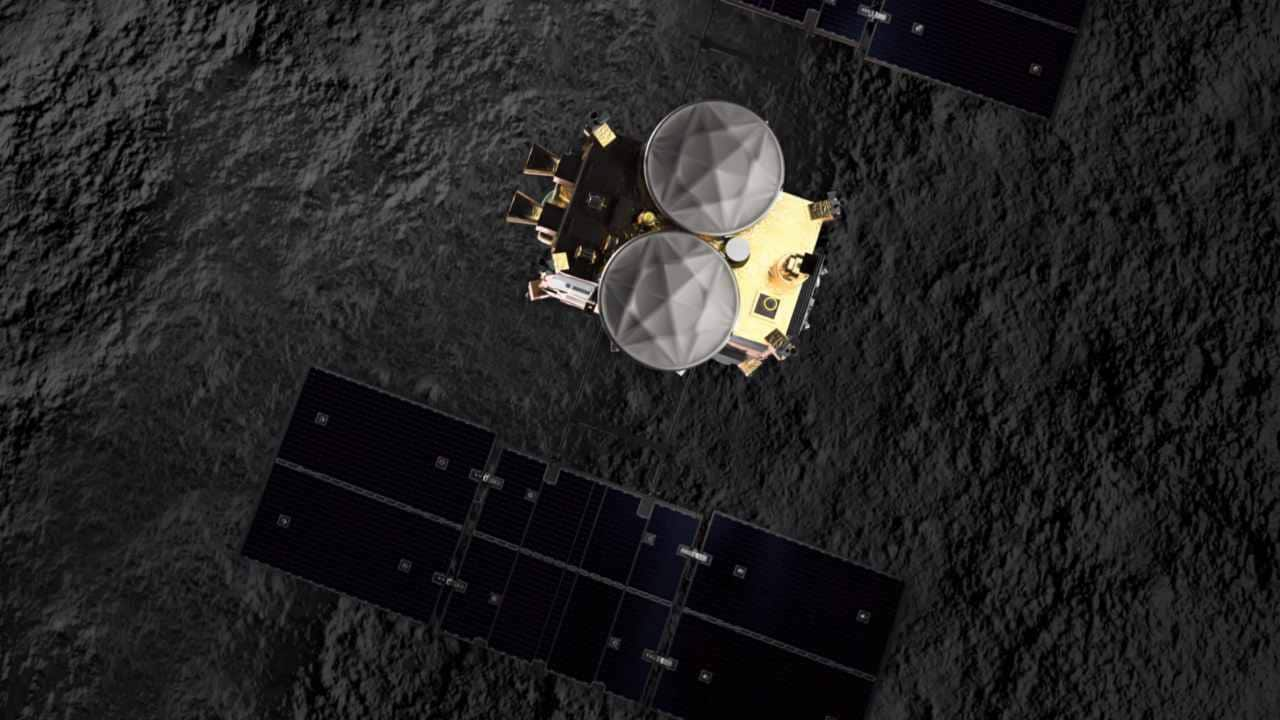
Representational image of Hayabusa-2 attempting to touchdown on Ryugu. DLR[/caption]JAXA plans to grab a sample from the asteroid using robotic arms on Hayabusa-2 and to repeat the manoeuvre two more times on different days and from different sites on the asteroid.If all goes successfully, the craft will then collect samples that would eventually be sent back to Earth, but the landing (even if only for a few seconds) will be a challenging one. The surface of asteroid Ryugu is uneven and covered with boulders.
Hayabusa2 is aiming for a spot with a 6-meter-diameter circle of room for it to avoid getting damaged. JAXA engineers will control the spacecraft's approach until it is 500 meters above the surface of Ryugu.After that, Hayabusa-2 is on its own — that's for its own good, too! It takes roughly 20 minutes for commands from Earth to reach the spacecraft, making it impossible for it to be controlled any way other than automated.First Published:Feb 21, 2019, 17:53:09 IST
Advertisement
Advertisement

Careless Whispers: Scientists discover that plants can 'talk' to each other using smells
Japanese scientists have recorded a video that shows plants, in certain conditions, communicate with each other using mists that carry smells. The discovery, reveals that plants release a fine mist of airborne compounds, to warn nearby plants of potential dangers
Life on Mars? European Space Agency’s Orbiter discovers ice water deposits at equator
European Space Agency's Mars Express Orbiter has identified massive ice and ice water deposits beneath the surface of Mars. The Mars Express orbiter was also the first to confirmed the presence of ice on Mars in 2004
Microsoft briefly overtakes Apple as the most valuable company, Apple back on top again
At its peak during the session, Microsoft's value reached $2.903 trillion, with a 2% surge. As of writing this article, Apple closed at $2.89 trillion, whereas Microsoft closed at $2.86 trillion
Even NASA is facing a tough time, starts layoffs following major budget cuts
NASA is facing some massive budget cuts, because of which, it has been forced to postpone some upcoming missions. NASA's Jet Propulsion Laboratory has been hit hard by recent federal budget cuts, resulting in the layoff of 100 contractors last week
ISRO, NASA's NISAR satellite to get ready by Jan-end, will monitor Earth's snow-covered regions
The NISAR satellite which has been developed jointly ISRO and NASA, should be ready for launch by the end of January 2024. The collaboration between NASA and ISRO on NISAR is the first time the two agencies have cooperated on hardware development for an Earth-observing mission
Advertisement
Advertisement