
Advertisement


Sections
Japanese space agency releases visuals of Hayabusa2 spacecraft bombing asteroid Ryugu
JAXA releases images that show details of the pockmarked surface of the asteroid that Hayabusa2 bombed.

On 5 April, Japanese spacecraft Hayabusa2 sent a "small carry-on impactor" (SCI), a cone-shaped device capped with a copper bottom, to bomb the surface of the 3,000-foot-wide (900 meters) asteroid Ryugu. An operation which took the spacecraft 40 minutes to finish.Recently JAXA, the Japanese Aerospace Exploration Agency released a video complied from images, taken by Hayabusa2, of the explosive reaching the surface of the asteroid. However, there is no actual video of the bombing because the spacecraft ducked behind the asteroid to protect itself from the explosion.[caption id="attachment_6506031" align="alignnone" width="1280"]![illustrations of Hayabusa2 created by Akihiro Ikeshita. Image credit: Hayabusa2]()
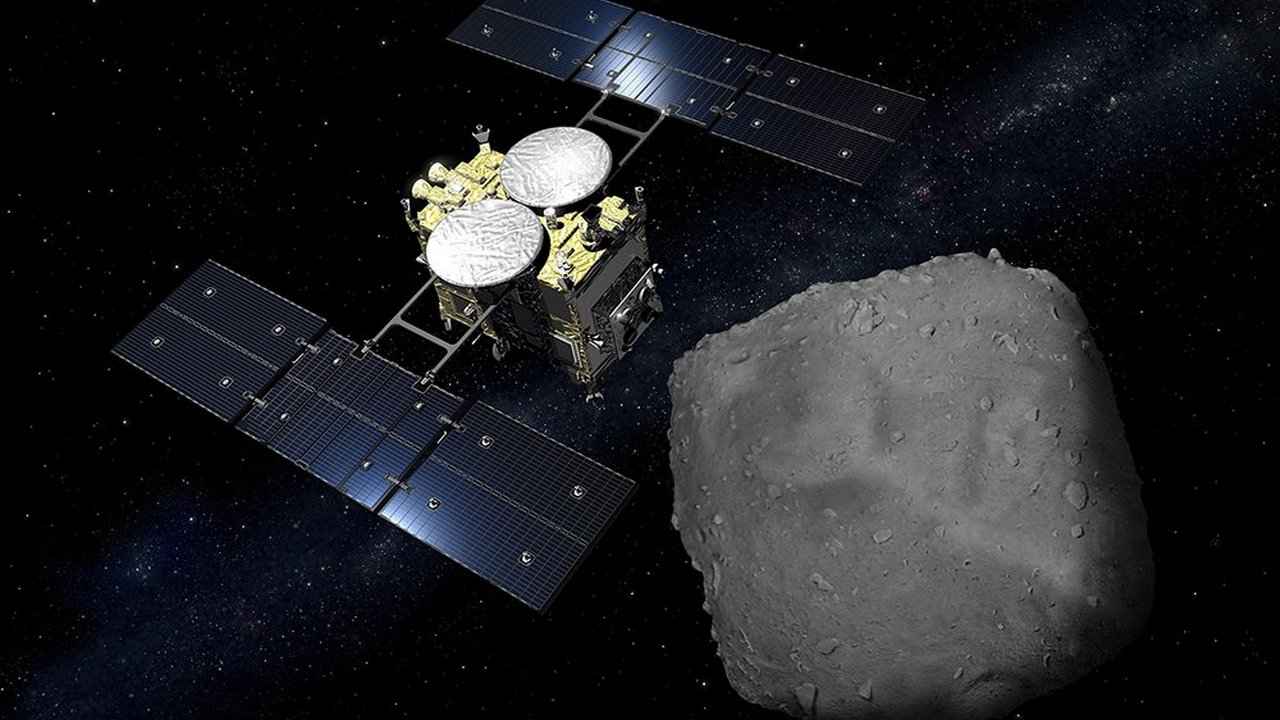
illustrations of Hayabusa2 created by Akihiro Ikeshita. Image credit: Hayabusa2[/caption]A camera called DCAM3 that accompanied the SCI payload has been able to capture actual images of the explosion itself.The scientists hope to retrieve some of the subsurface material that was dislodged by the bombing so that they can analyse it on Earth after the spacecraft returns.
The spacecraft has been studying the asteroid for nearly a year, since June 2018. The Hayabusa2 spacecraft over the course of it's mission made a brief landing on Ryugu and later fired projectile onto the asteroid's surface. These contacts are designed to help scientists understand the space rock better and what it could tell us about the early days of the solar system.Hayabusa2 had initially deployed two little "rovers" called MINERVA-II1A and MINERVA-II1B on 21 September. MINERVA stands for the "Micro Nano Experimental Robot Vehicle for Asteroid, the second generation. The first generation MINERVA was part of the original Hayabusa mission to the asteroid Itokawa.Unlike the Mars explorer Curiosity that rolls around, MINERVA-II1A and MINERVA-II1B will hop from place to place due to their small, rotating motors. Another rover named MASCOT is scheduled to be deployed in October, and a third rover, MINERVA-II2, is expected to land next year.Hayabusa2 will be sent back to the scene of the bombing to investigate, take images and collect the samples. It will then return to Earth, by the end of this year, with its precious cargo.First Published:Apr 24, 2019, 10:17:26 IST
Advertisement
Advertisement

Careless Whispers: Scientists discover that plants can 'talk' to each other using smells
Japanese scientists have recorded a video that shows plants, in certain conditions, communicate with each other using mists that carry smells. The discovery, reveals that plants release a fine mist of airborne compounds, to warn nearby plants of potential dangers
Life on Mars? European Space Agency’s Orbiter discovers ice water deposits at equator
European Space Agency's Mars Express Orbiter has identified massive ice and ice water deposits beneath the surface of Mars. The Mars Express orbiter was also the first to confirmed the presence of ice on Mars in 2004
Microsoft briefly overtakes Apple as the most valuable company, Apple back on top again
At its peak during the session, Microsoft's value reached $2.903 trillion, with a 2% surge. As of writing this article, Apple closed at $2.89 trillion, whereas Microsoft closed at $2.86 trillion
Even NASA is facing a tough time, starts layoffs following major budget cuts
NASA is facing some massive budget cuts, because of which, it has been forced to postpone some upcoming missions. NASA's Jet Propulsion Laboratory has been hit hard by recent federal budget cuts, resulting in the layoff of 100 contractors last week
ISRO, NASA's NISAR satellite to get ready by Jan-end, will monitor Earth's snow-covered regions
The NISAR satellite which has been developed jointly ISRO and NASA, should be ready for launch by the end of January 2024. The collaboration between NASA and ISRO on NISAR is the first time the two agencies have cooperated on hardware development for an Earth-observing mission
Advertisement
Advertisement