


Japanese Hayabusa mission to collect samples found water on the asteroid Itokawa
Scientists have found water content in the parent body after analysing the collected samples from Hayabusa

Japan’s Hayabusa was the first spacecraft sent to an asteroid — Itokawa to bring back samples. It studied the asteroid's shape, spin, topography, colour, composition, density, and history.It was launched in May 2003 and landed on the asteroid on November 2005 to collect samples in the form of tiny grains.The spacecraft had a rover attached to it — MINERVA (Micro-Nano Experimental Robot Vehicle for the Asteroid) however, it failed to land on the asteroid.[caption id="attachment_6567171" align="alignnone" width="1280"] The asteroid Itokawa. Image credit: Wikimedia Commons[/caption]The mission was launched by the Japan Aerospace Exploration Agency (JAXA) and returned to Earth in June 2010, along with the 1,500 samples it recovered.A study detailing all the findings has been published in the journal Science Advances.The asteroid Itokawa has been classified as an S-type asteroid. It is the most common type of asteroid orbiting the sun and it's shaped like a peanut, measuring at 1,800 feet long and 700-1,000 feet wide.However, it was not always this shape and size. It was part of a larger parent body and broke off 1.5 billion years ago, after an impact with another space rock.Since the particles collected were so tiny, special instruments had to be used to study the grains.The minerals had a water content of 698 to 988 parts per million (ppm) weight. Hence, scientists infer that the entire asteroid could have been a source of water during the formation of Earth. These minerals are also similar to those found on Earth.This information can tell us more about the solar system, the formation of our Earth and also about space and the things that are out there.[caption id="attachment_5235041" align="alignnone" width="1280"]
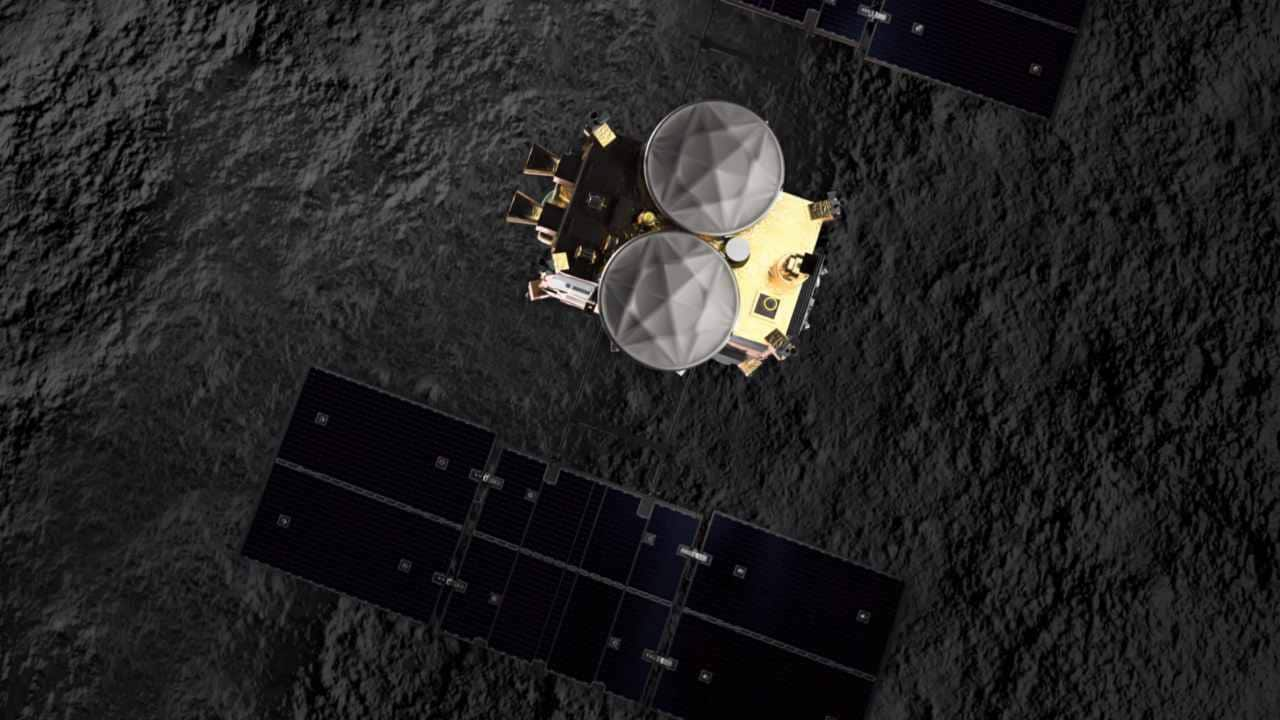 Representational image of Hayabusa-2 attempting to touchdown on Ryugu. DLR[/caption]JAXA has also sent another spacecraft Hayabusa2 to another asteroid called Ryugu. Two controlled explosions have been conducted so as to collect samples from the space rock. Two rovers — MINERVA I and MINERVA II — have successfully landed on the asteroid and are exploring it. Hayabusa2 will return to Earth in 2020.

Careless Whispers: Scientists discover that plants can 'talk' to each other using smells
Life on Mars? European Space Agency’s Orbiter discovers ice water deposits at equator
Microsoft briefly overtakes Apple as the most valuable company, Apple back on top again
Even NASA is facing a tough time, starts layoffs following major budget cuts
ISRO, NASA's NISAR satellite to get ready by Jan-end, will monitor Earth's snow-covered regions