


Inouye Solar Telescope reveals most detailed first-ever image captured of a sunspot
NSF’s Inouye Solar Telescope is located on the island of Maui in Hawaiʻi. Construction began in 2013 and is slated to be completed in 2021.

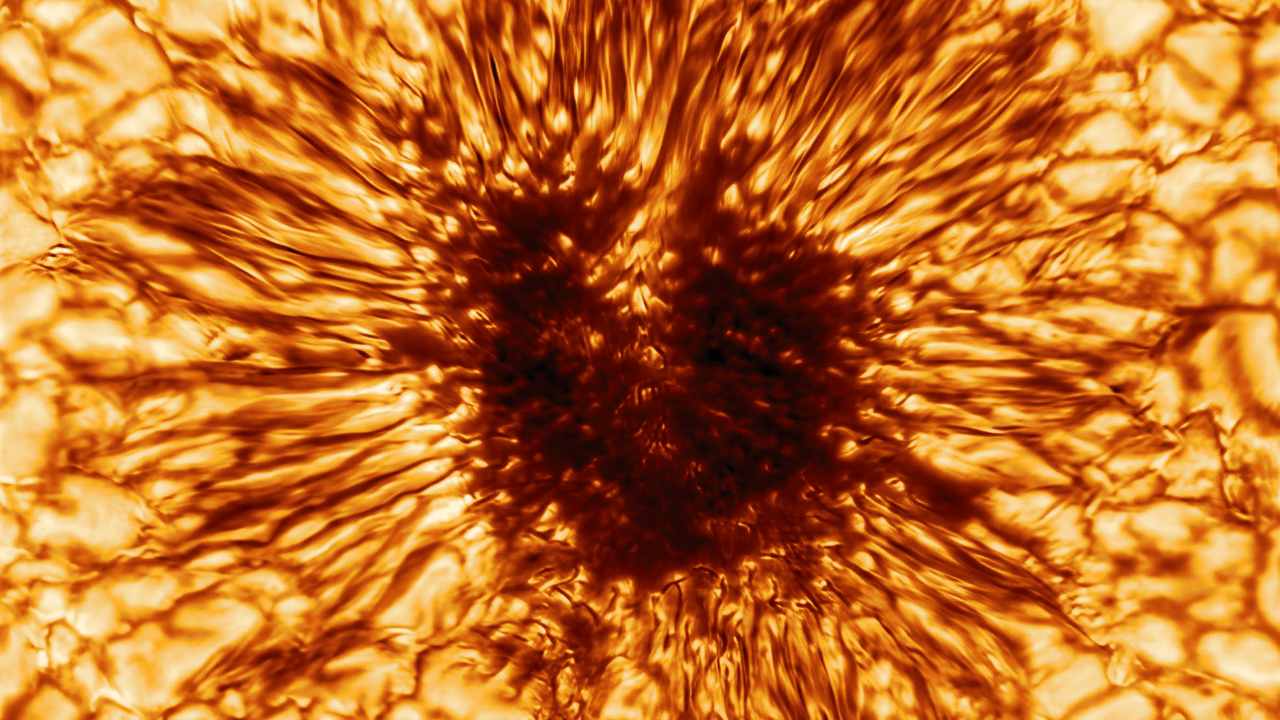
This is the first sunspot image taken on January 28, 2020 by the NSF’s Inouye Solar Telescope’s Wave Front Correction context viewer. The image reveals striking details of the sunspot’s structure as seen at the Sun’s surface. Image credit:NSO/AURA/NSF[/caption]Speaking about the image, Dr Thomas Rimmele said that the sunspot image achieves a spatial resolution about 2.5 times higher than what was recorded earlier, showing magnetic structures as small as 20 kilometres on the surface of the sun.The image showcases intricate details of the sunspot's structure as seen at the Sun's surface. Measuring at about 16,093 km (10,000 miles) across, it is just a tiny part of the Sun but is large enough for the entire Earth to comfortably fit inside.As per the statement, the streaky appearance of hot and cool gas spiralling out from the dark centre is the result of sculpting by a convergence of intense magnetic fields and hot gasses boiling up from below.The sunspot was one of the first of the new solar cycles, with Dr Matt Mountain, president of the Association of Universities for Research in Astronomy (AURA) stating that one can now point the world’s most advanced solar telescope at the Sun to capture and share incredibly detailed images and add to our scientific insights about the Sun’s activity.NSF’s Inouye Solar Telescope is located on the island of Maui in Hawaiʻi. Construction began in 2013 and is slated to be completed in 2021.

Careless Whispers: Scientists discover that plants can 'talk' to each other using smells
Life on Mars? European Space Agency’s Orbiter discovers ice water deposits at equator
Microsoft briefly overtakes Apple as the most valuable company, Apple back on top again
Even NASA is facing a tough time, starts layoffs following major budget cuts
ISRO, NASA's NISAR satellite to get ready by Jan-end, will monitor Earth's snow-covered regions