


India’s first robotic telescope in Ladakh begins observing the deep skies
Located at Indian Astronomical Observatory (IAO) in Ladakh it ‘s country’s first robotic telescope.

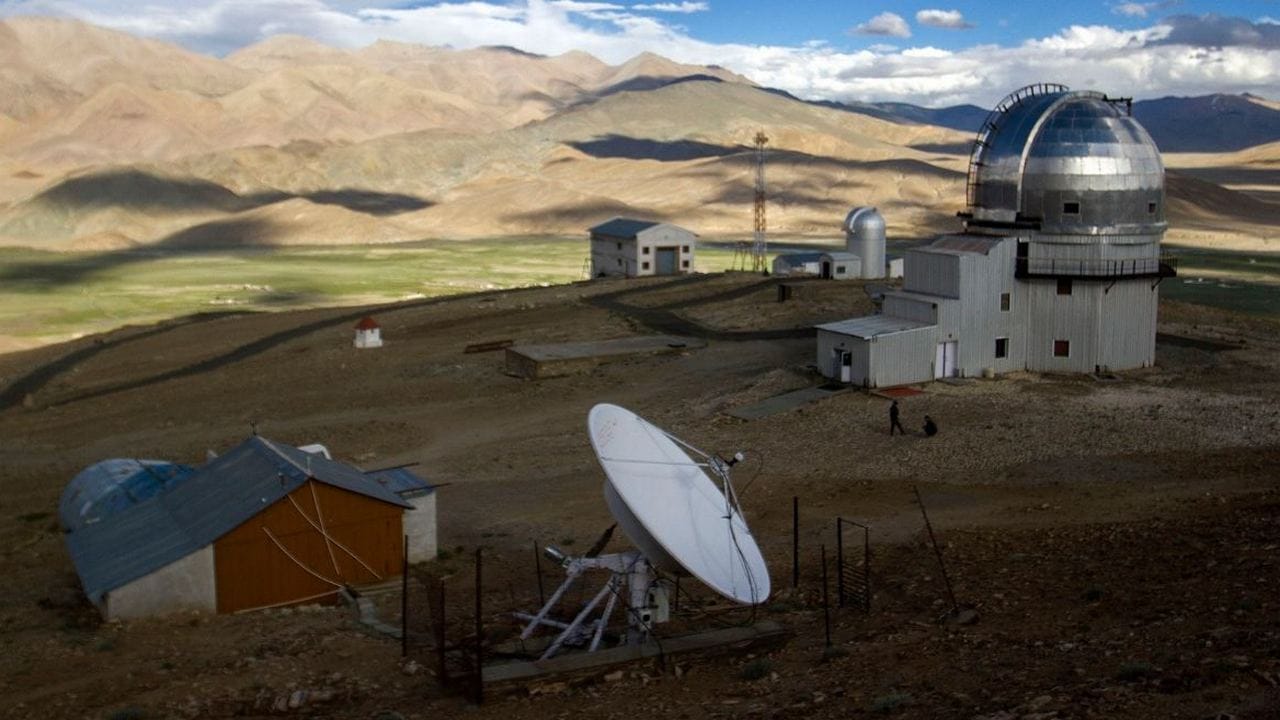
Hanle Observatory[/caption]Called GROWTH-India, the facility at Hanle is part of a multi-country collaborative initiative known as ‘Global Relay of Observatories Watching Transients Happen’ (GROWTH) to observe transient events in the universe. The fully robotic optical research telescope is designed to capture cosmic events occurring in timescales much shorter than light years – years, days and even hours.Universities and research institutes from the US, the UK, Japan, India, Germany, Taiwan and Israel are part of the initiative. The primary research objective of the project is time-domain astronomy, which entails the study of explosive transients and variable sources in the universe.“Together with partner telescopes strategically located around the world, we can continuously monitor any interesting object in the sky — uninterrupted by daylight,” explained Anupama.The Rs 3.5 crore telescope is a joint project of the Bangalore-based Indian Institute of Astrophysics (IIA) and the Indian Institute of Technology Bombay (IITB). The project is fully funded by the Science and Engineering Research Board (SERB) of the Department of Science and Technology (DST) under the PIRE project, administered by Indo US Science and Technology Forum. Anupama of IIA and Varun Bhalerao of IIT Bombay are the principal investigators of the project in India.The 70 cm robotic telescope joins other larger facilities at IAO in Hanle —the Himalayan Chandra Telescope, the gamma-ray array telescope (HAGAR), and the imaging Cherenkov telescope (MACE). The telescope is expected to generate enormous amounts of data — over one thousand gigabytes in a year.The telescope has a sensitive camera capable of detecting even the faintest transients found by partner survey telescopes such as the Zwicky Transient Facility at Palomar, California. It also is programmed to directly communicate with different ground-based and space-based surveys searching for transient sources.Transients often leave signatures in various electromagnetic wavelength bands, which astronomers try to capture using telescopes that are sensitive to a variety of wavelengths — from gamma-rays to infra-red. Transient surveys involve scanning a part of the sky, moving on to other areas, returning to the first part repeatedly and comparing images to see changes such as increase or decrease in brightness of a source. Telescopes dedicated for transient surveys are usually small, wide-field instruments.“Our primary science goals are studying electromagnetic counterparts to gravitational wave sources, young supernovae and near earth asteroids,” Anupama added.India Science Wire

Careless Whispers: Scientists discover that plants can 'talk' to each other using smells
Life on Mars? European Space Agency’s Orbiter discovers ice water deposits at equator
Microsoft briefly overtakes Apple as the most valuable company, Apple back on top again
Even NASA is facing a tough time, starts layoffs following major budget cuts
ISRO, NASA's NISAR satellite to get ready by Jan-end, will monitor Earth's snow-covered regions