


Indian-Australian Akshay Venkatesh wins Fields medal, the 'Nobel prize' for maths
The Fields medals are awarded every four years to the most promising mathematicians under 40.

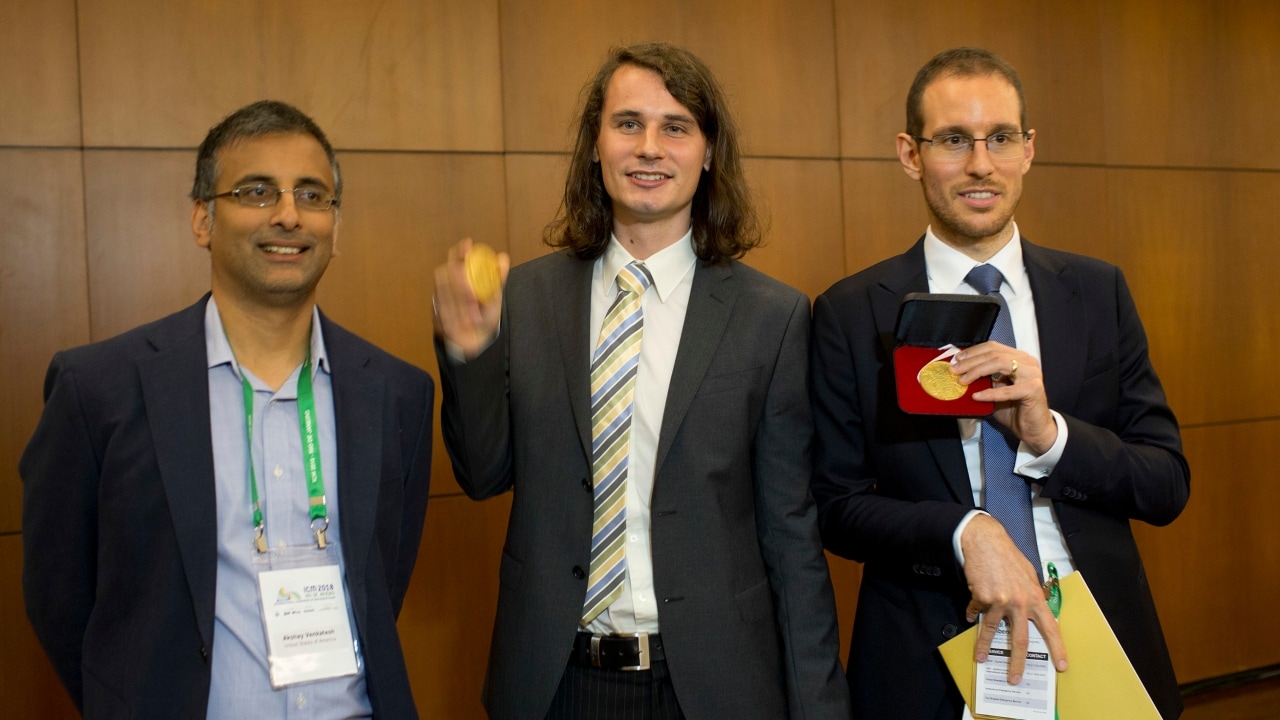
Italy's Alessio Figalli, right, Germany's Peter Scholze, center, and Akshay Venkatesh pose for a photo during the 2018 International Congress of Mathematicians in Rio de Janeiro. AP[/caption]Each winner receives a 15,000 Canadian-dollar cash prize.At least two, and preferably four people, are always honoured in the award ceremony.The prize was inaugurated in 1932 at the request of Canadian mathematician John Charles Fields, who ran the 1924 Mathematics Congress in Toronto.From being a child prodigy to becoming one of the most renowned researchers in the field of mathematics, Venkatesh's journey has been full of achievements and accolades.He moved to Perth, Australia, with his parents when he was 2.He participated in physics and math Olympiads the premier international competitions for high school students and won medals in the two subjects at ages 11 and 12, respectively.He finished high school when he was 13 and went to the University of Western Australia, graduating with first class honours in mathematics in 1997, at the age of 16.In 2002, he earned his PhD at the age of 20. Since then, he has gone from holding a post-doctoral position at MIT to becoming a Clay Research Fellow and, now a professor at Stanford University.Venkatesh has worked at the highest level in number theory, arithmetic geometry, topology, automorphic forms and ergodic theory.His research has been recognized with many awards, including the Ostrowski Prize, the Infosys Prize, the Salem Prize and Sastra Ramanujan Prize.

Careless Whispers: Scientists discover that plants can 'talk' to each other using smells
Life on Mars? European Space Agency’s Orbiter discovers ice water deposits at equator
Microsoft briefly overtakes Apple as the most valuable company, Apple back on top again
Even NASA is facing a tough time, starts layoffs following major budget cuts
ISRO, NASA's NISAR satellite to get ready by Jan-end, will monitor Earth's snow-covered regions