


Hubble telescopes finds that Andromeda’s halo is already touching the Milky Way's halo
Scientists have mapped the enormous halo of Andromeda and found that the halo extends 1.3 million light-years from the galaxy.

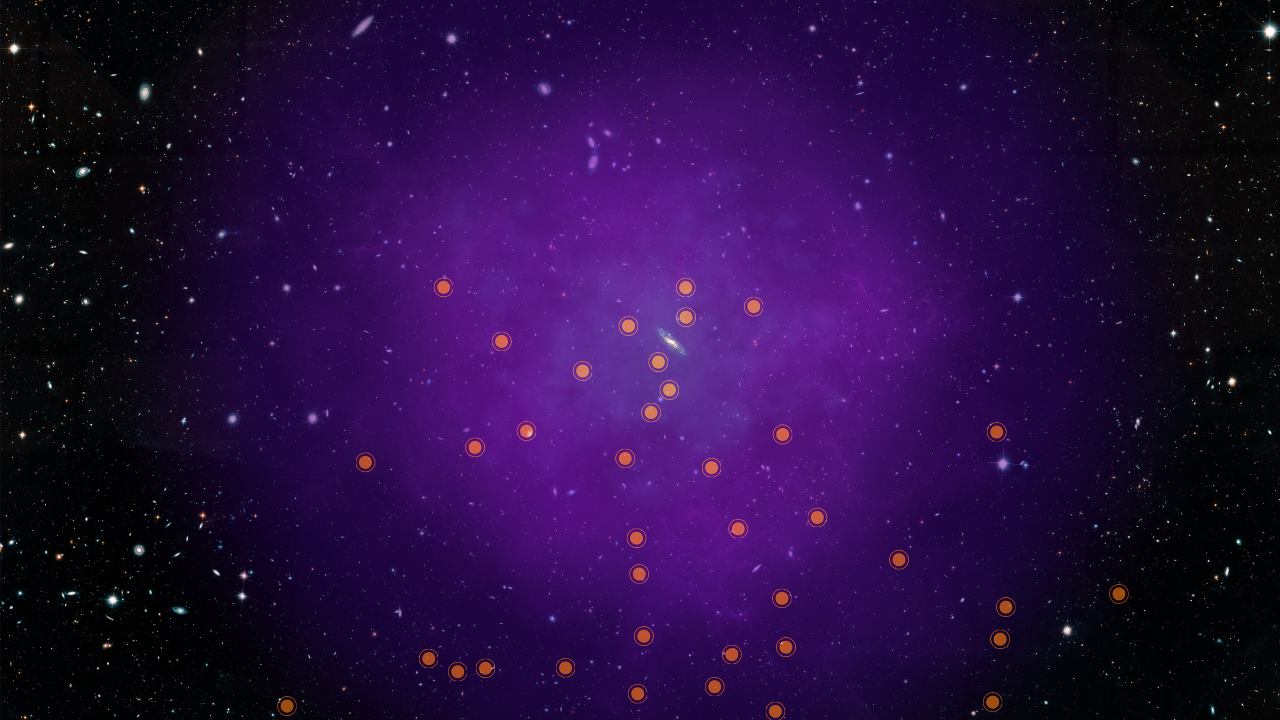
This illustration shows the location of the 43 quasars scientists used to probe Andromeda’s gaseous halo. These quasars—the very distant, brilliant cores of active galaxies powered by black holes—are scattered far behind the halo, allowing scientists to probe multiple regions. Looking through the immense halo at the quasars’ light, the team observed how this light is absorbed by the halo and how that absorption changes in different regions. By tracing the absorption of light coming from the background quasars, scientists are able to probe the halo’s material. Image Credits: NASA, ESA, and E. Wheatley (STScI)[/caption]In the recent study, scientists have managed to map the enormous halo of Andromeda and the results have revealed that the halo extends 1.3 million light-years from the galaxy. This is about halfway to the Milky Way, stated a report by NASA. The article also said that the extension is not linear and the halo has spread as far as two million light-years in certain directions. As the Milky Way has its own halo that spreads as far as one million light-years, Andromeda’s halo is already bumping into the halo of our own galaxy.Samantha Berek of Yale University in New Haven, Connecticut, who was a co-investigator in the project explained that this “reservoir of gas” or the halo contains fuel for future star formation within the galaxy. According to Berek the fuel is also for outflows from events such as supernovae. Berek adds that it is full of clues regarding the evolution of the galaxy, and they are finally able to study it in great detail.The mapping has also revealed the structure of the halo. According to the space agency, the nearly invisible halo has a layered structure with “two main nested and distinct shells of gas”. Scientists think the two-part structure might have been the result of a few supernova explosions within Andromeda’s main disk.The entire study has been published in The Astrophysical Journal.

Careless Whispers: Scientists discover that plants can 'talk' to each other using smells
Life on Mars? European Space Agency’s Orbiter discovers ice water deposits at equator
Microsoft briefly overtakes Apple as the most valuable company, Apple back on top again
Even NASA is facing a tough time, starts layoffs following major budget cuts
ISRO, NASA's NISAR satellite to get ready by Jan-end, will monitor Earth's snow-covered regions