
Advertisement


Sections
Historic: SpaceX grabs Falcon 9 fairing for reuse after launch of Israeli AMOS-17 satellite
SpaceX retired the rest of the thrice-used Falcon 9 from service after the 87-minute launch sequence.

The novelty of launching and landing a booster vertically, and then launching it again, appears to have worn off for SpaceX, but it sure is odd to watch a SpaceX launch that doesn't end in a satisfying booster landing. In a first, SpaceX launched an expendable, twice-flown Falcon 9 rocket on a satellite launch mission on 6 August and captured the rocket's fairing for reuse in future missions.Lifting off from Pad 40 in Florida, the Falcon 9 launched the third flight by the Falcon 9 booster. It was also the 25th time a SpaceX vehicle was reflown in an orbital launch. The company successfully launched an Israeli communication satellite, AMOS-17, on a twice-flown Falcon 9. The AMOS-17 satellite, the mission payload, is an Israeli communication satellite built to support broadcast, broadband, and data services in Africa.The Falcon 9 booster supporting the mission previously flew in support of the Telstar 19 VANTAGE in July 2018 and Es'hail-2 launch in November 2018.As planned, SpaceX retired the thrice-used Falcon 9 booster from service after the 87-minute launch sequence. At the moment, thrice is the maximum number of times a Falcon 9 can be reused without complications. However, the nose cone of the Falcon 9 (where the payload is housed), was returned safely for reuse in future missions, pending a little fixing up.[caption id="attachment_7123341" align="alignnone" width="1280"]![The Falcon 9's payload fairing recovery. image; SpaceX]()
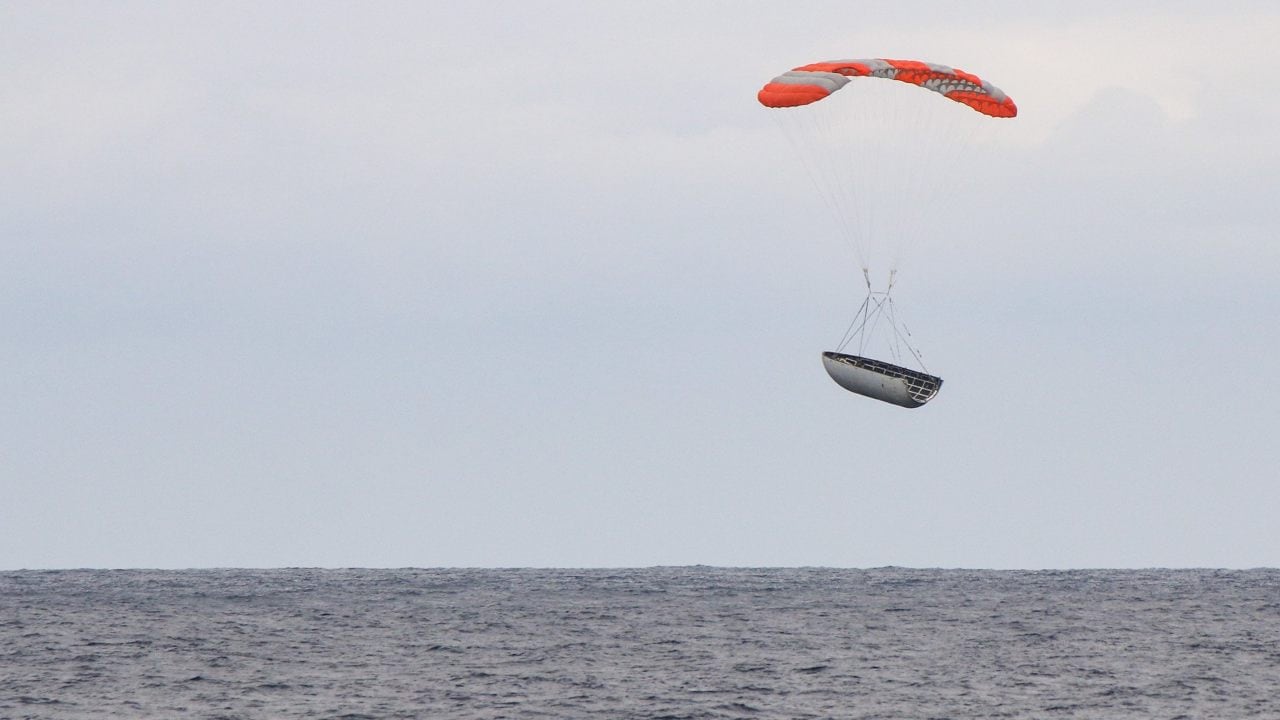
The Falcon 9's payload fairing mid-recovery in the final, January 2019 test. image; SpaceX[/caption]SpaceX caught the vehicle's nose cone after it fell back to Earth — the first time the company has ever attempted and pulled off such a feat. The fairing broke away in space and glided back to the surface tied to a parachute, where it was captured by SpaceX's boat — Ms Tree boat (Mystery boat, get it?) — retrofitted with a giant net. This recovery is something SpaceX experimented with at the start of the year with their other fairing capture boat, Mr Steven.
It was only just two and a half years ago that SpaceX first reused a Falcon 9 rocket stage, in the historic launch of the SES-10 communications satellite. SpaceX has now made reuse old news, having launched previously-flown Falcon 9 first stages more than two dozen times.Next on the agenda for the SpaceX is getting its Starhopper to hop right — without bursting into flames, that is.First Published:Aug 07, 2019, 11:00:16 IST
Advertisement
Advertisement

Careless Whispers: Scientists discover that plants can 'talk' to each other using smells
Japanese scientists have recorded a video that shows plants, in certain conditions, communicate with each other using mists that carry smells. The discovery, reveals that plants release a fine mist of airborne compounds, to warn nearby plants of potential dangers
Life on Mars? European Space Agency’s Orbiter discovers ice water deposits at equator
European Space Agency's Mars Express Orbiter has identified massive ice and ice water deposits beneath the surface of Mars. The Mars Express orbiter was also the first to confirmed the presence of ice on Mars in 2004
Microsoft briefly overtakes Apple as the most valuable company, Apple back on top again
At its peak during the session, Microsoft's value reached $2.903 trillion, with a 2% surge. As of writing this article, Apple closed at $2.89 trillion, whereas Microsoft closed at $2.86 trillion
Even NASA is facing a tough time, starts layoffs following major budget cuts
NASA is facing some massive budget cuts, because of which, it has been forced to postpone some upcoming missions. NASA's Jet Propulsion Laboratory has been hit hard by recent federal budget cuts, resulting in the layoff of 100 contractors last week
ISRO, NASA's NISAR satellite to get ready by Jan-end, will monitor Earth's snow-covered regions
The NISAR satellite which has been developed jointly ISRO and NASA, should be ready for launch by the end of January 2024. The collaboration between NASA and ISRO on NISAR is the first time the two agencies have cooperated on hardware development for an Earth-observing mission
Advertisement
Advertisement