


Heartbeat of supermassive black hole 600 mn light-years away still strong a decade after discovery
The time between each beat could reveal key information – particularly about the matter near the black hole, and its size.

Astronomers have confirmed that the heartbeat of a supermassive black hole under study is still going strong after ten years since its discovery.As per a BBC report on the finding, astronomers have said this is the longest-living heartbeat ever seen in a black hole, adding that it could help scientists deduce more about its size and the space surrounding it.The "heartbeat" of the black hole in question was first discovered in 2007, at the centre of a galaxy dubbed RE J1034+396 around 600 million light-years from Earth.[caption id="attachment_8469581" align="alignnone" width="1280"]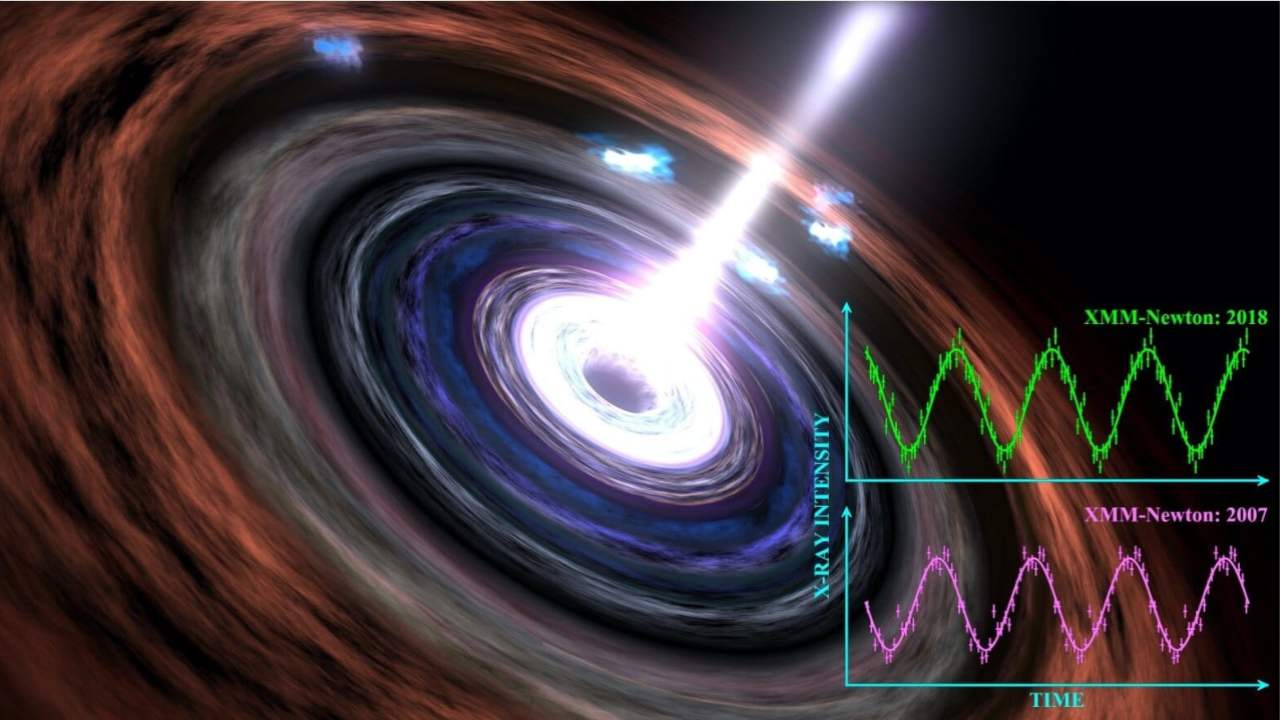 A black hole including the heartbeat signal observed in 2007 and 2018. Image credit: Chichuan Jin/National Astronomical Observatories, CAS/NASA Goddard.[/caption]Black holes tend to have a heartbeat when matter falls on to a black hole, the report adds, as matter falls into it. This phenomenon releases a tremendous burst of energy in a repetitive pattern, much like the rhythmic pulse of a heartbeat.The time between each beat could reveal information, particularly about the matter near the black hole – for example, how big these objects are, and the size of the black hole itself.The research was conducted by the National Astronomical Observatories along with the Chinese Academy of Sciences and Durham University. The study's findings were published in the journal Monthly Notices of the Royal Astronomical Society.It claims that the signal from this galactic giant repeated every hour, in a pattern that was observed in several snapshots before the object was blocked by the Sun in 2011.[caption id="attachment_8469571" align="alignnone" width="1280"]
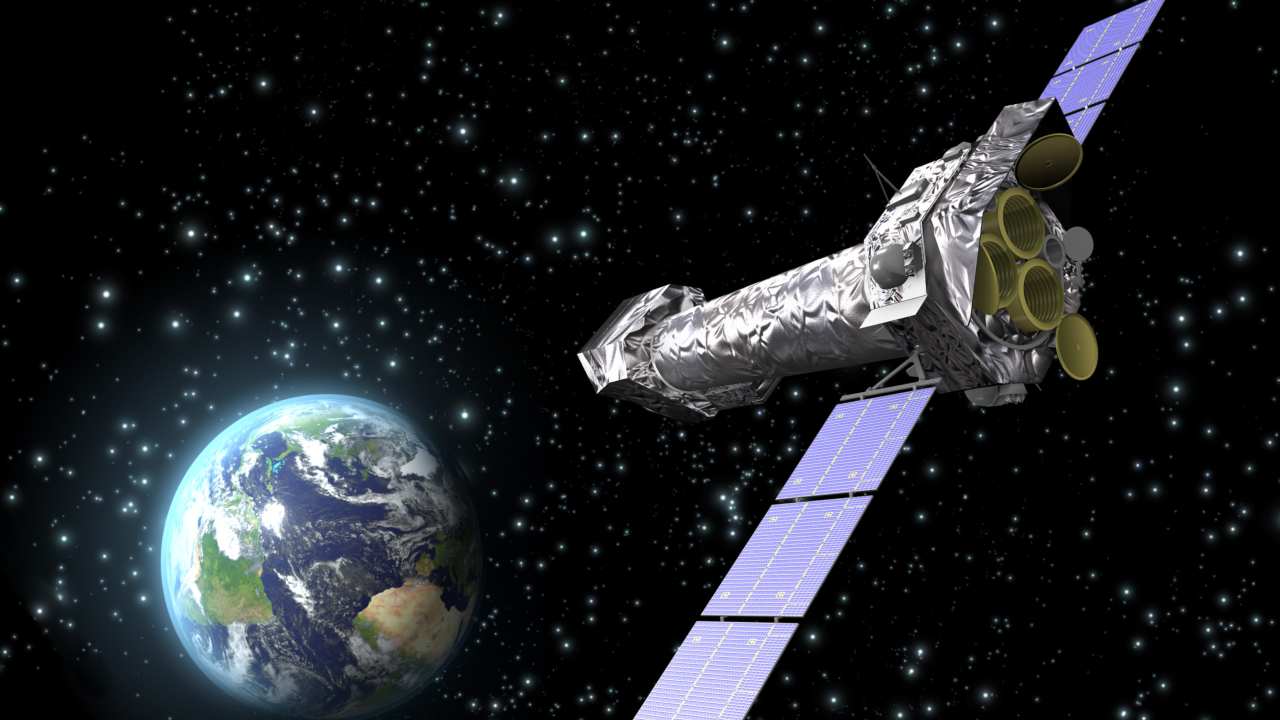 XMM-Newton (a.k.a the High Throughput X-ray Spectroscopy Mission and the X-ray Multi-Mirror Mission) is an X-ray space observatory launched by the European Space Agency in 1999. It is the second cornerstone mission of ESA's Horizon 2000 programme. Image: ESA[/caption]The European Space Agency's XMM-Newton X-ray satellite was able to finally tune in and observe the black hole again in 2018. To the scientists' amazement, the heartbeat could still be detected."This heartbeat is amazing!” lead author of the study Dr Chichuan Jin of the National Astronomical Observatories, Chinese Academy of Sciences, told Durham university press. "It proves that such signals arising from a supermassive black hole can be very strong and persistent. It also provides the best opportunity for scientists to further investigate the nature and origin of this heartbeat signal."

Careless Whispers: Scientists discover that plants can 'talk' to each other using smells
Life on Mars? European Space Agency’s Orbiter discovers ice water deposits at equator
Microsoft briefly overtakes Apple as the most valuable company, Apple back on top again
Even NASA is facing a tough time, starts layoffs following major budget cuts
ISRO, NASA's NISAR satellite to get ready by Jan-end, will monitor Earth's snow-covered regions