


Half of Antarctica's glacier-retaining ice shelves at risk of crumbling due to climate change
The findings show that atmospheric warming is attacking ice shelves from above as well as warm ocean water at the surface.

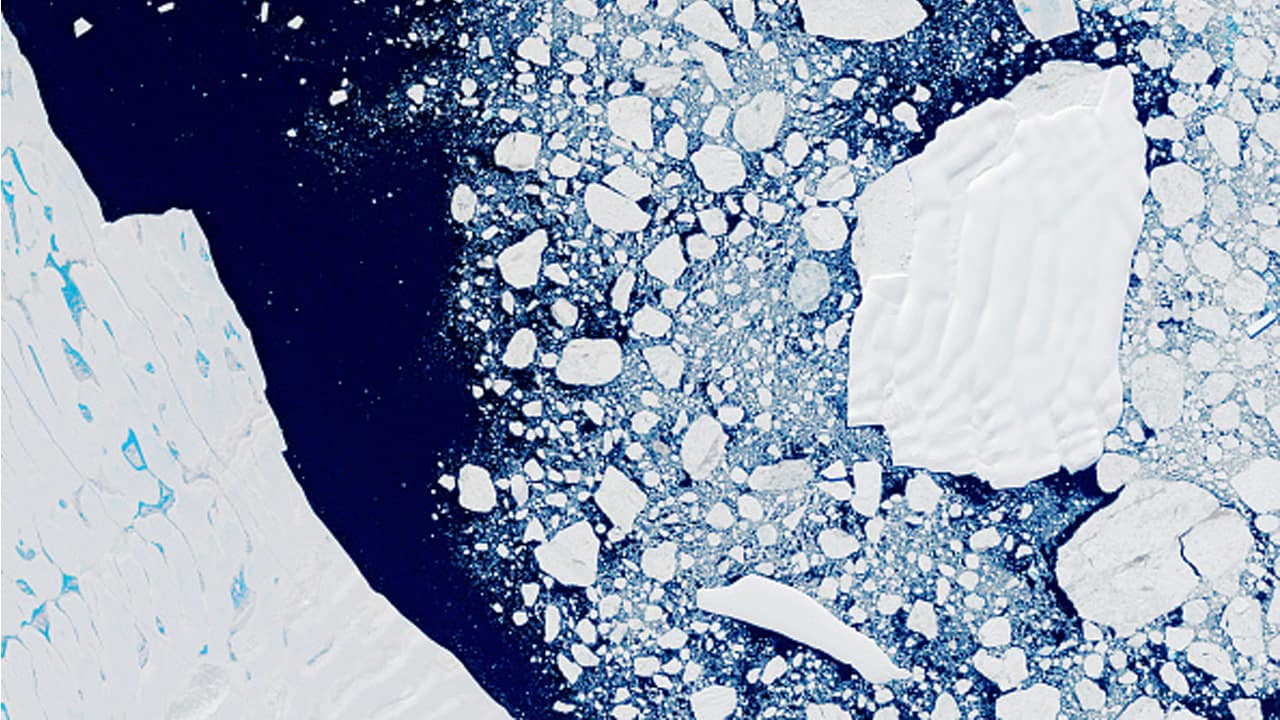
Part of the Larsen-B ice shelf breaking off from East Antarctica. Getty[/caption]
Violent fracturing, sliding ice shelves
Earth's average surface temperature has gone up by one degree Celsius since the last 19th century, enough to increase the intensity of droughts, heat waves and tropical cyclones.But the air over Antarctica has warmed more than twice that much.One of the consequences has been the appearance of long crevasses parallel to the shore line – up to tens of metres deep – on the top of ice shelves.As surface ice melts, water pours into these fissures and increases the likelihood of a process called hydrofracturing.When this happens, water – which is heavier than ice – "violently forces the fractures to zip open and cause the shelf to rapidly disintegrate", the researchers said in a statement.The Antarctic Peninsula, which has warmed more than any other part of the continent, has shown in dramatic fashion what this can lead to.Major chunks of the Peninsula's Larsen Ice Shelf -- which had been stable for more than 10,000 years -- disintegrated within days in 1995, and again in 2002. This was followed by the breakup of the nearby Wilkins Ice Shelf in 2008 and 2009.Hydrofracturing was almost certainly the main culprit in both cases.To find out what regions of the continent are most vulnerable, Kingslake and his colleagues used a machine-learning algorithm to analyse satellite images and compile the first complete mapping of Antarctica's ice shelves, and their crevasses.They estimate that 50 to 70 percent of the areas buttressing glaciers are prone to hydrofracturing."Taken together, the author's findings pinpoint the portions of ice shelves that are most vulnerable to atmospheric warming," Jeremy Bassis, a scientist at the University of Michigan, wrote in a comment, also in Nature."They show that large sections that are currently stable could collapse as atmospheric temperatures continue to rise."

Careless Whispers: Scientists discover that plants can 'talk' to each other using smells
Life on Mars? European Space Agency’s Orbiter discovers ice water deposits at equator
Microsoft briefly overtakes Apple as the most valuable company, Apple back on top again
Even NASA is facing a tough time, starts layoffs following major budget cuts
ISRO, NASA's NISAR satellite to get ready by Jan-end, will monitor Earth's snow-covered regions