


From penumbra to totality: Detailed schedule of the century's longest lunar eclipse
In India, the entire eclipse will be visible in their entirety from all parts of the country.

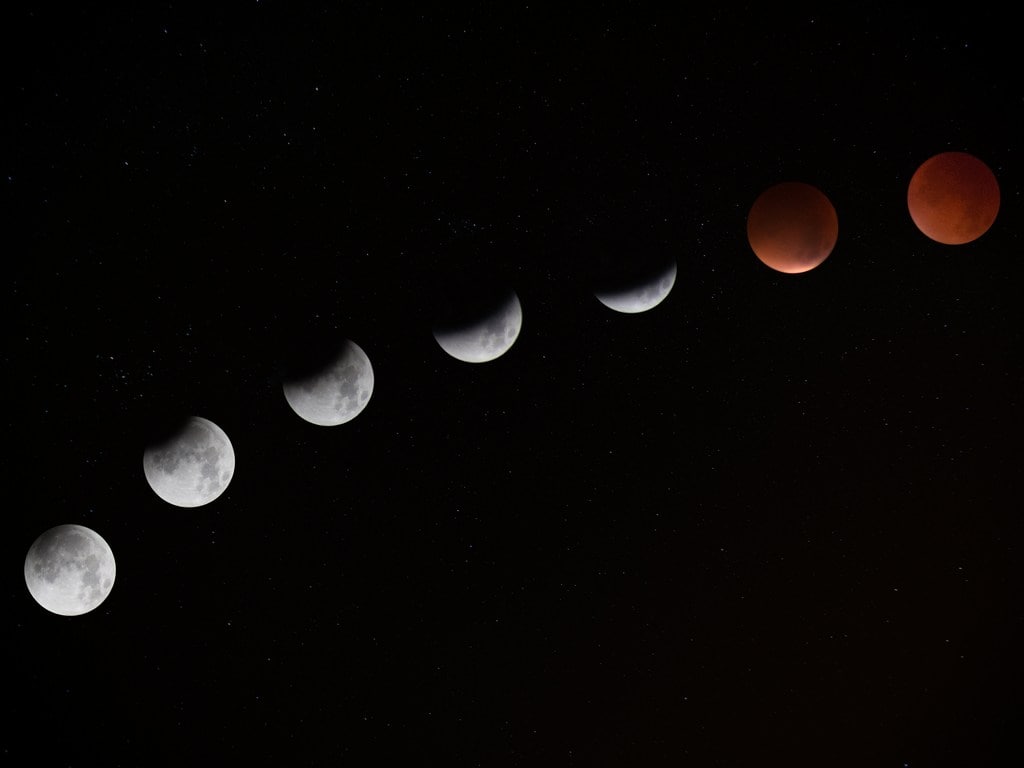
Stages of blood moon. Image: Jake Hills[/caption]The eclipse will be visible in parts of South America, most of Africa, and West and Central Asia. For viewers in India, the eclipse, both partial and the total, will be visible in their entirety from all parts of the country. The partial eclipse of the Moon will start around 11.52 pm IST, with the total eclipse beginning at 1 am on 28 July.Here is the detailed schedule of the movement of the moon during the eclipse (all times are IST):Stage 1: Moon enters penumbra at 10.42 pm and 48 seconds on 27 JulyStage 2: Moon enters umbra at 11.52 pm and 52 seconds on 27 JulyStage 3: Start of totality at 12.59 am and 39 seconds on 28 JulyStage 4: Maximum eclipse at 1.51 am and 27 seconds on 28 JulyStage 5: End of totality at 2.43 am and 14 seconds on 28 JulyStage 6: Moon leaves umbra at 3.49 am and 2 seconds on 28 JulyStage 7: Moon leaves penumbra at 5 am and 5 seconds on 28 JulyFor a total lunar eclipse of a long duration to occur, the moon has to pass through the central part of the Earth's shadow.The previous total lunar eclipse on 31 January lasted 1 hour and 16 minutes when the moon passed to the south of shadow's centre; and the next total lunar eclipse on 21 January, 2019 will be only for 1 hour and 2 minutes because it will pass to the north of the shadow's centre.Late at night on 27 July, the full moon will be near its apogee — the farthest point from Earth in its orbit around Earth — and it will be the smallest full moon of the year.

Careless Whispers: Scientists discover that plants can 'talk' to each other using smells
Life on Mars? European Space Agency’s Orbiter discovers ice water deposits at equator
Microsoft briefly overtakes Apple as the most valuable company, Apple back on top again
Even NASA is facing a tough time, starts layoffs following major budget cuts
ISRO, NASA's NISAR satellite to get ready by Jan-end, will monitor Earth's snow-covered regions