
Advertisement


Sections
First proof of 'interplanetary shock wave' in our system found by NASA's MMS mission
This phenomenon was caught in action by NASA's Magnetospheric Multiscale mission on 8 January 2019.

For the first time in human history, we have visible evidence of an "interplanetary shock".Starting at the sun, these shocks continually release streams of charged particles called the solar wind. Solar wind typically comes in two types — slow and fast. When a fast stream of solar wind overtakes a slower stream, it creates a shock wave. Like a boat moving through a river creates a wave, the wave then spreads out across the solar system, a NASA statement says.These shocks are found everywhere in the universe from distant stars to supernovae and black holes.This phenomenon was captured by the Magnetospheric Multiscale mission (MMS) on 8 January 2019. The MMS mission, a group of four spacecrafts orbiting the Earth in a tight formation, was launched in 2015. Their coordinated movement allows researchers to observe and map interplanetary shock waves in 3-D space. The study also collects information on magnetic fields around the Earth, how and where they overlap and the energy released when two such magnetic field lines intersect, in a process known as magnetic reconnection.MMS observes reconnection from right here in Earth's very own protective magnetic space environment, the magnetosphere. By studying reconnection in this local, natural laboratory, MMS can help us understand reconnection elsewhere in the universe as well, like in the atmosphere of the sun and other stars, in the vicinity of black holes and neutron stars, and at the boundary between our solar system's heliosphere and interstellar space.[caption id="attachment_7162821" align="alignnone" width="1280"]![Solar wind that is the cause of the planetary shocks. Image credit: NASA/YouTube]() Solar wind that is the cause of the planetary shocks. Image credit: NASA/YouTube[/caption]These spacecraft are fitted with high-resolution instruments that help them ‘see what no other spacecraft can.’ These instruments helped in taking measurements of the shock waves.One instrument suite in particular that aided the measurements is the Fast Plasma Investigation suite. It measures ions and electrons around the spacecraft at up to 6 times per second. Since speeding shock waves could pass the spacecraft in a mere half-second, the high-speed sampling capability of this instrument is essential to catching such shock wave events.[caption id="" align="alignnone" width="1280"]
Solar wind that is the cause of the planetary shocks. Image credit: NASA/YouTube[/caption]These spacecraft are fitted with high-resolution instruments that help them ‘see what no other spacecraft can.’ These instruments helped in taking measurements of the shock waves.One instrument suite in particular that aided the measurements is the Fast Plasma Investigation suite. It measures ions and electrons around the spacecraft at up to 6 times per second. Since speeding shock waves could pass the spacecraft in a mere half-second, the high-speed sampling capability of this instrument is essential to catching such shock wave events.[caption id="" align="alignnone" width="1280"]![]() Data from the Fast Plasma Investigation aboard MMS shows the shock and reflected ions as they washed over MMS. The colours represent the number of ions seen with warmer colours indicating higher numbers of ions. The reflected ions (yellow band that appears just above the middle of the figure) show up midway through the animation and can be seen increasing in intensity (warmer colours) as they pass MMS, shown as a white dot. Image Credits: Ian Cohen[/caption]When scientists look at data collected from that same day the shock recorded by MMS, they noticed a clump of ions picked up from the solar wind. Shortly after, they noticed a second clump of ions, created by ions already in the area that had bounced off the shock as it passed by. Analyzing this second population, the scientists found evidence to support a theory of energy transfer first proposed in the 1980s.Since the four MMS spacecraft were separated by only 19 kilometres at the time of the shock, the scientists could also see small-scale irregular patterns in the shock, which is still pending further study.The findings from this event has been published in the Journal of Geophysical Research.
Data from the Fast Plasma Investigation aboard MMS shows the shock and reflected ions as they washed over MMS. The colours represent the number of ions seen with warmer colours indicating higher numbers of ions. The reflected ions (yellow band that appears just above the middle of the figure) show up midway through the animation and can be seen increasing in intensity (warmer colours) as they pass MMS, shown as a white dot. Image Credits: Ian Cohen[/caption]When scientists look at data collected from that same day the shock recorded by MMS, they noticed a clump of ions picked up from the solar wind. Shortly after, they noticed a second clump of ions, created by ions already in the area that had bounced off the shock as it passed by. Analyzing this second population, the scientists found evidence to support a theory of energy transfer first proposed in the 1980s.Since the four MMS spacecraft were separated by only 19 kilometres at the time of the shock, the scientists could also see small-scale irregular patterns in the shock, which is still pending further study.The findings from this event has been published in the Journal of Geophysical Research.
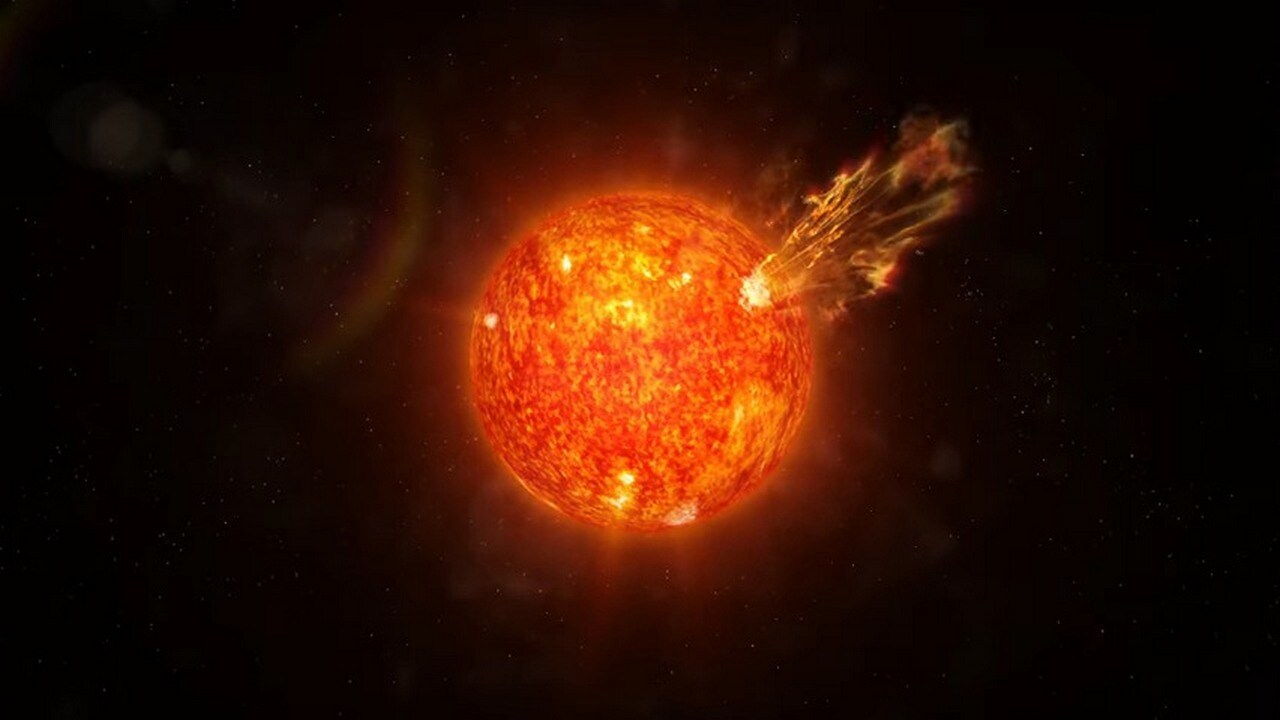 Solar wind that is the cause of the planetary shocks. Image credit: NASA/YouTube[/caption]These spacecraft are fitted with high-resolution instruments that help them ‘see what no other spacecraft can.’ These instruments helped in taking measurements of the shock waves.One instrument suite in particular that aided the measurements is the Fast Plasma Investigation suite. It measures ions and electrons around the spacecraft at up to 6 times per second. Since speeding shock waves could pass the spacecraft in a mere half-second, the high-speed sampling capability of this instrument is essential to catching such shock wave events.[caption id="" align="alignnone" width="1280"]
 Data from the Fast Plasma Investigation aboard MMS shows the shock and reflected ions as they washed over MMS. The colours represent the number of ions seen with warmer colours indicating higher numbers of ions. The reflected ions (yellow band that appears just above the middle of the figure) show up midway through the animation and can be seen increasing in intensity (warmer colours) as they pass MMS, shown as a white dot. Image Credits: Ian Cohen[/caption]When scientists look at data collected from that same day the shock recorded by MMS, they noticed a clump of ions picked up from the solar wind. Shortly after, they noticed a second clump of ions, created by ions already in the area that had bounced off the shock as it passed by. Analyzing this second population, the scientists found evidence to support a theory of energy transfer first proposed in the 1980s.Since the four MMS spacecraft were separated by only 19 kilometres at the time of the shock, the scientists could also see small-scale irregular patterns in the shock, which is still pending further study.The findings from this event has been published in the Journal of Geophysical Research.
First Published:Aug 14, 2019, 14:51:28 IST
Advertisement
Advertisement

Careless Whispers: Scientists discover that plants can 'talk' to each other using smells
Japanese scientists have recorded a video that shows plants, in certain conditions, communicate with each other using mists that carry smells. The discovery, reveals that plants release a fine mist of airborne compounds, to warn nearby plants of potential dangers
Life on Mars? European Space Agency’s Orbiter discovers ice water deposits at equator
European Space Agency's Mars Express Orbiter has identified massive ice and ice water deposits beneath the surface of Mars. The Mars Express orbiter was also the first to confirmed the presence of ice on Mars in 2004
Microsoft briefly overtakes Apple as the most valuable company, Apple back on top again
At its peak during the session, Microsoft's value reached $2.903 trillion, with a 2% surge. As of writing this article, Apple closed at $2.89 trillion, whereas Microsoft closed at $2.86 trillion
Even NASA is facing a tough time, starts layoffs following major budget cuts
NASA is facing some massive budget cuts, because of which, it has been forced to postpone some upcoming missions. NASA's Jet Propulsion Laboratory has been hit hard by recent federal budget cuts, resulting in the layoff of 100 contractors last week
ISRO, NASA's NISAR satellite to get ready by Jan-end, will monitor Earth's snow-covered regions
The NISAR satellite which has been developed jointly ISRO and NASA, should be ready for launch by the end of January 2024. The collaboration between NASA and ISRO on NISAR is the first time the two agencies have cooperated on hardware development for an Earth-observing mission
Advertisement
Advertisement