


First peek inside Hayabusa2 capsule; JAXA officials find more than anticipated asteroid sand, gas inside
They said that capsule successfully brought back asteroid gases that are clearly different from the air on Earth — a first sample-return of gases from outer space.

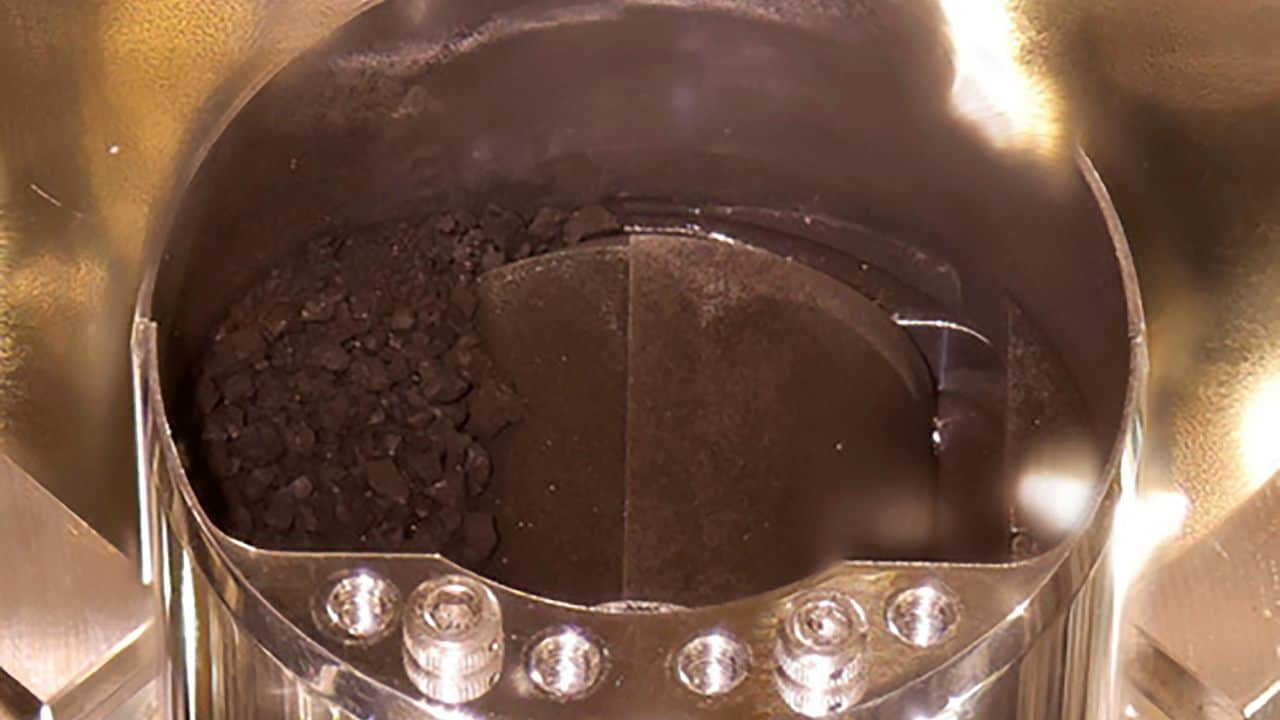
shows soil samples, seen inside a container of the re-entry capsule brought back by Hayabusa2, in Sagamihara, near Tokyo,Tuesday, Dec. 15, 2020. Image credit:JAXA via AP[/caption]Tsuda called the successful return of the asteroid soil and gas samples “a major scientific milestone.”The pan-shaped capsule, 40 centimetres in diameter, was dropped by Hayabusa2 from space to a predetermined spot in a sparsely populated Australian desert on Dec. 6 at the end of its six-year round trip to Ryugu, more than 300 million kilometres from Earth.The capsule arrived in Japan last Tuesday for research that scientists hope will provide insight into the origins of the solar system and life on Earth.Hirotaka Sawada, a JAXA scientist, was the first to look inside the capsule’s sample-catcher. Sawada said he was “almost speechless” with joy when he found that the samples inside included some that were, as expected, dust size, but also some the size of pebbles.
Soil samples in photos shown in Tuesday’s presentation looked like heaps of dark coffee grounds mixed with granules.Sawada said the tightly sealed capsule successfully brought back asteroid gases that are clearly different from the air on Earth — a first sample-return of gases from outer space. Kyushu University scientist Ryuji Okazaki said that gases could be related to minerals in asteroid soil and that he hopes to identify the gaseous samples and determine their age.Scientists are hoping samples from the asteroid’s subsurface can provide information from billions of years ago that are unaffected by space radiation and other environmental factors. JAXA scientists say they are particularly interested in organic materials in the samples to learn about how they were distributed in the solar system and if they are related to life on Earth.Sei-ichiro Watanabe, a Nagoya University earth and environmental scientist working with JAXA, said having more sample material to work with than expected is great news as it will expand the scope of studies.The samples were gathered from two touchdowns that Hayabusa2 made last year on Ryugu. The landings were more difficult than expected because of the asteroid’s extremely rocky surface.The first landing collected samples from Ryugu’s surface and the second from underground. Each was stored separately. JAXA said it will look into another compartment, used for a second touchdown, next week, and will continue an initial examination ahead of the later studies of the material.Following studies in Japan, some of the samples will be shared with NASA and other international space agencies for additional research beginning in 2022.Hayabusa2, meanwhile, is now on an 11-year expedition to another asteroid to try to study possible defenses against meteorites that could fly toward Earth.
Careless Whispers: Scientists discover that plants can 'talk' to each other using smells
Life on Mars? European Space Agency’s Orbiter discovers ice water deposits at equator
Microsoft briefly overtakes Apple as the most valuable company, Apple back on top again
Even NASA is facing a tough time, starts layoffs following major budget cuts
ISRO, NASA's NISAR satellite to get ready by Jan-end, will monitor Earth's snow-covered regions