


Eyes wide open: NASA equips Perseverance rover with advanced lenses to explore Mars
The Mastcam-Z, located on the rover’s head, can zoom into images and will help the mission create 3D imagery more easily.

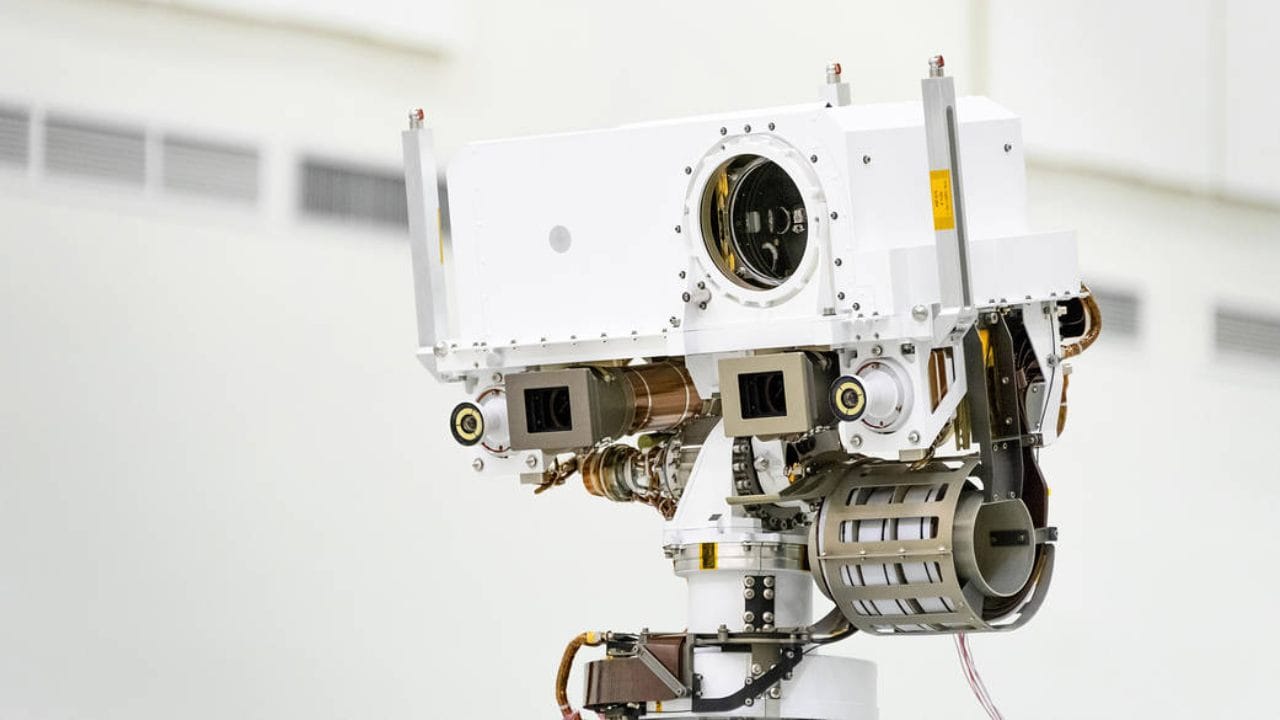
A close-up of the head of Mars Perseverance's remote sensing mast. The mast head contains the SuperCam instrument (its lens is in the large circular opening). In the gray boxes beneath mast head are the two Mastcam-Z imagers. On the exterior sides of those imagers are the rover's two navigation cameras.
Credits: NASA/JPL-Caltech[/caption]“The original plan was for Curiosity to have a zoom camera that could go out to an extreme wide-angle, like a spaghetti western view,” said Jim Bell of Arizona State University, Mastcam-Z's principal investigator and Mastcam's deputy principal investigator.He added that they found it hard to execute the plan at that time.Mastcam-Z has the capability to view surroundings under various wavelengths of light. Using this feature, NASA aims to discover the various materials on Mars’ surface, such as fallen meteorites.The instrument will provide “superhuman vision,” helping view the landscapes in a variety of colours, including some that can’t be detected by the human eye.It is not a spectrometer, an instrument that uses light to do a detailed scientific analysis, but “it can provide mineral clues that other instruments will follow up on.”The Mars 2020 mission is expected to take off on 17 July.NASA is gearing up to launch astronauts Doug Hurley and Bob Behnken into space on 27 May in partnership with private aerospace company SpaceX.This is happening almost 10 years after the last Space Shuttle Program lifted off (2011) from the Kennedy Space Centre.

Careless Whispers: Scientists discover that plants can 'talk' to each other using smells
Life on Mars? European Space Agency’s Orbiter discovers ice water deposits at equator
Microsoft briefly overtakes Apple as the most valuable company, Apple back on top again
Even NASA is facing a tough time, starts layoffs following major budget cuts
ISRO, NASA's NISAR satellite to get ready by Jan-end, will monitor Earth's snow-covered regions