


Exoplanet hunting telescope TESS finds first Earth-size planet with habitable conditions
TESS discovered three exoplanets in total, TOI 700 b, c and d, revolving around its star TOI 700.

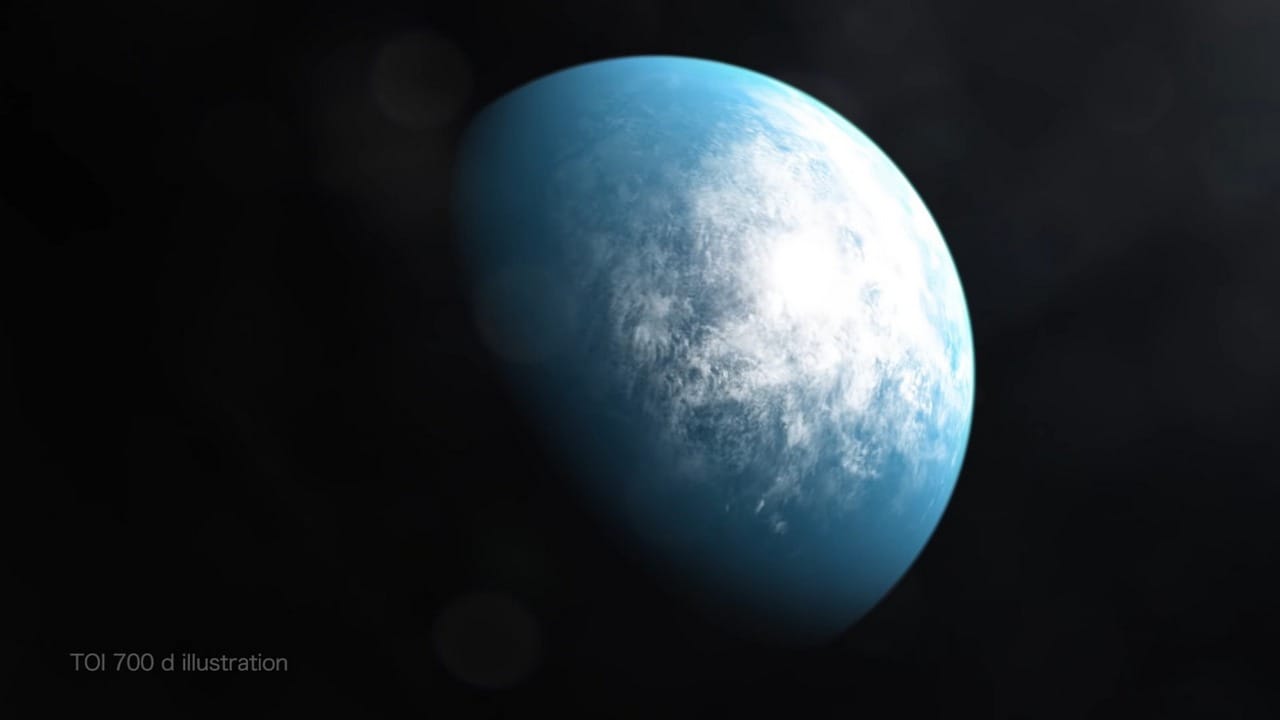
Artist impression of Earth-size planet TOI 700 d. Image credit: YouTube/NASA[/caption]“TESS was designed and launched specifically to find Earth-sized planets orbiting nearby stars,” said Paul Hertz, astrophysics division director at NASA Headquarters in Washington, in a statement. “Planets around nearby stars are easiest to follow-up with larger telescopes in space and on Earth. Discovering TOI 700 d is a key science finding for TESS. Confirming the planet’s size and habitable zone status with Spitzer is another win for Spitzer as it approaches the end of science operations this January."
The star — TOI 700
TESS had identified three planets, TOI 700 b, c and d that revolve around the star TOI 700 which is a small, cool M dwarf star in the southern constellation Dorado. It is around 40 percent of the Sun’s mass and size and about half its surface temperature.According to ANI, the star was originally misclassified in the TESS database as being more similar to our Sun, which meant the planets appeared larger and hotter than they really are. Several researchers, including Alton Spencer, a high school student working with members of the TESS team, identified the error.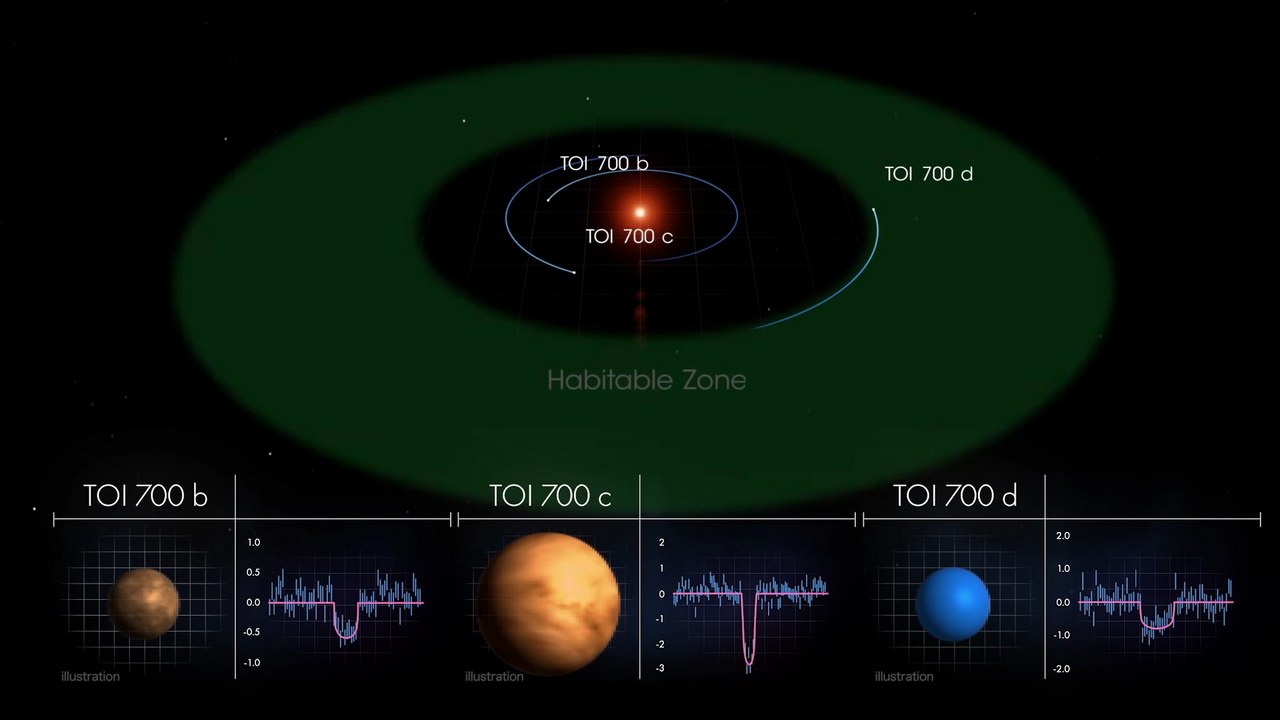
The three exoplanets discovered by space telescope TESS, rotating around their star TOI 700. Image credit: Youtube/NASA[/caption]
Habitable conditions on TOI 700 d
While the exact conditions on TOI 700 d are unknown, scientists can use current information, like the planet's size and the type of star it orbits, to generate computer models and make predictions. Researchers at NASA's Goddard Space Flight Center in Greenbelt, Maryland, modelled 20 potential environments of TOI 700 d to gauge if any version would result in surface temperatures and pressures suitable for habitability.Their 3D climate models examined a variety of surface types and atmospheric compositions typically associated with what scientists regard to be potentially habitable worlds. Since TOI 700 d is tidally locked to its star, the cloud formations of the planet and its wind patterns might be different from Earth's.One simulation included an ocean-covered TOI 700 d with a dense, carbon-dioxide-dominated atmosphere similar to what scientists suspect surrounded Mars when it was young. The model atmosphere contains a deep layer of clouds on the star-facing side. Another model depicts TOI 700 d as a cloudless, all-land version of modern Earth, where winds flow away from the night side of the planet and converge on the point directly facing the star.When the starlight passes through the atmosphere of a planet, it interacts with gaseous molecules like nitrogen and carbon dioxide and produces signals known as spectral lines. The researchers simulated spectra for the 20 modelled versions of TOI 700 d."Someday, when we have real spectra from TOI 700 d, we can backtrack, match them to the closest simulated spectrum, and then match that to a model. It's exciting because no matter what we find out about the planet, it's going to look completely different from what we have here on Earth," said Gabrielle Engelmann-Suissa.With inputs from ANI

Careless Whispers: Scientists discover that plants can 'talk' to each other using smells
Life on Mars? European Space Agency’s Orbiter discovers ice water deposits at equator
Microsoft briefly overtakes Apple as the most valuable company, Apple back on top again
Even NASA is facing a tough time, starts layoffs following major budget cuts
ISRO, NASA's NISAR satellite to get ready by Jan-end, will monitor Earth's snow-covered regions