
Advertisement


Sections
ESA awards contracts worth €129.4 million for design, manufacture, testing of Hera asteroid mission
The Hera mission will be the first spacecraft in history to explore a binary asteroid system.

The European Space Agency (ESA) has awarded €129.4 million in contracts to design, manufacture and test its Hera spacecraft, the space agency's first planetary defence mission.According to a report by The Guardian, Hera is the European Space Agency's contribution to an experiment called the asteroid impact and deflection assessment. The second component in this assessment is NASA's Double Asteroid Redirection Test, slated for a 2022 launch. Both spacecraft have been designed to visit the double asteroid system Didymos.As per a release by Thales, named after the Greek goddess of marriage, the Hera mission is aiming to find out if we are capable of deflecting an asteroid and prevent it from hitting Earth. Hera is scheduled for launch in 2024 and will travel for the first time in history to explore a binary asteroid system.[caption id="attachment_8544771" align="alignnone" width="1280"]![An illustration of NASA’s DART spacecraft and the Italian Space Agency’s LICIACube before impact at the Didymos binary system. Image: NASA/Johns Hopkins APL/Steve Gribben]() An illustration of NASA’s DART spacecraft and the Italian Space Agency’s LICIACube before impact at the Didymos binary system. Image: NASA/Johns Hopkins APL/Steve Gribben[/caption]As per the statement, the systems provided by Thales Alenia Space will allow researchers to control and track the spacecraft from a distance up to 500 million kilometer far away and send all information gathered by Hera back to Earth and to perform radio science. Eduardo Bellido, CEO of Thales Alenia Space in Spain said that it is exciting to be part of the historic experiment for humanity to protect the Earth against asteroid collisions. According to Bellido, their technology will deliver essential data to scientists to be able to establish a planetary defence strategy based on asteroids deflection and to prevent the threat of an impact on Earth.[caption id="attachment_8830011" align="alignnone" width="1280"]
An illustration of NASA’s DART spacecraft and the Italian Space Agency’s LICIACube before impact at the Didymos binary system. Image: NASA/Johns Hopkins APL/Steve Gribben[/caption]As per the statement, the systems provided by Thales Alenia Space will allow researchers to control and track the spacecraft from a distance up to 500 million kilometer far away and send all information gathered by Hera back to Earth and to perform radio science. Eduardo Bellido, CEO of Thales Alenia Space in Spain said that it is exciting to be part of the historic experiment for humanity to protect the Earth against asteroid collisions. According to Bellido, their technology will deliver essential data to scientists to be able to establish a planetary defence strategy based on asteroids deflection and to prevent the threat of an impact on Earth.[caption id="attachment_8830011" align="alignnone" width="1280"]![A collision between an asteroid threat in space and a spacecraft might only change the velocity of the rock by a few millimeters. However, over vast distances like millions of kilometers, the same change in trajectory could make the rock miss Earth. Image Courtest: Aerospace In America]() A collision between an asteroid threat in space and a spacecraft might only change the velocity of the rock by a few millimeters. However, over vast distances like millions of kilometers, the same change in trajectory could make the rock miss Earth. Image Courtest: Aerospace In America[/caption]As per the statement, Hera will send key information to Earth on the physical properties of Dimorphos to determine the momentum transfer efficiency of the impact and to allow scaling it to different asteroids among other things.According to the Thales statement, the Didymos binary asteroid system is like thousands of asteroids that pose a hazardous risk of impact to our planet. Around the main body of Didymos, orbits a 160 meter moonlet, Dimorphos, which is similar in size to the great pyramid of Giza. Hera will target this moonlet, which will become the smallest asteroid ever visited by a probe.
NASA's DART mission will deliberately smash into an asteroid in 2022
A collision between an asteroid threat in space and a spacecraft might only change the velocity of the rock by a few millimeters. However, over vast distances like millions of kilometers, the same change in trajectory could make the rock miss Earth. Image Courtest: Aerospace In America[/caption]As per the statement, Hera will send key information to Earth on the physical properties of Dimorphos to determine the momentum transfer efficiency of the impact and to allow scaling it to different asteroids among other things.According to the Thales statement, the Didymos binary asteroid system is like thousands of asteroids that pose a hazardous risk of impact to our planet. Around the main body of Didymos, orbits a 160 meter moonlet, Dimorphos, which is similar in size to the great pyramid of Giza. Hera will target this moonlet, which will become the smallest asteroid ever visited by a probe.
NASA's DART mission will deliberately smash into an asteroid in 2022
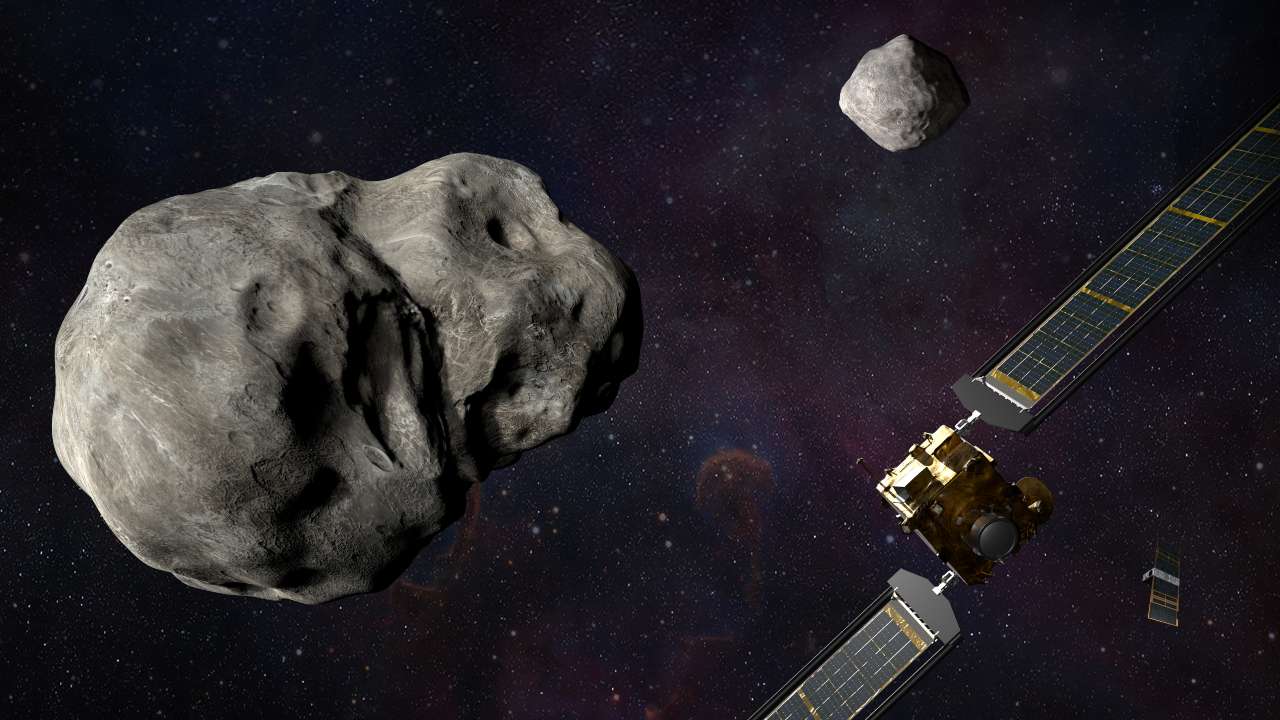 An illustration of NASA’s DART spacecraft and the Italian Space Agency’s LICIACube before impact at the Didymos binary system. Image: NASA/Johns Hopkins APL/Steve Gribben[/caption]As per the statement, the systems provided by Thales Alenia Space will allow researchers to control and track the spacecraft from a distance up to 500 million kilometer far away and send all information gathered by Hera back to Earth and to perform radio science. Eduardo Bellido, CEO of Thales Alenia Space in Spain said that it is exciting to be part of the historic experiment for humanity to protect the Earth against asteroid collisions. According to Bellido, their technology will deliver essential data to scientists to be able to establish a planetary defence strategy based on asteroids deflection and to prevent the threat of an impact on Earth.[caption id="attachment_8830011" align="alignnone" width="1280"]
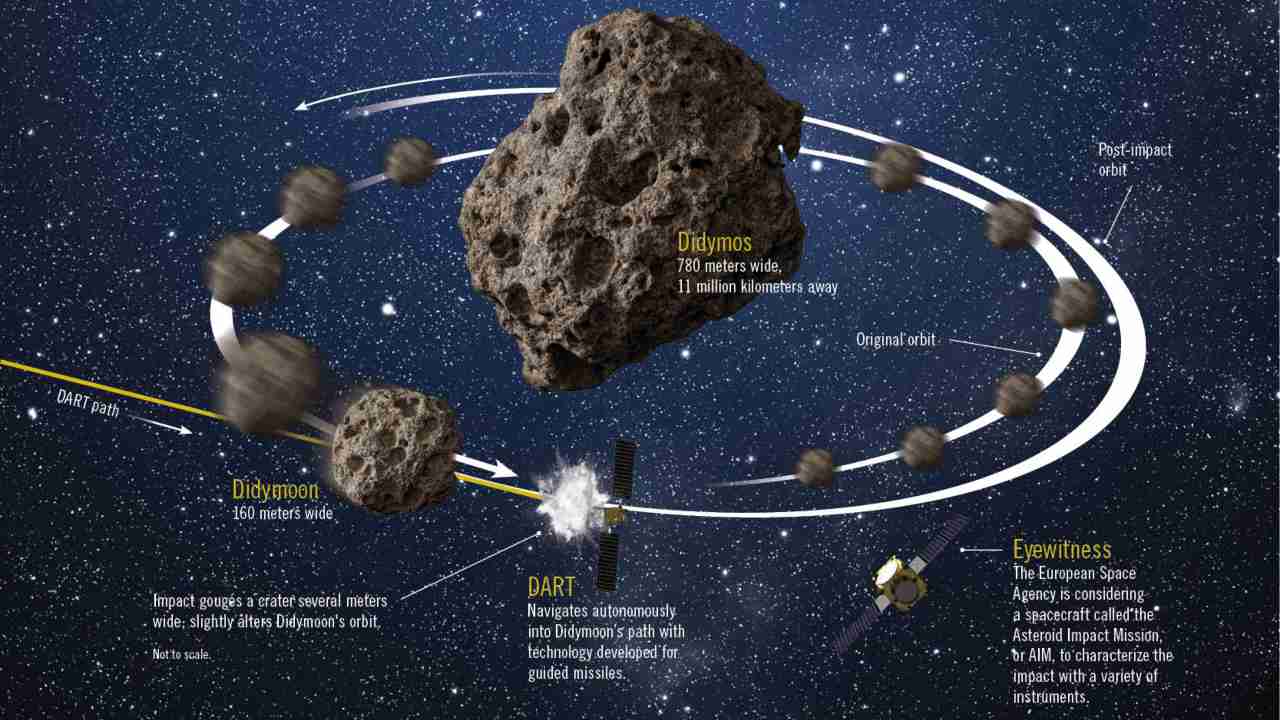 A collision between an asteroid threat in space and a spacecraft might only change the velocity of the rock by a few millimeters. However, over vast distances like millions of kilometers, the same change in trajectory could make the rock miss Earth. Image Courtest: Aerospace In America[/caption]As per the statement, Hera will send key information to Earth on the physical properties of Dimorphos to determine the momentum transfer efficiency of the impact and to allow scaling it to different asteroids among other things.According to the Thales statement, the Didymos binary asteroid system is like thousands of asteroids that pose a hazardous risk of impact to our planet. Around the main body of Didymos, orbits a 160 meter moonlet, Dimorphos, which is similar in size to the great pyramid of Giza. Hera will target this moonlet, which will become the smallest asteroid ever visited by a probe.
Also Read
report by The Guardian
First Published:Sep 18, 2020, 18:06:35 IST
Advertisement
Advertisement

Careless Whispers: Scientists discover that plants can 'talk' to each other using smells
Japanese scientists have recorded a video that shows plants, in certain conditions, communicate with each other using mists that carry smells. The discovery, reveals that plants release a fine mist of airborne compounds, to warn nearby plants of potential dangers
Life on Mars? European Space Agency’s Orbiter discovers ice water deposits at equator
European Space Agency's Mars Express Orbiter has identified massive ice and ice water deposits beneath the surface of Mars. The Mars Express orbiter was also the first to confirmed the presence of ice on Mars in 2004
Microsoft briefly overtakes Apple as the most valuable company, Apple back on top again
At its peak during the session, Microsoft's value reached $2.903 trillion, with a 2% surge. As of writing this article, Apple closed at $2.89 trillion, whereas Microsoft closed at $2.86 trillion
Even NASA is facing a tough time, starts layoffs following major budget cuts
NASA is facing some massive budget cuts, because of which, it has been forced to postpone some upcoming missions. NASA's Jet Propulsion Laboratory has been hit hard by recent federal budget cuts, resulting in the layoff of 100 contractors last week
ISRO, NASA's NISAR satellite to get ready by Jan-end, will monitor Earth's snow-covered regions
The NISAR satellite which has been developed jointly ISRO and NASA, should be ready for launch by the end of January 2024. The collaboration between NASA and ISRO on NISAR is the first time the two agencies have cooperated on hardware development for an Earth-observing mission
Advertisement
Advertisement