


Elusive neutron star remnants of famous Supernova 1987A finally found, scientists claim
In a decade, scientists expect to be able to see emissions from the pulsar better, to back their hypothesis with evidence.

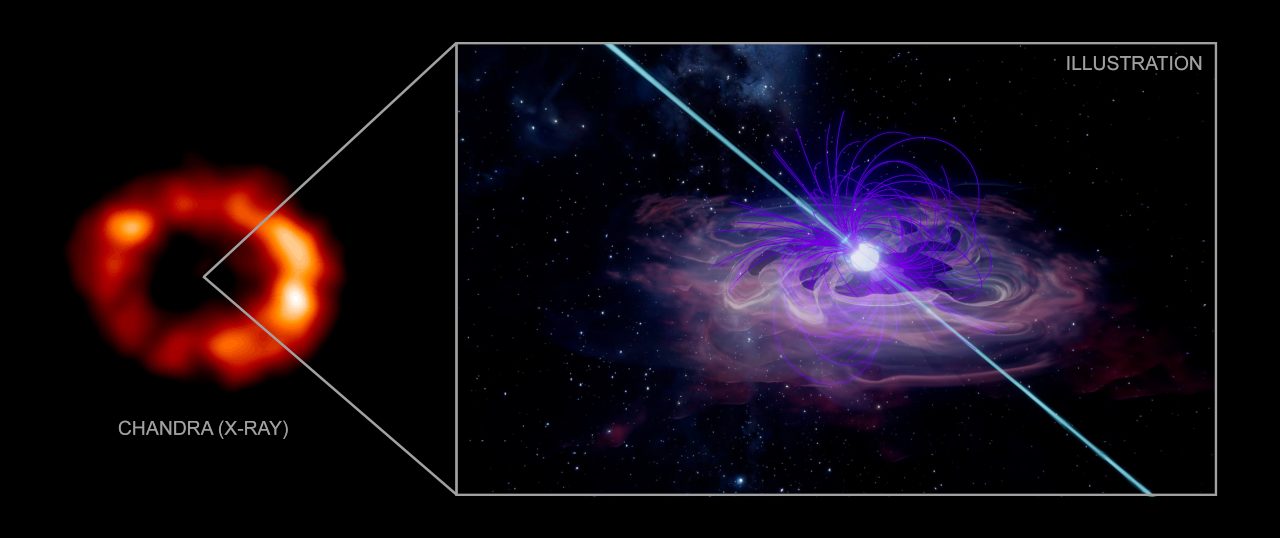
An X-ray image taken bu Chandra (L) and illustration of Supernova 1987A. Image credit: Chandra/NASA/CXC/Univ. di Palermo/E. Greco/INAF-Osservatorio Astronomico di Palermo/Salvatore Orlando[/caption]According to study authors, when a star explodes, it collapses onto itself before the outer layers explode. However, the compression turns the core into an extremely dense object called neutron stars. Rapidly rotating, highly magnetised neutron stars called pulsars produce beams of radiations that astronomers detect as pulses. If the core is indeed a pulsar at the center of SN 1987A, it would be the youngest one discovered yet.In Chandra and NuSTAR data, researchers identified relatively low-energy X-rays from SN 1987A’s debris crashing into surrounding material. They also found evidence of high-energy particles, using NuSTAR’s ability to detect more energetic X-rays. The study authors, considering different theories of what the source of the energetic X-rays could be, argue that it was a pulsar (which has a wind) and charged particles from it that are accelerated to near-light speed, forming a nebula around the pulsar. This phenomenon, also called a pulsar wind nebula, can theoretically be found inside the shell of a supernova remnant, the statement said.The debris surrounding the pulsar is capably of absorbing its lower energy X-ray emission, making it difficult to detect at present. According to the study, this material will disperse over the next few years, thereby reducing its absorbing power. Emission from the pulsar, researchers said, can be expected to emerge in about ten years. This would reveal the existence of the reclusive neutron star at the heart of SN 1987A.

Careless Whispers: Scientists discover that plants can 'talk' to each other using smells
Life on Mars? European Space Agency’s Orbiter discovers ice water deposits at equator
Microsoft briefly overtakes Apple as the most valuable company, Apple back on top again
Even NASA is facing a tough time, starts layoffs following major budget cuts
ISRO, NASA's NISAR satellite to get ready by Jan-end, will monitor Earth's snow-covered regions