
Advertisement


Sections
Elon Musk still wants to drop nuclear bombs on Mars; releases ‘Nuke Mars’ t-shirt
Back in 2015, Elon Musk had suggested a fast way of making Mars habitable was to drop nukes on its poles

Elon Musk is back at it again with his idea of nuking the surface of Mars to terraform it or make it habitable for humans. After tweeting “Nuke Mars!”, Musk is now selling t-shirts on the SpaceX online shop with the same message printed on it.[caption id="attachment_4967151" align="alignnone" width="1024"]![Elon Musk speaks at a community meeting in Bel Air, Los Angeles, California, US. Image: Reuters]() Elon Musk speaks at a community meeting in Bel Air, Los Angeles, California, US. Image: Reuters[/caption]In an interview at Stephen Colbert’s late-night show in 2015, Colbert and Musk had talked about humans going to Mars. While we all know that Mars is inhabitable for humans, Musk suggested an idea of detonating thermonuclear weapons on the poles to warm the red planet. With all the ice melting, carbon dioxide will be released into its atmosphere, eventually kickstarting a rapid greenhouse effect. He believes this will raise the global temperature on Mars significantly to make conditions livable for humans.However, a recent NASA study titled “Inventory of CO2 available for terraforming Mars” explored how much CO2 is present in the Martian planet. According to the 2018 paper, the Mars Atmosphere and Volatile Evolution Mission probe, Mars Express spacecraft, Mars Reconnaissance Orbiter and the Mars Odyssey spacecraft, collectively found that there isn’t much of carbon dioxide left on the planet to start off with significant greenhouse warming in the atmosphere. It concluded that terraforming the fourth rock from the Sun is practically impossible with present-day technology.[caption id="attachment_7178431" align="alignnone" width="1920"]
Elon Musk speaks at a community meeting in Bel Air, Los Angeles, California, US. Image: Reuters[/caption]In an interview at Stephen Colbert’s late-night show in 2015, Colbert and Musk had talked about humans going to Mars. While we all know that Mars is inhabitable for humans, Musk suggested an idea of detonating thermonuclear weapons on the poles to warm the red planet. With all the ice melting, carbon dioxide will be released into its atmosphere, eventually kickstarting a rapid greenhouse effect. He believes this will raise the global temperature on Mars significantly to make conditions livable for humans.However, a recent NASA study titled “Inventory of CO2 available for terraforming Mars” explored how much CO2 is present in the Martian planet. According to the 2018 paper, the Mars Atmosphere and Volatile Evolution Mission probe, Mars Express spacecraft, Mars Reconnaissance Orbiter and the Mars Odyssey spacecraft, collectively found that there isn’t much of carbon dioxide left on the planet to start off with significant greenhouse warming in the atmosphere. It concluded that terraforming the fourth rock from the Sun is practically impossible with present-day technology.[caption id="attachment_7178431" align="alignnone" width="1920"]![This infographic shows the various sources of carbon dioxide on Mars and their estimated contribution to Martian atmospheric pressure. Image: NASA Goddard Space Flight Center.]() This infographic shows the various sources of carbon dioxide on Mars and their estimated contribution to Martian atmospheric pressure. Image: NASA Goddard Space Flight Center.[/caption]Musk followed this up on Twitter by saying “there’s a massive amount of CO2 adsorbed into the soil that’d be released upon heating”. Discover Magazine went into a deeper dive with this claim asking the scientists whether this could actually work out. Bruce Jakosky, head of NASA’s Mars MAVEN mission and lead author of the paper, said that although there is adsorbed CO2 in the Martian soil, extracting it isn’t a simple process with present-day technology. Jakosky suggested that there are two possibilities where one could import or manufacture a huge amount of CFC gases to be released in the atmosphere and the second was to build a massive mirror as large as Mars to rapidly heat up the surface, releasing the trapped CO2. And still, the amount of released CO2 won’t be able to achieve a comparable air pressure on Earth at sea level.Whether the idea of terraforming Mars with nuclear weapons works out or not, Musk’s space company SpaceX has been working on the Starship spacecraft that will eventually transport humans to the moon. The Starship space vehicle will aim to travel to Mars in the future and set up a base on the planet.SpaceX is working on building two orbital Starship prototypes named Mk1 and Mk2 at facilities in Texas and Florida respectively. An early prototype of the Starship called the Starhopper completed a few tests before and it will be conducting another one soon after it was delayed for “hazard analysis” by the FAA. No date has been announced yet for the next flight test of Starhopper.
This infographic shows the various sources of carbon dioxide on Mars and their estimated contribution to Martian atmospheric pressure. Image: NASA Goddard Space Flight Center.[/caption]Musk followed this up on Twitter by saying “there’s a massive amount of CO2 adsorbed into the soil that’d be released upon heating”. Discover Magazine went into a deeper dive with this claim asking the scientists whether this could actually work out. Bruce Jakosky, head of NASA’s Mars MAVEN mission and lead author of the paper, said that although there is adsorbed CO2 in the Martian soil, extracting it isn’t a simple process with present-day technology. Jakosky suggested that there are two possibilities where one could import or manufacture a huge amount of CFC gases to be released in the atmosphere and the second was to build a massive mirror as large as Mars to rapidly heat up the surface, releasing the trapped CO2. And still, the amount of released CO2 won’t be able to achieve a comparable air pressure on Earth at sea level.Whether the idea of terraforming Mars with nuclear weapons works out or not, Musk’s space company SpaceX has been working on the Starship spacecraft that will eventually transport humans to the moon. The Starship space vehicle will aim to travel to Mars in the future and set up a base on the planet.SpaceX is working on building two orbital Starship prototypes named Mk1 and Mk2 at facilities in Texas and Florida respectively. An early prototype of the Starship called the Starhopper completed a few tests before and it will be conducting another one soon after it was delayed for “hazard analysis” by the FAA. No date has been announced yet for the next flight test of Starhopper.
 Elon Musk speaks at a community meeting in Bel Air, Los Angeles, California, US. Image: Reuters[/caption]In an interview at Stephen Colbert’s late-night show in 2015, Colbert and Musk had talked about humans going to Mars. While we all know that Mars is inhabitable for humans, Musk suggested an idea of detonating thermonuclear weapons on the poles to warm the red planet. With all the ice melting, carbon dioxide will be released into its atmosphere, eventually kickstarting a rapid greenhouse effect. He believes this will raise the global temperature on Mars significantly to make conditions livable for humans.
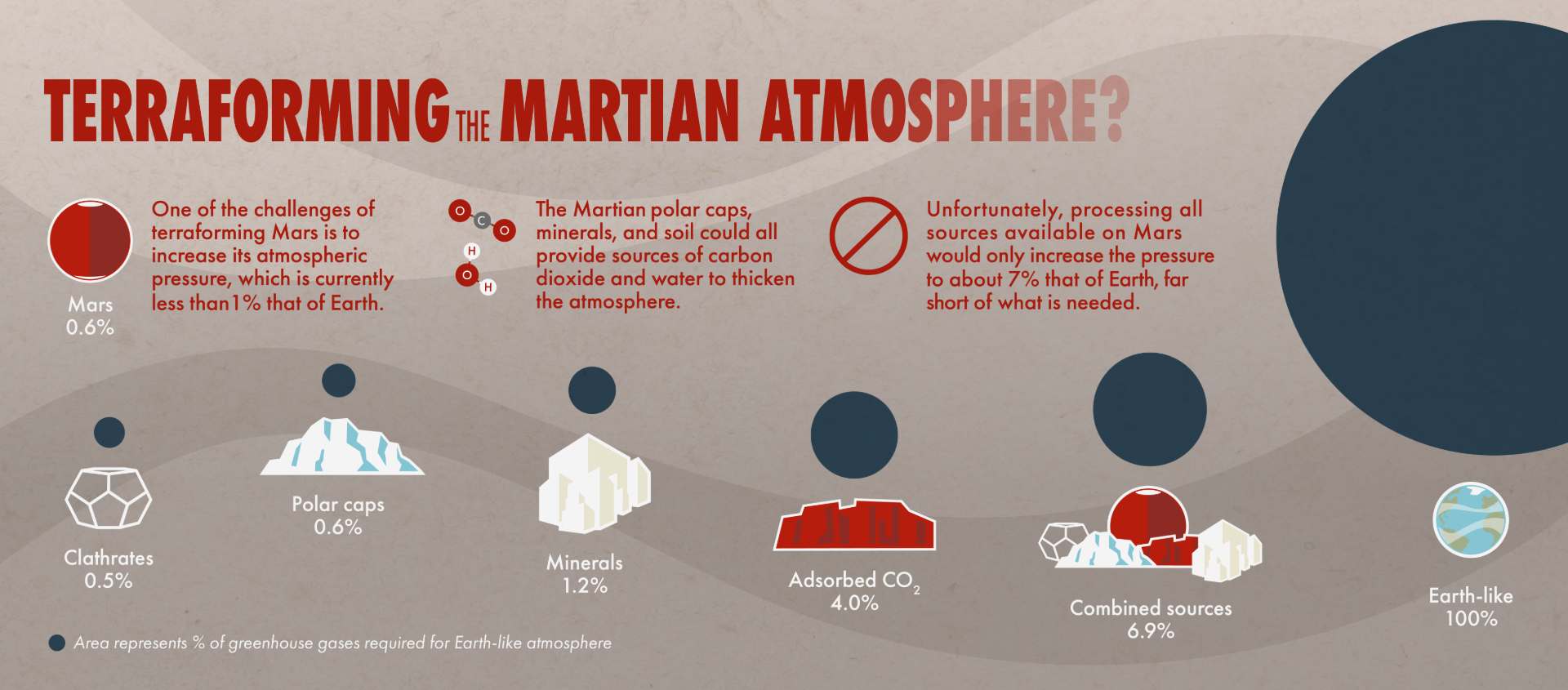 This infographic shows the various sources of carbon dioxide on Mars and their estimated contribution to Martian atmospheric pressure. Image: NASA Goddard Space Flight Center.[/caption]Musk followed this up on Twitter by saying “there’s a massive amount of CO2 adsorbed into the soil that’d be released upon heating”. Discover Magazine went into a deeper dive with this claim asking the scientists whether this could actually work out. Bruce Jakosky, head of NASA’s Mars MAVEN mission and lead author of the paper, said that although there is adsorbed CO2 in the Martian soil, extracting it isn’t a simple process with present-day technology. Jakosky suggested that there are two possibilities where one could import or manufacture a huge amount of CFC gases to be released in the atmosphere and the second was to build a massive mirror as large as Mars to rapidly heat up the surface, releasing the trapped CO2. And still, the amount of released CO2 won’t be able to achieve a comparable air pressure on Earth at sea level.Whether the idea of terraforming Mars with nuclear weapons works out or not, Musk’s space company SpaceX has been working on the Starship spacecraft that will eventually transport humans to the moon. The Starship space vehicle will aim to travel to Mars in the future and set up a base on the planet.SpaceX is working on building two orbital Starship prototypes named Mk1 and Mk2 at facilities in Texas and Florida respectively. An early prototype of the Starship called the Starhopper completed a few tests before and it will be conducting another one soon after it was delayed for “hazard analysis” by the FAA. No date has been announced yet for the next flight test of Starhopper.
First Published:Aug 17, 2019, 15:15:31 IST
Advertisement
Advertisement

Careless Whispers: Scientists discover that plants can 'talk' to each other using smells
Japanese scientists have recorded a video that shows plants, in certain conditions, communicate with each other using mists that carry smells. The discovery, reveals that plants release a fine mist of airborne compounds, to warn nearby plants of potential dangers
Life on Mars? European Space Agency’s Orbiter discovers ice water deposits at equator
European Space Agency's Mars Express Orbiter has identified massive ice and ice water deposits beneath the surface of Mars. The Mars Express orbiter was also the first to confirmed the presence of ice on Mars in 2004
Microsoft briefly overtakes Apple as the most valuable company, Apple back on top again
At its peak during the session, Microsoft's value reached $2.903 trillion, with a 2% surge. As of writing this article, Apple closed at $2.89 trillion, whereas Microsoft closed at $2.86 trillion
Even NASA is facing a tough time, starts layoffs following major budget cuts
NASA is facing some massive budget cuts, because of which, it has been forced to postpone some upcoming missions. NASA's Jet Propulsion Laboratory has been hit hard by recent federal budget cuts, resulting in the layoff of 100 contractors last week
ISRO, NASA's NISAR satellite to get ready by Jan-end, will monitor Earth's snow-covered regions
The NISAR satellite which has been developed jointly ISRO and NASA, should be ready for launch by the end of January 2024. The collaboration between NASA and ISRO on NISAR is the first time the two agencies have cooperated on hardware development for an Earth-observing mission
Advertisement
Advertisement