
Advertisement


Sections
Dive to discover new species in world's deepest oceanic trench also finds plastic
The dive to Mariana was only the third time people have reached the ocean's extreme depths.

An underwater exploration team has dived to the deepest trench in the world, the Challenger Deep in Pacific Ocean Mariana Trench and found marine life a-plenty, but also... trash.Victor Vescovo, a pro diver and member of the Deep Five Explorations team, has become the first man to completed a version of the "Four Corners of the Earth": trek the Mt Everest, dive the Challenger Deep, and ski on both the geographic poles. In an unexpected title that even Vescovo wasn't expecting, he is now also the first man to discover a plastic bag and sweet wrappers at the bottom of the world's deepest trench, according to BBC.Vescovo said he wasn't surprised by the discovery, though, disappointed to see "human contamination" in the deep ocean. While he saw particles of an object, he can't be certain if it was made of plastic or metal. They did have sharp edges, he said in an interview with Discovery, and one of the particles has a letter printed on it, making the assumption that the object was man-made a fair one.[caption id="attachment_6629211" align="alignnone" width="1280"]![What looks like a plastic wrapper at the far right hand corner of the picture. Image credit: Reuters/ Atlantic Productions]() What looks like a plastic wrapper at the far right-hand corner of the picture. Image credit: Reuters/ Atlantic Productions[/caption]The dive series has helped the Five Deeps research team identify three new species of marine animals, including a type of long-appendaged Amphipod.Vescovo told Discovery that finding new species with each dive isn't all that surprising either. The dives are intentionally planned in parts of the ocean that haven't been thoroughly explored. It's only fair to assume that undiscovered species and evolution taking its course will unearth new deep-sea life forms in dives like Five Deeps'.[caption id="attachment_6629151" align="alignnone" width="1280"]
What looks like a plastic wrapper at the far right-hand corner of the picture. Image credit: Reuters/ Atlantic Productions[/caption]The dive series has helped the Five Deeps research team identify three new species of marine animals, including a type of long-appendaged Amphipod.Vescovo told Discovery that finding new species with each dive isn't all that surprising either. The dives are intentionally planned in parts of the ocean that haven't been thoroughly explored. It's only fair to assume that undiscovered species and evolution taking its course will unearth new deep-sea life forms in dives like Five Deeps'.[caption id="attachment_6629151" align="alignnone" width="1280"]![One of the new species captured on camera during the dive to the Marina trench . Image credit: Reuters /Atlantic Production]() One of the new species captured on camera during the dive to the Mariana Trench. Image credit: Reuters /Atlantic Production[/caption]The expedition reached a maximum depth of 10,928 meters into the Trench.The only two other people to reach these depths was in 2012 by filmmaker James Cameron in his submersible, the Deepsea Challenger, and Lieutenant Don Walsh and Swiss scientist Jacques Piccard of the US Navy in the Trieste a deep submarine in 1960.The Deep Five exploratory dives to the five oceans of the world are being filmed by Atlantic Productions for a documentary series with Discovery Channel.
One of the new species captured on camera during the dive to the Mariana Trench. Image credit: Reuters /Atlantic Production[/caption]The expedition reached a maximum depth of 10,928 meters into the Trench.The only two other people to reach these depths was in 2012 by filmmaker James Cameron in his submersible, the Deepsea Challenger, and Lieutenant Don Walsh and Swiss scientist Jacques Piccard of the US Navy in the Trieste a deep submarine in 1960.The Deep Five exploratory dives to the five oceans of the world are being filmed by Atlantic Productions for a documentary series with Discovery Channel.
 What looks like a plastic wrapper at the far right-hand corner of the picture. Image credit: Reuters/ Atlantic Productions[/caption]The dive series has helped the Five Deeps research team identify three new species of marine animals, including a type of long-appendaged Amphipod.Vescovo told Discovery that finding new species with each dive isn't all that surprising either. The dives are intentionally planned in parts of the ocean that haven't been thoroughly explored. It's only fair to assume that undiscovered species and evolution taking its course will unearth new deep-sea life forms in dives like Five Deeps'.[caption id="attachment_6629151" align="alignnone" width="1280"]
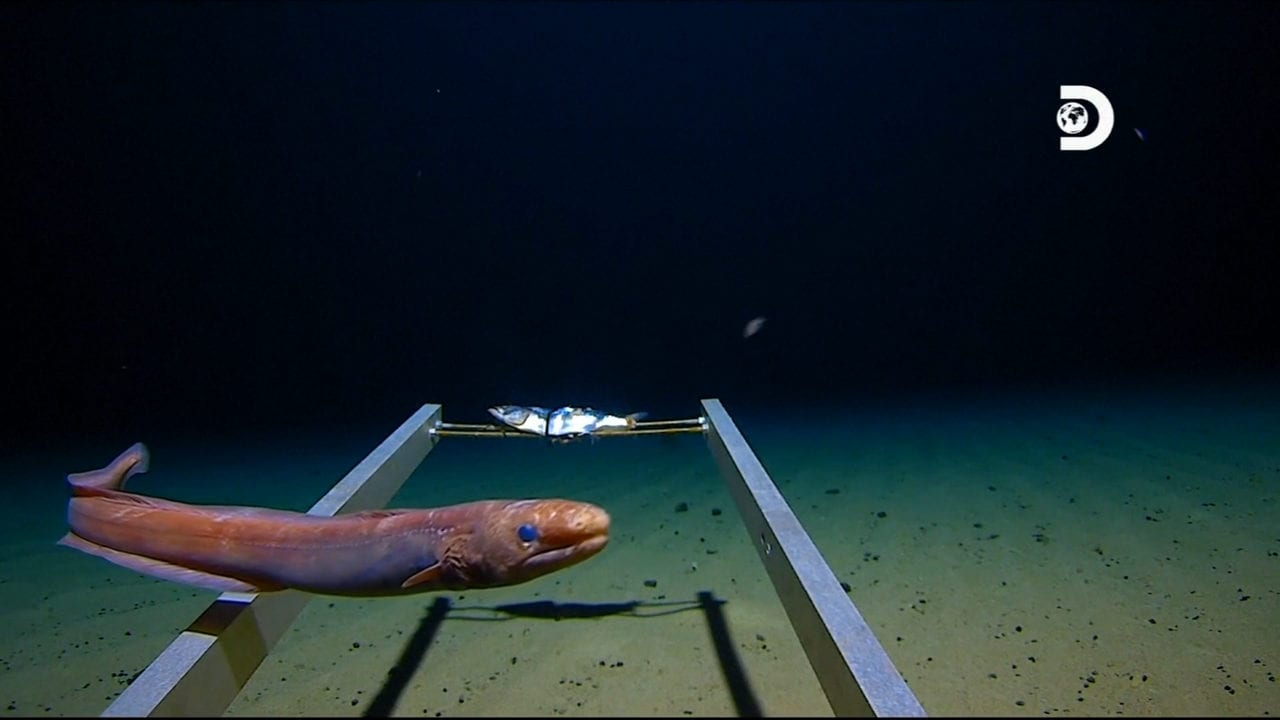 One of the new species captured on camera during the dive to the Mariana Trench. Image credit: Reuters /Atlantic Production[/caption]The expedition reached a maximum depth of 10,928 meters into the Trench.The only two other people to reach these depths was in 2012 by filmmaker James Cameron in his submersible, the Deepsea Challenger, and Lieutenant Don Walsh and Swiss scientist Jacques Piccard of the US Navy in the Trieste a deep submarine in 1960.The Deep Five exploratory dives to the five oceans of the world are being filmed by Atlantic Productions for a documentary series with Discovery Channel.
First Published:May 14, 2019, 13:26:49 IST
Advertisement
Advertisement

Careless Whispers: Scientists discover that plants can 'talk' to each other using smells
Japanese scientists have recorded a video that shows plants, in certain conditions, communicate with each other using mists that carry smells. The discovery, reveals that plants release a fine mist of airborne compounds, to warn nearby plants of potential dangers
Life on Mars? European Space Agency’s Orbiter discovers ice water deposits at equator
European Space Agency's Mars Express Orbiter has identified massive ice and ice water deposits beneath the surface of Mars. The Mars Express orbiter was also the first to confirmed the presence of ice on Mars in 2004
Microsoft briefly overtakes Apple as the most valuable company, Apple back on top again
At its peak during the session, Microsoft's value reached $2.903 trillion, with a 2% surge. As of writing this article, Apple closed at $2.89 trillion, whereas Microsoft closed at $2.86 trillion
Even NASA is facing a tough time, starts layoffs following major budget cuts
NASA is facing some massive budget cuts, because of which, it has been forced to postpone some upcoming missions. NASA's Jet Propulsion Laboratory has been hit hard by recent federal budget cuts, resulting in the layoff of 100 contractors last week
ISRO, NASA's NISAR satellite to get ready by Jan-end, will monitor Earth's snow-covered regions
The NISAR satellite which has been developed jointly ISRO and NASA, should be ready for launch by the end of January 2024. The collaboration between NASA and ISRO on NISAR is the first time the two agencies have cooperated on hardware development for an Earth-observing mission
Advertisement
Advertisement