


Discs of active, non-active spiral twin galaxies have significant differences, study proposes
Researchers scoured through over 600 spiral galaxies that are 'almost twin' but had different nuclear activity.

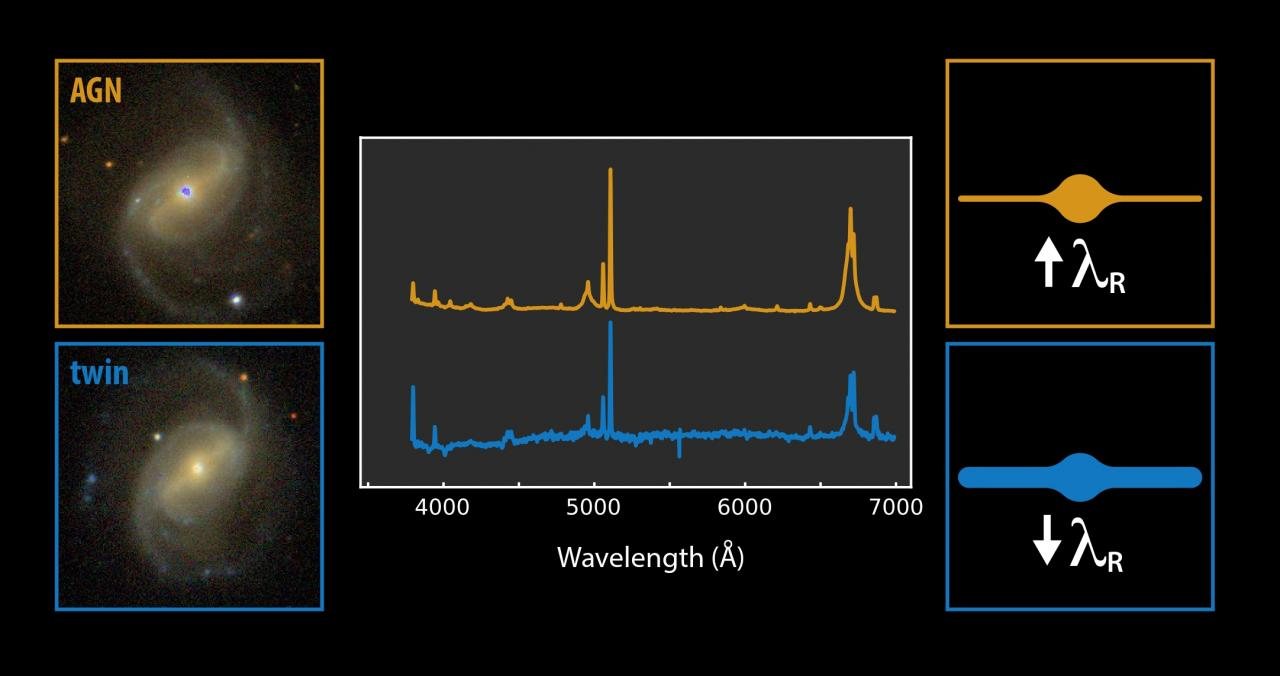
An illustration of the comparison seen between an active spiral galaxy (orange box) and its non-active twin (blue box). Image Credit: Gabriel Prrez Diaz/SMM/IAC[/caption]Unravelling that will require the understanding of how active and non-active galaxies are different. Castro picked up over 600 galaxies that are "almost twin" but with different nuclear activity. The study has been accepted to be published in the scientific journal Astronomy & Astrophysics Letters.While large samples of active and non-active samples were studied in earlier studies, this time researchers compared one active galaxy with another non-active one, maintaining that these are similar in appearance, have the same mass, orientation and brightness. This novel method narrowed down the causes for the differences.Either angular momentum resulted in the gas falling into the centre. Or, the infall of gas happened from the outside when the galaxy captured any smaller galaxy. The study said both scenarios are compatible with this result, and they are not mutually exclusive.IAC researcher and co-author Begoña García Lorenzo said, “The result surprised us; we really didn't expect to find this type of differences on a large scale, given that the duration of the active phase is very short in comparison with the lifetime of a galaxy, and with the time needed to produce morphological and dynamical changes”.

Careless Whispers: Scientists discover that plants can 'talk' to each other using smells
Life on Mars? European Space Agency’s Orbiter discovers ice water deposits at equator
Microsoft briefly overtakes Apple as the most valuable company, Apple back on top again
Even NASA is facing a tough time, starts layoffs following major budget cuts
ISRO, NASA's NISAR satellite to get ready by Jan-end, will monitor Earth's snow-covered regions