
Advertisement


Sections
Deep-sea fish species can see colour in pitch dark with unique gene adaptation
Some fish species had over 30 copies of the gene that controls light-sensing pigments in the eye.

While people and other vertebrates are colour blind in dim light, some deep-sea fish may possess keen colour vision to thrive in the near total darkness of their extreme environment thanks to a unique genetic adaptation, scientists said on Thursday.Researchers analysed the genomes of 101 fish species and found that three lineages of deep-sea fish, living up to about a mile (1,500 meters) below the surface, boast a specialized visual system to allow for colour vision in inky blackness.Having acute vision could provide tremendous advantages to these fish as they search for food and mates and try to avoid becoming another creature’s dinner in the exotic dark world of the ocean depths, the planet’s largest habitat.[caption id="attachment_6606831" align="alignnone" width="1280"]![Stylephorus chordatus is one of several species of fish with extra genes for eye pigment. Image: YouTube/QLBrainLearning]() Rod cells contain a single type of photopigment — pigments that react to a certain wavelength of light — called rhodopsin. The researchers found 13 species from the three lineages of deep-sea fish that had a proliferation of genes controlling rhodopsin, apparently letting the fish use rods to detect colours. One species, the silver spinyfin, had 38 copies of the rhodopsin gene, rather than the usual one.The spinyfin, with a bright silver body, has an almost circular body shape and large eyes. Other fish with this visual system includes the extremely elongated tube-eye fish and the bioluminescent lanternfish."They very likely are able to see colour purely by rods, which is unique among vertebrates," Musilova said.
Rod cells contain a single type of photopigment — pigments that react to a certain wavelength of light — called rhodopsin. The researchers found 13 species from the three lineages of deep-sea fish that had a proliferation of genes controlling rhodopsin, apparently letting the fish use rods to detect colours. One species, the silver spinyfin, had 38 copies of the rhodopsin gene, rather than the usual one.The spinyfin, with a bright silver body, has an almost circular body shape and large eyes. Other fish with this visual system includes the extremely elongated tube-eye fish and the bioluminescent lanternfish."They very likely are able to see colour purely by rods, which is unique among vertebrates," Musilova said.
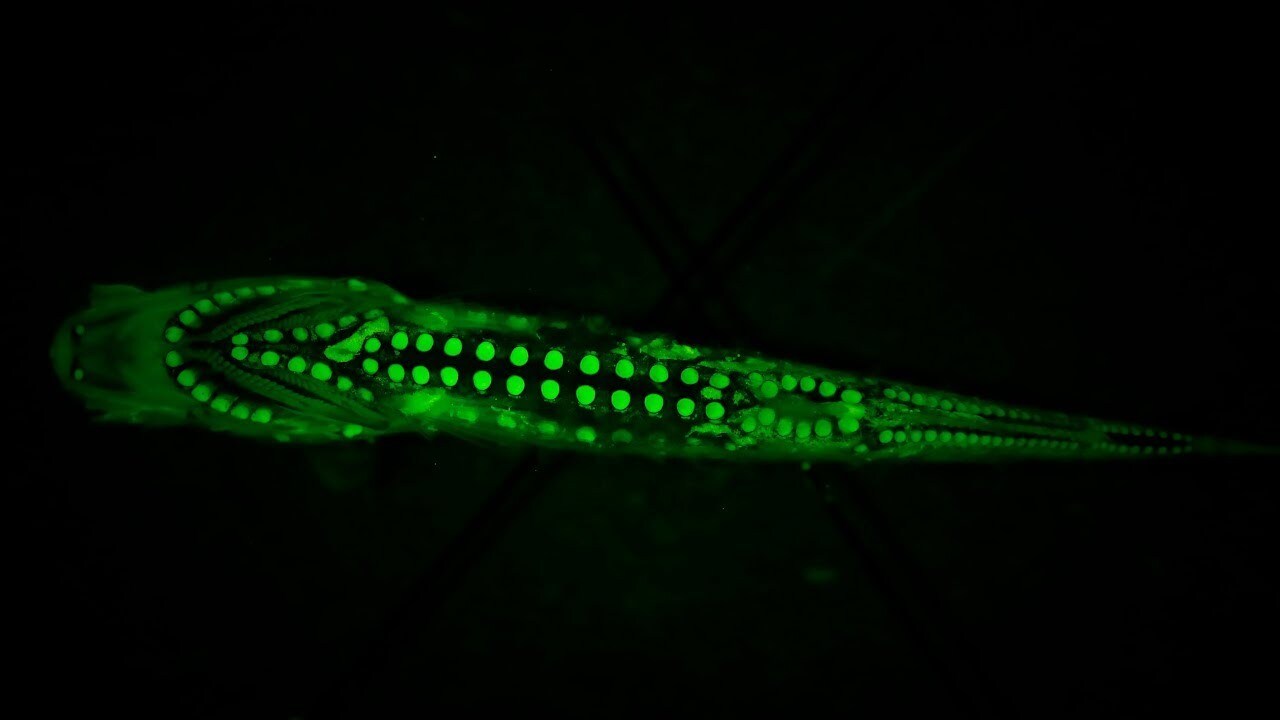
Stylephorus chordatus is one of several species of fish with extra genes for eye pigment. Image: YouTube/QLBrainLearning[/caption]"Their eyes are certainly much more sensitive, so we believe their vision in the depths would be very good," said evolutionary biologist Zuzana Musilova of Charles University in Prague, one of the researchers in the study published in the journal Science.Vertebrates use two types of photoreceptor cells in the retina to see: light-sensitive so-called rods and cones. The cones are employed in bright-light conditions and perceive colours. The rods are used in dim light, not geared to detect colours.
First Published:May 10, 2019, 10:47:26 IST
Advertisement
Advertisement

Careless Whispers: Scientists discover that plants can 'talk' to each other using smells
Japanese scientists have recorded a video that shows plants, in certain conditions, communicate with each other using mists that carry smells. The discovery, reveals that plants release a fine mist of airborne compounds, to warn nearby plants of potential dangers
Life on Mars? European Space Agency’s Orbiter discovers ice water deposits at equator
European Space Agency's Mars Express Orbiter has identified massive ice and ice water deposits beneath the surface of Mars. The Mars Express orbiter was also the first to confirmed the presence of ice on Mars in 2004
Microsoft briefly overtakes Apple as the most valuable company, Apple back on top again
At its peak during the session, Microsoft's value reached $2.903 trillion, with a 2% surge. As of writing this article, Apple closed at $2.89 trillion, whereas Microsoft closed at $2.86 trillion
Even NASA is facing a tough time, starts layoffs following major budget cuts
NASA is facing some massive budget cuts, because of which, it has been forced to postpone some upcoming missions. NASA's Jet Propulsion Laboratory has been hit hard by recent federal budget cuts, resulting in the layoff of 100 contractors last week
ISRO, NASA's NISAR satellite to get ready by Jan-end, will monitor Earth's snow-covered regions
The NISAR satellite which has been developed jointly ISRO and NASA, should be ready for launch by the end of January 2024. The collaboration between NASA and ISRO on NISAR is the first time the two agencies have cooperated on hardware development for an Earth-observing mission
Advertisement
Advertisement