
Advertisement


Sections
Curiosity rover on Mars captures clouds passing overhead, similar to Earth's
Due to their high altitude, the 'noctilucent' clouds on Mars seen in the video can be lit up by the sun even at night time.

A car-sized rover that landed on Mars on 6 August 2012, better known as the Curiosity rover, has captured stunning footage of clouds passing over the Martian surface. Shot by cameras attached to the top of Curiosity, the five-minute-clip shows clouds above the surface of Mars. The footage was captured on 19 March 2021 and has been shared by North Carolina State University’s scientist Dr Paul Byrne.According to a report in the Independent, five minutes of time has been captured by the navigation camera on Curiosity in eight separate visuals that have been stitched together. The "noctilucent" clouds on Mars in the video can be lit up by the sun even during the night because of how high up they are above the surface.The clouds seen in the video appear to be moving similarly to those on Earth. But the report mentions that due to the vast difference in atmospheres of the two planets, the clouds must have formed in different ways. The atmosphere of Mars is thinner than Earth's. While the atmosphere enveloping our home plant is rich in nitrogen and oxygen, the atmosphere of Mars is rich in carbon dioxide, European Space Agency stated. [caption id="attachment_9453071" align="alignnone" width="1280"]![Comparing the atmospheres of Mars and Earth. Image: ESA]()
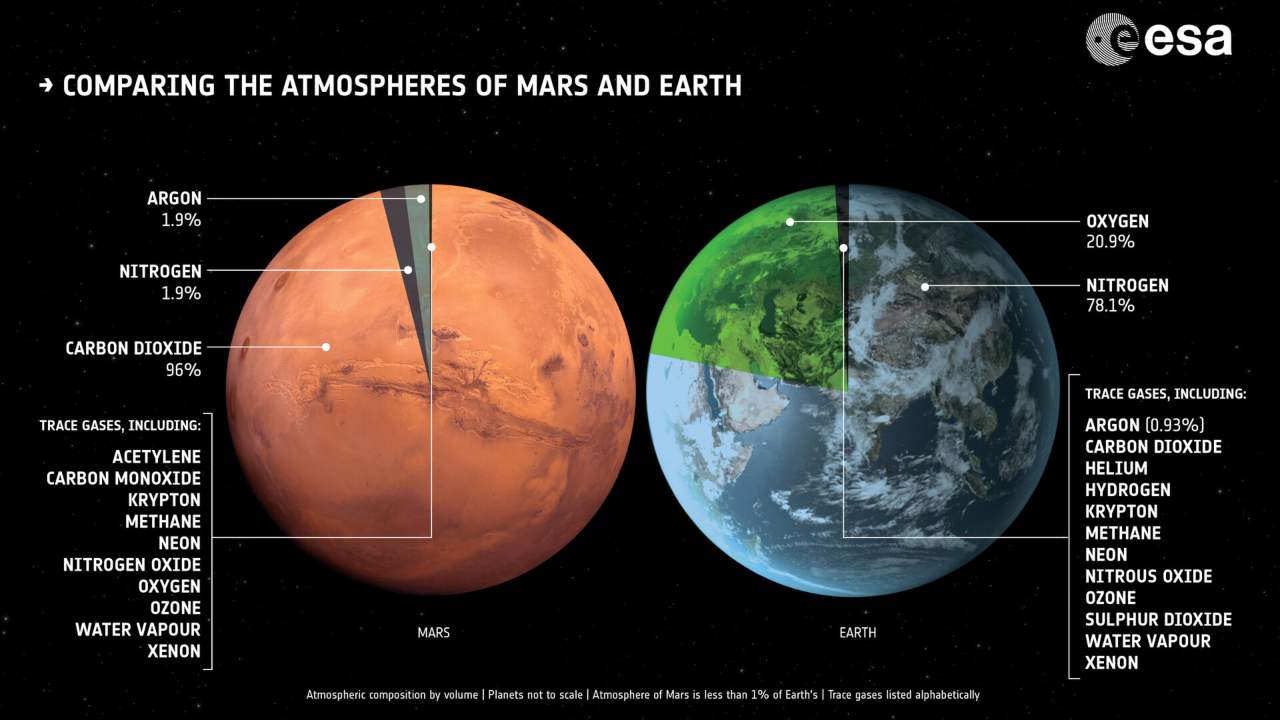
Comparing the atmospheres of Mars and Earth. Image: ESA[/caption]Snow was detected on the surface by the Phoenix lander in 2008, according to the Independent. But unlike on Earth, snow on Mars is formed by carbon dioxide. The thin atmosphere of Mars causes light clouds to form above the surface, while the clouds on Earth are mostly thick. The dust formed when space debris hits the atmosphere of the planet is also believed to be responsible for cloud formation.The Red Planet, considered an 'alternative' world that human beings may inhabit in the future, is half the size of Earth.
First Published:Mar 23, 2021, 16:06:55 IST
Advertisement
Advertisement

Careless Whispers: Scientists discover that plants can 'talk' to each other using smells
Japanese scientists have recorded a video that shows plants, in certain conditions, communicate with each other using mists that carry smells. The discovery, reveals that plants release a fine mist of airborne compounds, to warn nearby plants of potential dangers
Life on Mars? European Space Agency’s Orbiter discovers ice water deposits at equator
European Space Agency's Mars Express Orbiter has identified massive ice and ice water deposits beneath the surface of Mars. The Mars Express orbiter was also the first to confirmed the presence of ice on Mars in 2004
Microsoft briefly overtakes Apple as the most valuable company, Apple back on top again
At its peak during the session, Microsoft's value reached $2.903 trillion, with a 2% surge. As of writing this article, Apple closed at $2.89 trillion, whereas Microsoft closed at $2.86 trillion
Even NASA is facing a tough time, starts layoffs following major budget cuts
NASA is facing some massive budget cuts, because of which, it has been forced to postpone some upcoming missions. NASA's Jet Propulsion Laboratory has been hit hard by recent federal budget cuts, resulting in the layoff of 100 contractors last week
ISRO, NASA's NISAR satellite to get ready by Jan-end, will monitor Earth's snow-covered regions
The NISAR satellite which has been developed jointly ISRO and NASA, should be ready for launch by the end of January 2024. The collaboration between NASA and ISRO on NISAR is the first time the two agencies have cooperated on hardware development for an Earth-observing mission
Advertisement
Advertisement