


Corona of supermassive black hole seen disappearing, reappearing in a remarkable first
Changes in brightness usually seen over thousands to millions of years were seen taking place in under a year.

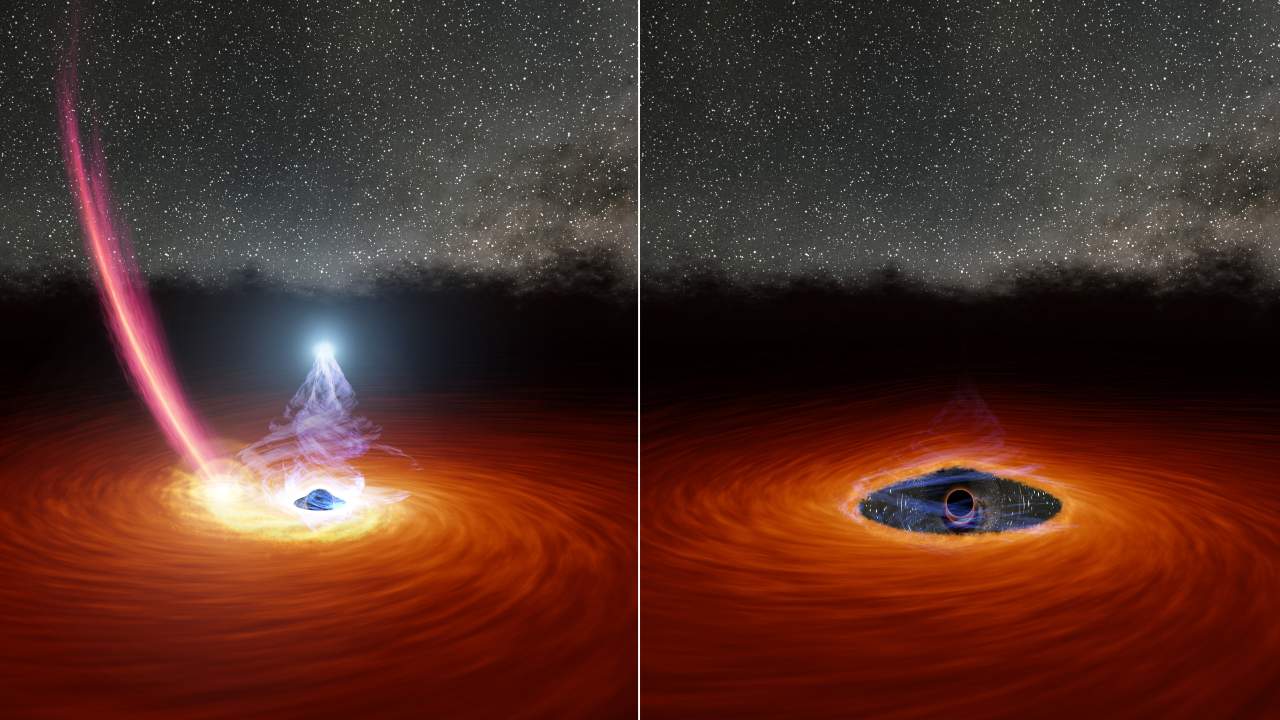
Astronomers at MIT and elsewhere watched a black hole’s corona disappear, then reappear, for first time. A colliding star may have triggered the drastic transformation. Image: NASA/JPL-Caltech/MIT[/caption]Erin Kara, assistant professor of physics at MIT, said that usually, changes in luminosity of this intensity are expected to occur over thousands to millions of years."But in this object, we saw it change by 10,000 over a year, and it even changed by a factor of 100 in eight hours, which is just totally unheard of and really mind-boggling,” a report by EurekAlert quoted Kara saying.The wayward star that fell into the supermassive black hole also might have disturbed the magnetic field lines of the black hole's accretion disk, according to the study authors. This disruption is likely why it could no longer support a high-energy corona.Following the corona's disappearance, astronomers reportedly continued watching the black hole as it began slowly pulling together materials from its outer edges to reform its swirling disk.The newly-formed disk then started to emit high-energy X-rays close to the black hole's event horizon, the MIT News report said. In a matter of months, the black hole was able to regenerate its corona.Researchers think the unusual event could offer the astrophysics community clue into how coronas form, and what is needed in a black hole to support one.The study's results were published in The Astrophysical Journal Letters.

Careless Whispers: Scientists discover that plants can 'talk' to each other using smells
Life on Mars? European Space Agency’s Orbiter discovers ice water deposits at equator
Microsoft briefly overtakes Apple as the most valuable company, Apple back on top again
Even NASA is facing a tough time, starts layoffs following major budget cuts
ISRO, NASA's NISAR satellite to get ready by Jan-end, will monitor Earth's snow-covered regions