


China's Tianwen-1 is currently parked in temporary orbit, waiting to land on Mars
A successful bid to land Tianwen-1 would make China only the second country after the US to place a spacecraft on Mars.

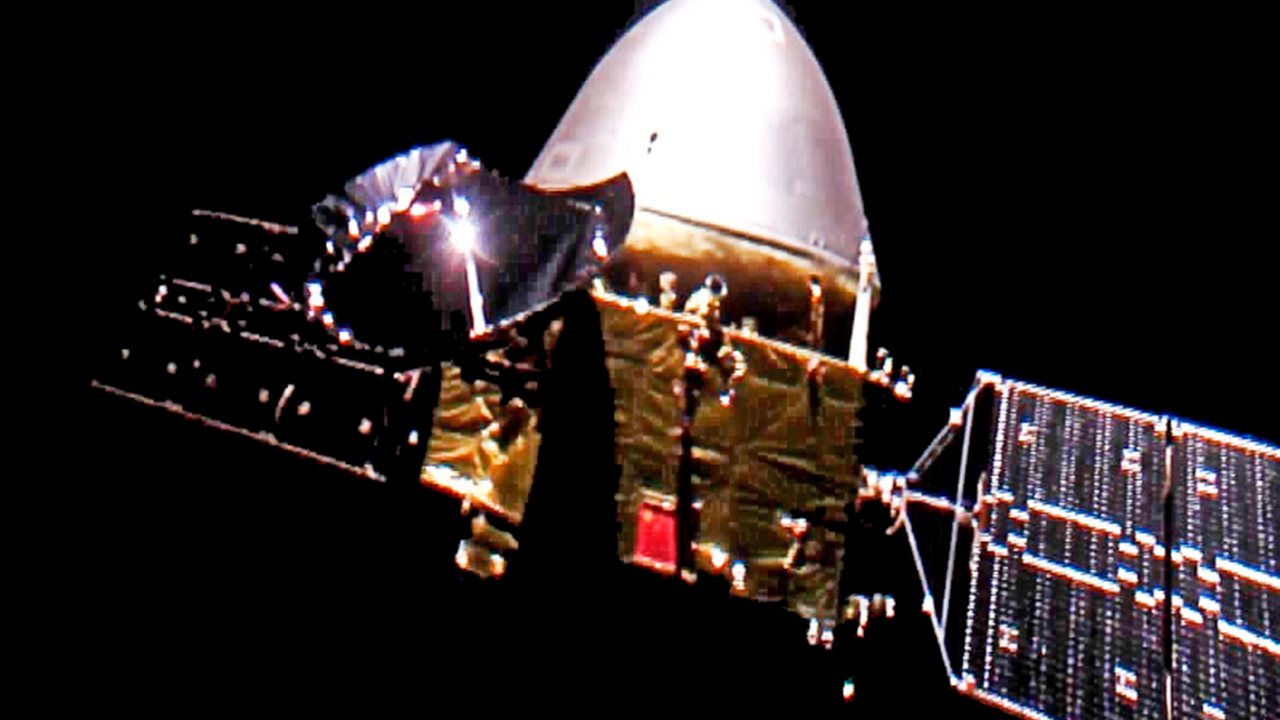
Tianwen is the title of an ancient poem that means “Quest for Heavenly Truth.” The solar-powered vehicle, about the size of a golf cart, will collect data on underground water and look for evidence that the planet may have once harboured microscopic life. Image credit: CNSA via AP)[/caption]A successful bid to land Tianwen-1 would make China only the second country after the US to place a spacecraft on Mars. China’s solar-powered vehicle, about the size of a golf cart, will collect data on underground water and look for evidence that the planet may have once harboured microscopic life.Tianwen, the title of an ancient poem, means “Quest for Heavenly Truth.”Landing a spacecraft on Mars is notoriously tricky. About a dozen orbiters missed the mark. In 2011, a Mars-bound Chinese orbiter that was part of a Russian mission didn’t make it out of Earth orbit.China’s attempt will involve a parachute, rocket firings and airbags. Its proposed landing site is a vast, rock-strewn plain called Utopia Planitia, where the U.S. Viking 2 lander touched down in 1976.Tianwen-1′s arrival at Mars on Feb. 10 was preceded by that of an orbiter from the United Arab Emirates. All three of the latest missions were launched in July to take advantage of the close alignment between Earth and Mars that happens only once every two years.Tianwen-1 represents the most ambitious mission yet for China’s secretive, military-linked space program that first put an astronaut in orbit around Earth in 2003 and last year brought moon rocks back to Earth for the first time since the 1970s. China was also the first country to land a spacecraft on the little-explored far side of the moon in 2019.China is also building a permanent space station and planning a crewed lunar mission and a possible permanent research base on the moon, though no dates have yet been proposed.On Monday, a massive Long March-5B Y2 rocket was moved into place at the Wenchang Spacecraft Launch Site in Hainan province for assembly and testing before it launches the space station’s core module, christened Tianhe. The launch is scheduled for the first half of this year, the first of 11 missions slated over the next two years for the station’s construction.China is not a participant in the International Space Station, partly at the insistence of the United States.The space program is a source of enormous national pride in China and Tianwen-1 has attracted a particularly strong following among the public. Tourists flocked to tropical Hainan island to watch the launch, while others visit mock Mars colonies in desert sites with white domes, airlocks and spacesuits.

Careless Whispers: Scientists discover that plants can 'talk' to each other using smells
Life on Mars? European Space Agency’s Orbiter discovers ice water deposits at equator
Microsoft briefly overtakes Apple as the most valuable company, Apple back on top again
Even NASA is facing a tough time, starts layoffs following major budget cuts
ISRO, NASA's NISAR satellite to get ready by Jan-end, will monitor Earth's snow-covered regions