


China defends rocket debris, says it's held to different standards than other countries
Hua Chunying said Beijing was being treated unfairly, the American media romanticises their launches and space debris free falls.

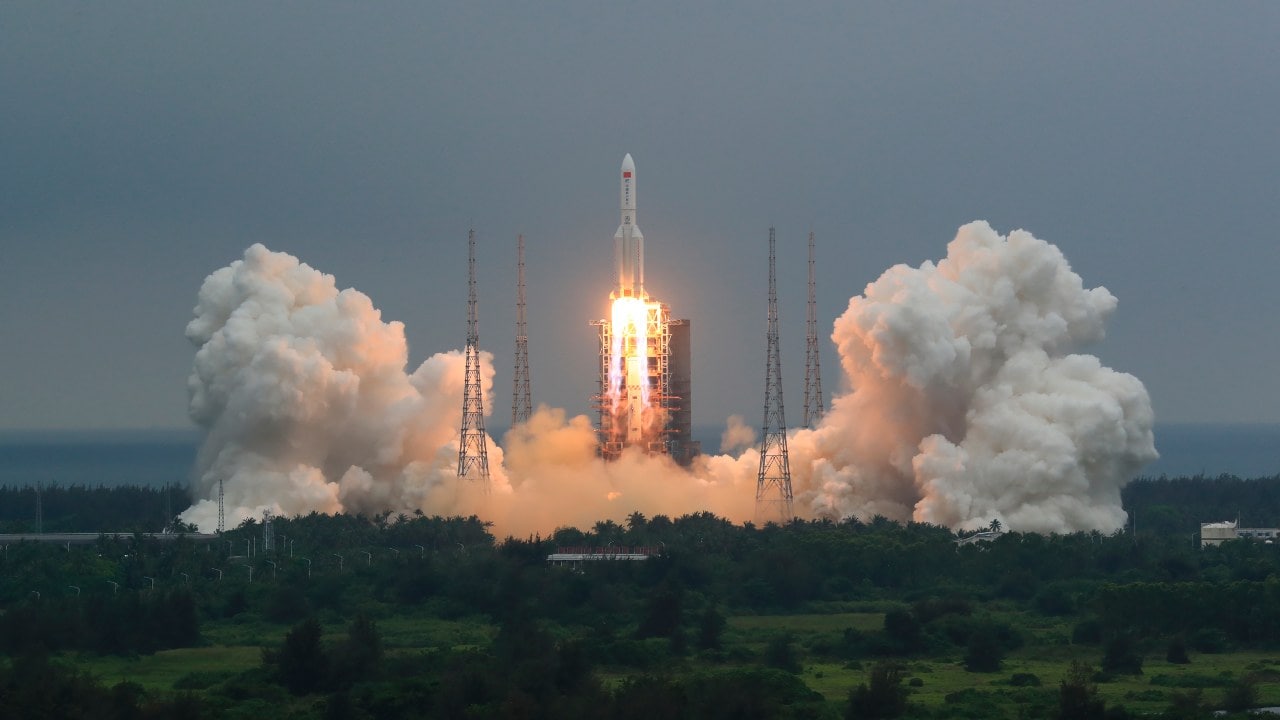
In this April 29, 2021, file photo released by China's Xinhua News Agency, a Long March 5B rocket carrying a module for a Chinese space station lifts off from the Wenchang Spacecraft Launch Site in Wenchang in southern China's Hainan Province. Image credit: Ju Zhenhua/Xinhua via AP,[/caption]“China has been closely tracking its trajectory and issued statements on the re-entry situation in advance,” Foreign Ministry spokesperson Hua Chunying said. “There has been no report of harm on the ground. China also shares the results of re-entry predictions through international cooperation mechanisms.”China’s official Xinhua News Agency later clarified that reentry occurred Sunday at 10:24 a.m. Beijing time. “The vast majority of items were burned beyond recognition during the reentry process," the report said.Hua, the Chinese spokesperson, complained that Beijing was being treated unfairly. She pointed to the reaction to debris from a rocket launched by US aerospace company SpaceX that fell to Earth in Washington and on the Oregon coast in March.“American media used romantic rhetoric like ‘shooting stars lighting up the night sky,’” she said. “But when it comes to the Chinese side, it’s a completely different approach.”“We are willing to work with other countries including the United States to strengthen cooperation in the use of outer space, but we also oppose double standards on this issue," Hua said.China's space agency also said that the core segment of its biggest rocket reentered Earth’s atmosphere above the Maldives in the Indian Ocean and that most of it burned up early Sunday.Harvard astrophysicist Jonathan McDowell, who tracked the tumbling rocket part, said on Twitter, “An ocean reentry was always statistically the most likely. It appears China won its gamble… But it was still reckless.”People in Jordan, Oman and Saudi Arabia reported sightings of the Chinese rocket debris on social media, with scores of users posting footage of the debris piercing the early dawn skies over the Middle East.The rocket carried the core module of the Tianhe, or Heavenly Harmony, space station into orbit on 29 April. China plans 10 more launches to complete the construction of the station.Usually, discarded rocket stages reenter the atmosphere soon after liftoff, normally over water, and don’t go into orbit. The roughly 30-meter (100-foot) long rocket stage is among the biggest space debris to fall to Earth. China's space program, with its close military links, hasn’t said why it put the main component of the rocket into space rather than allowing it to fall back to earth soon after discharging its payload, as is usual in such operations.
US reacts
NASA Administrator Bill Nelson accused China in a statement of “failing to meet responsible standards" in handling space debris.US Defense Secretary Lloyd Austin suggested last week that China had been negligent, and NASA Administrator Bill Nelson echoed that after the re-entry on Sunday."Spacefaring nations must minimize the risks to people and property on Earth of re-entries of space objects and maximize transparency regarding those operations," Nelson said in a statement."It is clear that China is failing to meet responsible standards regarding their space debris." With inputs from wires

Careless Whispers: Scientists discover that plants can 'talk' to each other using smells
Life on Mars? European Space Agency’s Orbiter discovers ice water deposits at equator
Microsoft briefly overtakes Apple as the most valuable company, Apple back on top again
Even NASA is facing a tough time, starts layoffs following major budget cuts
ISRO, NASA's NISAR satellite to get ready by Jan-end, will monitor Earth's snow-covered regions