
Advertisement


Sections
Chang'e-4: Yutu-2 lunar rover takes first samples of Moon's mantle from huge impact
The rocks were likely thrown upwards & released to the surface after the largest even lunar impact.

For the first time in mankind's history, a rover has taken samples from the Moon's mantle — an interior region of the Moon below its crust — that were likely thrown upwards and released to the surface during an ancient cosmic impact.The Yutu-2 rover, which landed on the Moon in January this year after hitching a ride aboard China's Chang'e-4 mission, spotted the seemingly-primitive material in a smaller crater within the South Pole-Aitken basin — the largest impact crater on the Moon, roughly 2500 kilometres across.The rover found minerals that were markedly different from what is typically found on the lunar surface, indicating that it was from a different layer, likely the Mantle below the SPA Basin floor.Also Read: Chang'e-4 relays first images after historic touchdown on Moon's far sideResearchers think the rock samples could help uncover details about the ocean of magma from the Moon's formative eons.[embed]https://www.lpi.usra.edu/exploration/training/resources/lunar-magma-ocean/Lunar-Magma-Ocean720.mp4[/embed]Like many of the other rocky bodies in the inner solar system, the Moon, too, was covered in an ocean of magma that was hundreds of kilometres deep for millions of it years after it was formed, past research has suggested. Earlier this month, researchers also found that the moon has shrunk 50 meters (and continues to shrink) as it gradually cools from its molten hot creation.Also Read: Shrinking Moon: Sporadic quakes from tectonic activity has left wrinkles on the MoonAs the ocean of magma cooled, some of the denser minerals like oxides of iron and magnesium would have crystallised at its base and the lighter minerals rich in aluminum or silicon would have risen up to the surface, giving the Moon its stunning, silica-studded glow.[caption id="attachment_5724851" align="alignnone" width="1280"]![Representational image.]()
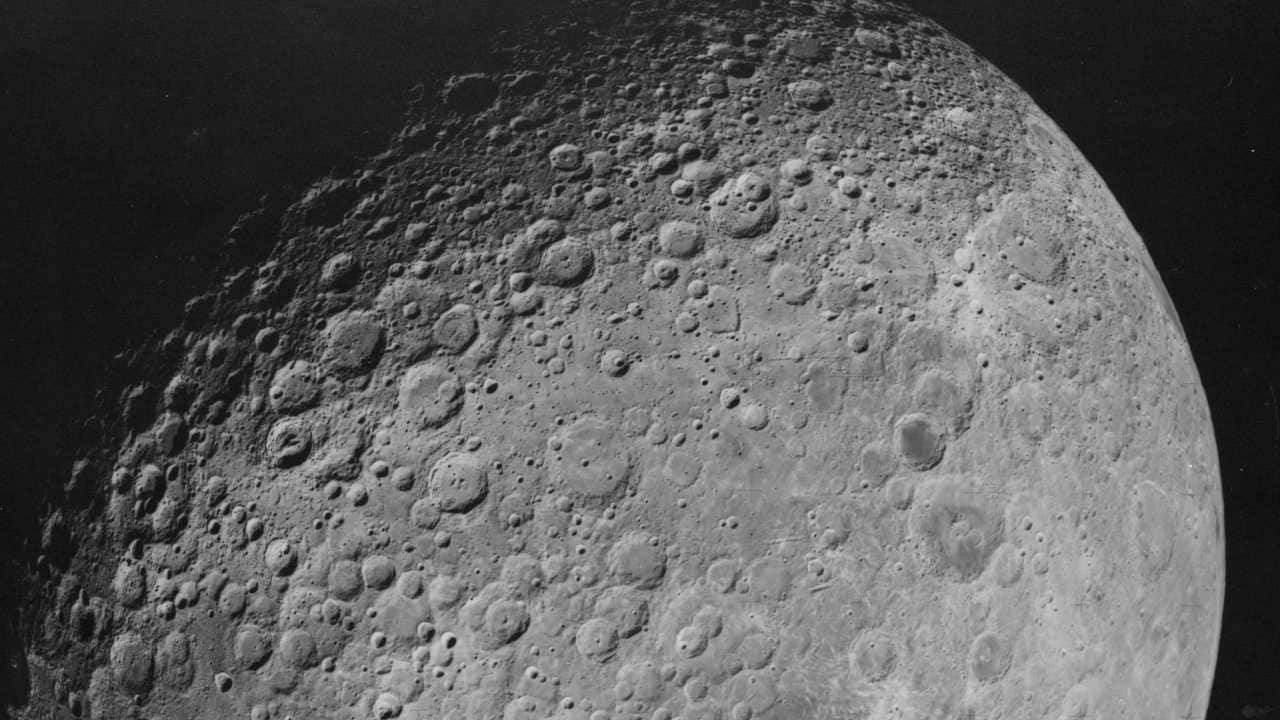
The Moon's breathtaking, beautiful surface is chronicled with meteorite impacts over its 4.6-billion-year-old history.[/caption]"The ultimate goal is to decipher the mystery of the lunar mantle composition," Chunlai Li from the Chinese Academy of Sciences in Beijing, told New Scientist. The rocks could be a useful tool to look into how the Moon and other rocky celestial bodies like the Earth have evolved — how its surfaces have changed so remarkably since then.The scientists have detailed their findings from the Yutu-2 rover in a recent paper published in Nature.
First Published:May 16, 2019, 11:02:44 IST
Advertisement
Advertisement

Careless Whispers: Scientists discover that plants can 'talk' to each other using smells
Japanese scientists have recorded a video that shows plants, in certain conditions, communicate with each other using mists that carry smells. The discovery, reveals that plants release a fine mist of airborne compounds, to warn nearby plants of potential dangers
Life on Mars? European Space Agency’s Orbiter discovers ice water deposits at equator
European Space Agency's Mars Express Orbiter has identified massive ice and ice water deposits beneath the surface of Mars. The Mars Express orbiter was also the first to confirmed the presence of ice on Mars in 2004
Microsoft briefly overtakes Apple as the most valuable company, Apple back on top again
At its peak during the session, Microsoft's value reached $2.903 trillion, with a 2% surge. As of writing this article, Apple closed at $2.89 trillion, whereas Microsoft closed at $2.86 trillion
Even NASA is facing a tough time, starts layoffs following major budget cuts
NASA is facing some massive budget cuts, because of which, it has been forced to postpone some upcoming missions. NASA's Jet Propulsion Laboratory has been hit hard by recent federal budget cuts, resulting in the layoff of 100 contractors last week
ISRO, NASA's NISAR satellite to get ready by Jan-end, will monitor Earth's snow-covered regions
The NISAR satellite which has been developed jointly ISRO and NASA, should be ready for launch by the end of January 2024. The collaboration between NASA and ISRO on NISAR is the first time the two agencies have cooperated on hardware development for an Earth-observing mission
Advertisement
Advertisement