
Advertisement


Sections
Chandrayaan 2's first image of the moon features iconic lunar landmarks, captured 2,650 km from the surface
Two of the most visible features in the photograph are the Mare Orientale basin and the Apollo craters.

India's second moon exploration mission Chandrayaan 2 has beamed back the first images taken from the moon's orbit, the Indian Space Research Organisation announced in a tweet Thursday. The image was captured by Chandrayaan 2 at an altitude of 2650 kilometres from the moon's surface on 21 August. Two of the most visible features in the frame are the Mare Orientale basin and the Apollo craters.The image was captured by the LI-4 camera on Chandrayaan 2 at 7.03 pm IST, as per ISRO's website. "Take a look at the first Moon image captured by #Chandrayaan2 #VikramLander taken at a height of about 2650 km from Lunar surface on August 21, 2019," ISRO's tweet read.[caption id="attachment_7211521" align="alignnone" width="1280"]![First photo of the moon from Chandrayaan 2. Image: ISRO]() First photo of the moon from Chandrayaan 2 shows the Mare Orientale basin in the top right-of-centre, and the Apollo crater in the centre-right of the image. Image: ISRO[/caption]Chandrayaan 2 successfully completed its first orbital manoeuvre in lunar orbit on 20 August. This critical manoeuvre is one of four similar "retrofirings" of the onboard propulsion system that are meant to lower the spacecraft's orbit (thereby also reducing its speed) till the spacecraft is in a 100 x 100 km (nearest x farthest altitude in orbit) circular orbit around the moon. Currently, it is in an elliptical orbit of 114 x 4,412 km (nearest x farthest altitude in orbit).[caption id="attachment_7161011" align="alignnone" width="1142"]
First photo of the moon from Chandrayaan 2 shows the Mare Orientale basin in the top right-of-centre, and the Apollo crater in the centre-right of the image. Image: ISRO[/caption]Chandrayaan 2 successfully completed its first orbital manoeuvre in lunar orbit on 20 August. This critical manoeuvre is one of four similar "retrofirings" of the onboard propulsion system that are meant to lower the spacecraft's orbit (thereby also reducing its speed) till the spacecraft is in a 100 x 100 km (nearest x farthest altitude in orbit) circular orbit around the moon. Currently, it is in an elliptical orbit of 114 x 4,412 km (nearest x farthest altitude in orbit).[caption id="attachment_7161011" align="alignnone" width="1142"]![Orbit-raising diagram for the Chandrayaan 2 misson. Image: ISRO]() Orbit-raising diagram for the Chandrayaan 2 misson. Image: ISRO[/caption]Chandrayaan 2 entered lunar orbit on Tuesday, 20 August after a roughly 6-week sojourn form liftoff. Between the current stage and the spacecraft attaining its 100 km-orbit (slated for 1 September), the spacecraft's three components will be travelling together. After a few circular orbits at 100 x 100 km, the Vikram lander is expected to separate from the orbiter, on 2 September.The Vikram lander is expected to make its long-awaited powered descent and landing on 7 September at 1.55 am IST, in what the ISRO Chief describes as '15 minutes of terror'.
Orbit-raising diagram for the Chandrayaan 2 misson. Image: ISRO[/caption]Chandrayaan 2 entered lunar orbit on Tuesday, 20 August after a roughly 6-week sojourn form liftoff. Between the current stage and the spacecraft attaining its 100 km-orbit (slated for 1 September), the spacecraft's three components will be travelling together. After a few circular orbits at 100 x 100 km, the Vikram lander is expected to separate from the orbiter, on 2 September.The Vikram lander is expected to make its long-awaited powered descent and landing on 7 September at 1.55 am IST, in what the ISRO Chief describes as '15 minutes of terror'.
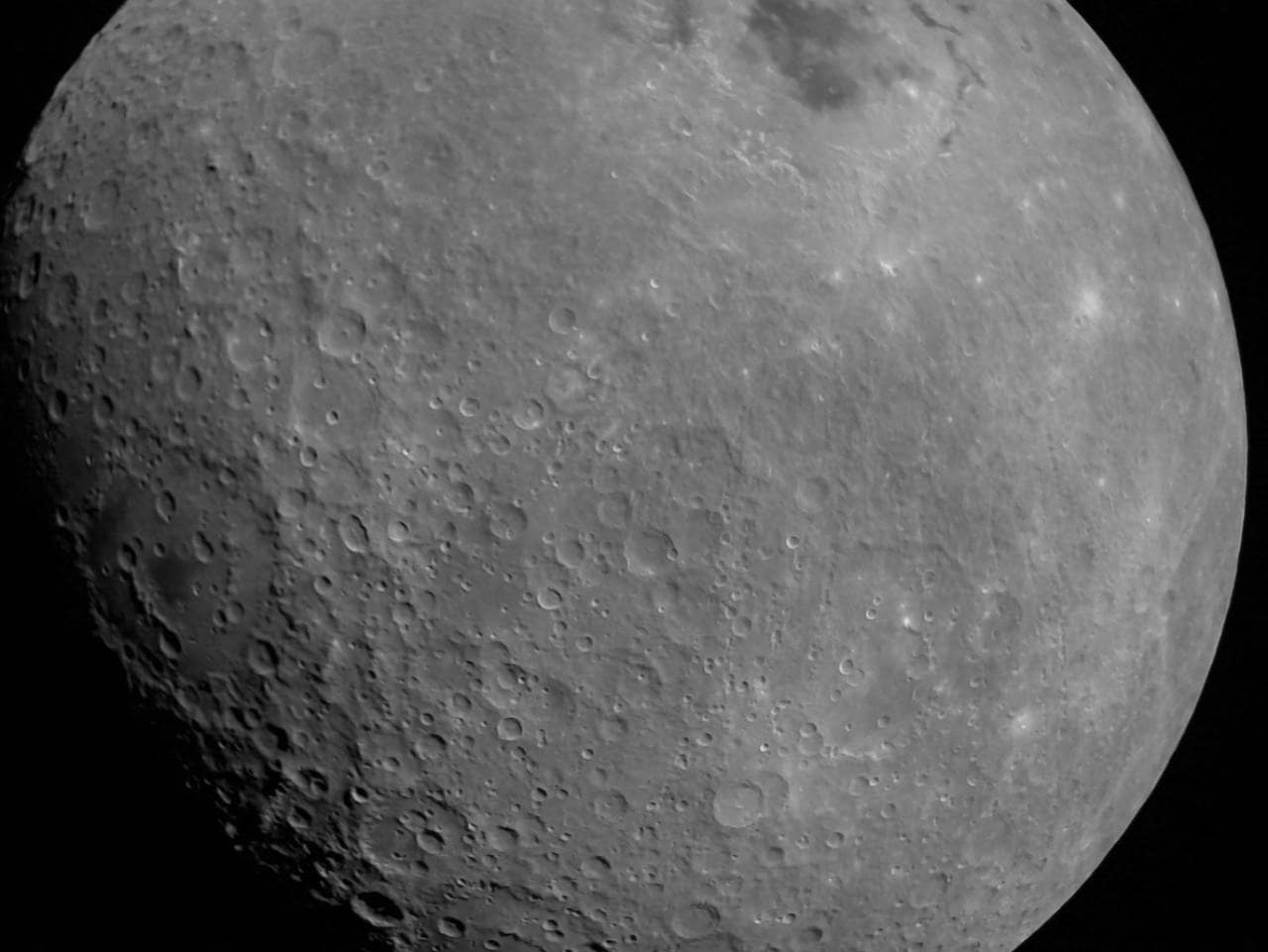 First photo of the moon from Chandrayaan 2 shows the Mare Orientale basin in the top right-of-centre, and the Apollo crater in the centre-right of the image. Image: ISRO[/caption]Chandrayaan 2 successfully completed its first orbital manoeuvre in lunar orbit on 20 August. This critical manoeuvre is one of four similar "retrofirings" of the onboard propulsion system that are meant to lower the spacecraft's orbit (thereby also reducing its speed) till the spacecraft is in a 100 x 100 km (nearest x farthest altitude in orbit) circular orbit around the moon. Currently, it is in an elliptical orbit of 114 x 4,412 km (nearest x farthest altitude in orbit).[caption id="attachment_7161011" align="alignnone" width="1142"]
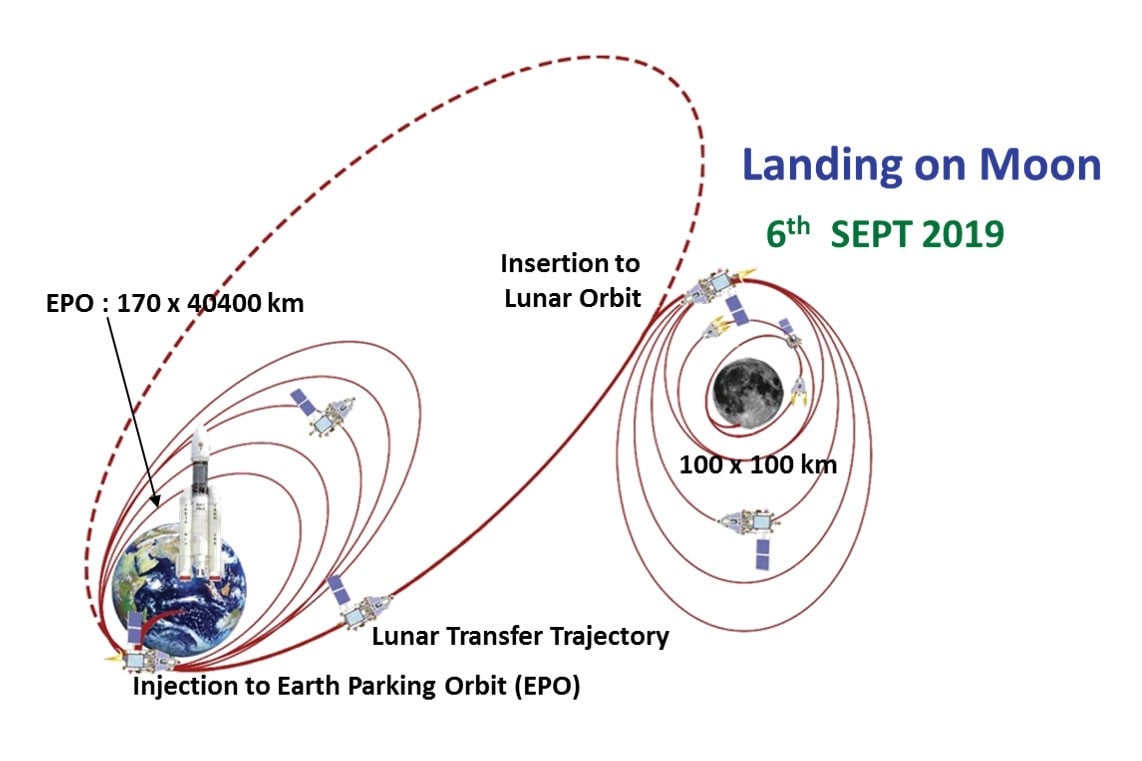 Orbit-raising diagram for the Chandrayaan 2 misson. Image: ISRO[/caption]Chandrayaan 2 entered lunar orbit on Tuesday, 20 August after a roughly 6-week sojourn form liftoff. Between the current stage and the spacecraft attaining its 100 km-orbit (slated for 1 September), the spacecraft's three components will be travelling together. After a few circular orbits at 100 x 100 km, the Vikram lander is expected to separate from the orbiter, on 2 September.The Vikram lander is expected to make its long-awaited powered descent and landing on 7 September at 1.55 am IST, in what the ISRO Chief describes as '15 minutes of terror'.
First Published:Aug 23, 2019, 07:58:21 IST
Advertisement
Advertisement

Careless Whispers: Scientists discover that plants can 'talk' to each other using smells
Japanese scientists have recorded a video that shows plants, in certain conditions, communicate with each other using mists that carry smells. The discovery, reveals that plants release a fine mist of airborne compounds, to warn nearby plants of potential dangers
Life on Mars? European Space Agency’s Orbiter discovers ice water deposits at equator
European Space Agency's Mars Express Orbiter has identified massive ice and ice water deposits beneath the surface of Mars. The Mars Express orbiter was also the first to confirmed the presence of ice on Mars in 2004
Microsoft briefly overtakes Apple as the most valuable company, Apple back on top again
At its peak during the session, Microsoft's value reached $2.903 trillion, with a 2% surge. As of writing this article, Apple closed at $2.89 trillion, whereas Microsoft closed at $2.86 trillion
Even NASA is facing a tough time, starts layoffs following major budget cuts
NASA is facing some massive budget cuts, because of which, it has been forced to postpone some upcoming missions. NASA's Jet Propulsion Laboratory has been hit hard by recent federal budget cuts, resulting in the layoff of 100 contractors last week
ISRO, NASA's NISAR satellite to get ready by Jan-end, will monitor Earth's snow-covered regions
The NISAR satellite which has been developed jointly ISRO and NASA, should be ready for launch by the end of January 2024. The collaboration between NASA and ISRO on NISAR is the first time the two agencies have cooperated on hardware development for an Earth-observing mission
Advertisement
Advertisement