


Chandrayaan-2 to carry a total of 13 payloads including one from NASA, confirms ISRO
Chandrayaan-2 is expected to launch between 9-16 July, with an expected Moon landing on 6 September.

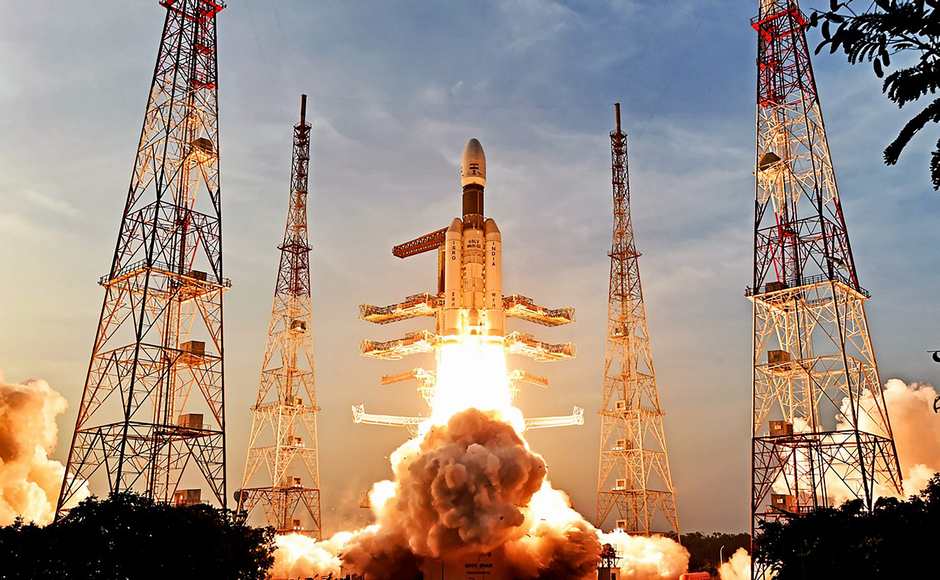
ISRO's Geosynchronous Satellite Launch Vehicle Mark III. Image: PTI[/caption]The orbiter will orbit 100 km from the lunar surface, while the lander (Vikram) will do a soft landing near the south pole of the moon, and Rover (Pragyan) will conduct in-situ experiments.The orbiter and lander modules will be interfaced mechanically and stacked together as an integrated module and accommodated inside the GSLV MK-III launch vehicle, ISRO has said, adding the rover is housed inside the lander.After launch into earth-bound orbit by GSLV MK-III, the integrated module will reach Moon orbit using orbiter propulsion module, and subsequently, lander will separate from the orbiter and soft land at the predetermined site close to lunar South Pole.
Further, the rover will roll out for carrying out scientific experiments on the lunar surface, ISRO has said, noting that instruments are also mounted on lander and orbiter for carrying out scientific experiments.ISRO Chairman K Sivan had said in January, "We are going to land at a place where nobody else has gone-the Moon's South Pole... it is unexplored region."Chandrayaan-2 mission, is an advanced version of the previous Chandrayaan-1 mission about 10 years ago.Chandrayaan-1 had 11 payloads- five from India, three from Europe, 2 from USA and 1 from Bulgaria, and the mission had the credit for discovery of water on the lunar surface.The 1.4-tonne spacecraft was launched using PSLV and the orbiter had orbited 100 km from the lunar surface.
Careless Whispers: Scientists discover that plants can 'talk' to each other using smells
Life on Mars? European Space Agency’s Orbiter discovers ice water deposits at equator
Microsoft briefly overtakes Apple as the most valuable company, Apple back on top again
Even NASA is facing a tough time, starts layoffs following major budget cuts
ISRO, NASA's NISAR satellite to get ready by Jan-end, will monitor Earth's snow-covered regions