
Advertisement


Sections
Chandrayaan 2: Orbiter insturments study Argon 40 levels in moon's exosphere for the first time
Also referred to as a 'gas held prisoner by lava', Argon 40 can be used to date lava flow that is between a million and billion years old.

From an altitude of roughly 100 kilometres, the Chandrayaan 2 mission's orbiter has detected Argon-40 in the gaseous envelope around the moon, the Indian Space Research Organisation (ISRO) announced on Thursday. A specialised instrument on the orbiter, the Chandra's Atmospheric Composition Explorer-2 (CHACE-2), made the finding during a study of the thin lunar exosphere, its composition, and distribution."The CHACE-2 payload aboard the Chandrayaan-2 orbiter has detected Argon-40 from an altitude of approximately 100 kilometres," ISRO said in a tweet.The gas envelope around the Moon known as the 'lunar exosphere' is tenuous, with weak forces and the gas atoms in it rarely colliding with each other. On Earth, the atmosphere near (the mean) sea level has ~10^19 atoms every cubic centimetre of volume. The lunar exosphere, however, has ~ 10^4 to 10^6 atoms per cubic centimetre.[caption id="attachment_7608901" align="alignnone" width="1280"]![Argon 40 detected by Chandrayaan orbiter's CHASE 2 instrument in the lunar exosphere. Image: ISRO]() Argon 40 detected by Chandrayaan orbiter's CHASE-2 instrument in the lunar exosphere. Image: ISRO[/caption]Argon 40 is an isotope, belonging to the class of unreactive, inert gases dubbed 'noble gas'. Argon is also an important component in the lunar exosphere. Sometimes referred to as a "gas held prisoner by lava", Argon 40 can be used to date lava flows whose age is between a million and a billion years. It originates from the radioactive disintegration of Potassium-40 (K 40).The radioactive K 40 atom, which is present deep below the lunar surface, disintegrates to 40Ar, which, in turn, diffuses through the intergranular space and makes way up to the lunar exosphere through seepages and faults.
[caption id="attachment_7516651" align="alignnone" width="1280"]
Argon 40 detected by Chandrayaan orbiter's CHASE-2 instrument in the lunar exosphere. Image: ISRO[/caption]Argon 40 is an isotope, belonging to the class of unreactive, inert gases dubbed 'noble gas'. Argon is also an important component in the lunar exosphere. Sometimes referred to as a "gas held prisoner by lava", Argon 40 can be used to date lava flows whose age is between a million and a billion years. It originates from the radioactive disintegration of Potassium-40 (K 40).The radioactive K 40 atom, which is present deep below the lunar surface, disintegrates to 40Ar, which, in turn, diffuses through the intergranular space and makes way up to the lunar exosphere through seepages and faults.
[caption id="attachment_7516651" align="alignnone" width="1280"]![First images and data gathered by the IIRS instrument on Chandrayaan 2.]() First images and data gathered by the IIRS instrument on Chandrayaan 2. Image: ISRO[/caption]The image below is to look at the northern hemisphere that shows several craters including Sommerfield, Kirkwood, and Stebbins. ISRO also carried out a preliminary analysis, it was established that the IIRS was able to measure the variations in the reflected solar radiation that bounces off the lunar surface from different kinds of surface types. This includes central peaks on craters, crater floors, and also the sun-illuminated inner rims of craters.After an uncomfortably long silence, the Indian Space Research Organisation (ISRO) had released images and the first scientific data from the Chandrayaan 2 mission, which is survived by the Orbiter. Captured by the Orbiter's High-Resolution Camera (OHRC) from an altitude of ~100 km, ISRO shared that the images are the highest resolution visuals ever taken of the Moon.The mission's lander Vikram and rover Pragyan, which crash-landed on the Moon during a soft-landing attempt on 7 September, continue to be incommunicado with ISRO.
First images and data gathered by the IIRS instrument on Chandrayaan 2. Image: ISRO[/caption]The image below is to look at the northern hemisphere that shows several craters including Sommerfield, Kirkwood, and Stebbins. ISRO also carried out a preliminary analysis, it was established that the IIRS was able to measure the variations in the reflected solar radiation that bounces off the lunar surface from different kinds of surface types. This includes central peaks on craters, crater floors, and also the sun-illuminated inner rims of craters.After an uncomfortably long silence, the Indian Space Research Organisation (ISRO) had released images and the first scientific data from the Chandrayaan 2 mission, which is survived by the Orbiter. Captured by the Orbiter's High-Resolution Camera (OHRC) from an altitude of ~100 km, ISRO shared that the images are the highest resolution visuals ever taken of the Moon.The mission's lander Vikram and rover Pragyan, which crash-landed on the Moon during a soft-landing attempt on 7 September, continue to be incommunicado with ISRO.
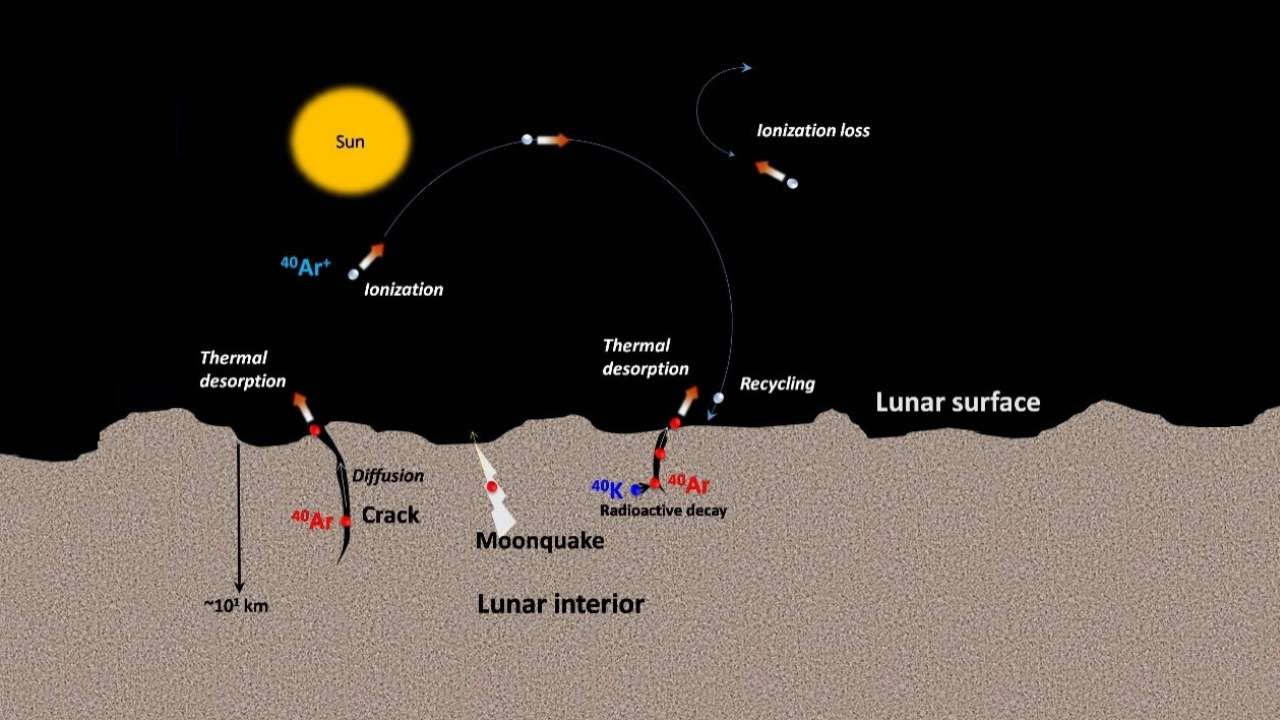 Argon 40 detected by Chandrayaan orbiter's CHASE-2 instrument in the lunar exosphere. Image: ISRO[/caption]Argon 40 is an isotope, belonging to the class of unreactive, inert gases dubbed 'noble gas'. Argon is also an important component in the lunar exosphere. Sometimes referred to as a "gas held prisoner by lava", Argon 40 can be used to date lava flows whose age is between a million and a billion years. It originates from the radioactive disintegration of Potassium-40 (K 40).The radioactive K 40 atom, which is present deep below the lunar surface, disintegrates to 40Ar, which, in turn, diffuses through the intergranular space and makes way up to the lunar exosphere through seepages and faults.
Also Read
#ISRO
 First images and data gathered by the IIRS instrument on Chandrayaan 2. Image: ISRO[/caption]The image below is to look at the northern hemisphere that shows several craters including Sommerfield, Kirkwood, and Stebbins. ISRO also carried out a preliminary analysis, it was established that the IIRS was able to measure the variations in the reflected solar radiation that bounces off the lunar surface from different kinds of surface types. This includes central peaks on craters, crater floors, and also the sun-illuminated inner rims of craters.After an uncomfortably long silence, the Indian Space Research Organisation (ISRO) had released images and the first scientific data from the Chandrayaan 2 mission, which is survived by the Orbiter. Captured by the Orbiter's High-Resolution Camera (OHRC) from an altitude of ~100 km, ISRO shared that the images are the highest resolution visuals ever taken of the Moon.The mission's lander Vikram and rover Pragyan, which crash-landed on the Moon during a soft-landing attempt on 7 September, continue to be incommunicado with ISRO.
First Published:Nov 06, 2019, 10:47:05 IST
Advertisement
Advertisement

Careless Whispers: Scientists discover that plants can 'talk' to each other using smells
Japanese scientists have recorded a video that shows plants, in certain conditions, communicate with each other using mists that carry smells. The discovery, reveals that plants release a fine mist of airborne compounds, to warn nearby plants of potential dangers
Life on Mars? European Space Agency’s Orbiter discovers ice water deposits at equator
European Space Agency's Mars Express Orbiter has identified massive ice and ice water deposits beneath the surface of Mars. The Mars Express orbiter was also the first to confirmed the presence of ice on Mars in 2004
Microsoft briefly overtakes Apple as the most valuable company, Apple back on top again
At its peak during the session, Microsoft's value reached $2.903 trillion, with a 2% surge. As of writing this article, Apple closed at $2.89 trillion, whereas Microsoft closed at $2.86 trillion
Even NASA is facing a tough time, starts layoffs following major budget cuts
NASA is facing some massive budget cuts, because of which, it has been forced to postpone some upcoming missions. NASA's Jet Propulsion Laboratory has been hit hard by recent federal budget cuts, resulting in the layoff of 100 contractors last week
ISRO, NASA's NISAR satellite to get ready by Jan-end, will monitor Earth's snow-covered regions
The NISAR satellite which has been developed jointly ISRO and NASA, should be ready for launch by the end of January 2024. The collaboration between NASA and ISRO on NISAR is the first time the two agencies have cooperated on hardware development for an Earth-observing mission
Advertisement
Advertisement