
Advertisement


Sections
Chandrayaan 2 hours away from lander, orbiter separation, expected by 1.45 pm today
If successful, the Vikram lander will be put on a separate, circular path identical to the orbiter.

Chandrayaan 2 — ISRO's second moon mission — completed its final orbit-lowering manoeuvre yesterday (1 September) evening. Now, the next step is the separation of the landing module (the Vikram lander with the Pragyan rover inside it), which is scheduled for today (2 September) between 12.45 and 1.45 pm IST.If successful, the Vikram lander will then be put on a separate, circular path identical to the orbiter, passing over the lunar poles at a distance of roughly 100 km from the surface.By attaining a near-circular orbit, there are only three more mission milestones before the Vikram lander attempts its planned soft-landing on the moon's surface on 7 September at 1.55 am IST. This includes two deorbit (orbit-lowering) manoeuvres on 3 and 4 September and its powered descent from an elliptical orbit of 36 x 110 km between 1.30-2.30 am on 7 September.[caption id="attachment_7200881" align="alignnone" width="1280"]![Chandrayaan 2 composite orbiting the moon before the lander's separation. Image: ISRO]() Chandrayaan 2 composite orbiting the moon before the lander's separation. Image: ISRO[/caption]Over the course of the next few days, the first maps of the landing site will be created (planned for 3 and 4 September) by the Vikram lander to ensure the landing site is safe, as previously thought, to make a soft-landing. This is a crucial step in the mission since ISRO's mission engineers won't be operating the spacecraft remotely from the control centre.The orbiter will also be surveilling its year-long home for the first time, ensuring that no damage was caused to its instruments on the journey so far and conducting a thorough examination of the Vikram lander's landing site at the moon's South Polar region.While subsequent events in the mission won't be streamed live, you can catch live updates on the mission on our dedicated Chandrayaan 2 domain, our Twitter page, ISRO's website, or Twitter page.
Chandrayaan 2 composite orbiting the moon before the lander's separation. Image: ISRO[/caption]Over the course of the next few days, the first maps of the landing site will be created (planned for 3 and 4 September) by the Vikram lander to ensure the landing site is safe, as previously thought, to make a soft-landing. This is a crucial step in the mission since ISRO's mission engineers won't be operating the spacecraft remotely from the control centre.The orbiter will also be surveilling its year-long home for the first time, ensuring that no damage was caused to its instruments on the journey so far and conducting a thorough examination of the Vikram lander's landing site at the moon's South Polar region.While subsequent events in the mission won't be streamed live, you can catch live updates on the mission on our dedicated Chandrayaan 2 domain, our Twitter page, ISRO's website, or Twitter page.
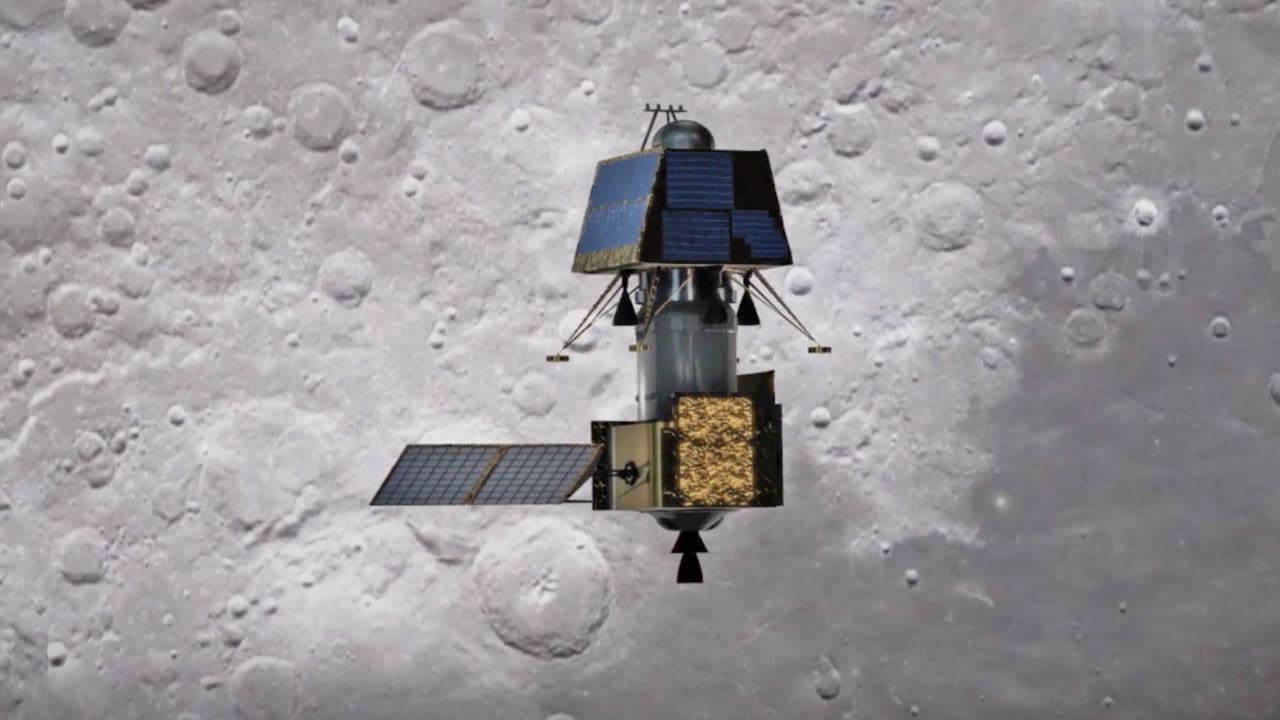 Chandrayaan 2 composite orbiting the moon before the lander's separation. Image: ISRO[/caption]Over the course of the next few days, the first maps of the landing site will be created (planned for 3 and 4 September) by the Vikram lander to ensure the landing site is safe, as previously thought, to make a soft-landing. This is a crucial step in the mission since ISRO's mission engineers won't be operating the spacecraft remotely from the control centre.
Tags
First Published:Sep 02, 2019, 10:42:06 IST
Advertisement
Advertisement

Careless Whispers: Scientists discover that plants can 'talk' to each other using smells
Japanese scientists have recorded a video that shows plants, in certain conditions, communicate with each other using mists that carry smells. The discovery, reveals that plants release a fine mist of airborne compounds, to warn nearby plants of potential dangers
Life on Mars? European Space Agency’s Orbiter discovers ice water deposits at equator
European Space Agency's Mars Express Orbiter has identified massive ice and ice water deposits beneath the surface of Mars. The Mars Express orbiter was also the first to confirmed the presence of ice on Mars in 2004
Microsoft briefly overtakes Apple as the most valuable company, Apple back on top again
At its peak during the session, Microsoft's value reached $2.903 trillion, with a 2% surge. As of writing this article, Apple closed at $2.89 trillion, whereas Microsoft closed at $2.86 trillion
Even NASA is facing a tough time, starts layoffs following major budget cuts
NASA is facing some massive budget cuts, because of which, it has been forced to postpone some upcoming missions. NASA's Jet Propulsion Laboratory has been hit hard by recent federal budget cuts, resulting in the layoff of 100 contractors last week
ISRO, NASA's NISAR satellite to get ready by Jan-end, will monitor Earth's snow-covered regions
The NISAR satellite which has been developed jointly ISRO and NASA, should be ready for launch by the end of January 2024. The collaboration between NASA and ISRO on NISAR is the first time the two agencies have cooperated on hardware development for an Earth-observing mission
Advertisement
Advertisement