
Advertisement


Sections
Breakthrough? IISc physicists may have just discovered a room temperature superconductor
If verified, the finding is among the biggest physics discoveries to have ever come out of India.

A pair of Indian scientists may have just discovered the first superconductor material that works at room temperature. Their finding – which is currently surrounded by controversy – comes ten months after they were admonished by their peers because of a lack of evidence to support their findings.The Indian Institute of Science (IISc), Bengaluru researchers have pre-published their research for review in arXiv, with the backing of eight more researchers and plenty more evidence a second time, and the final verdict is still weeks away.[caption id="attachment_6710281" align="alignnone" width="1280"]![A superconductor exhibiting magnetic levitation. Image: Wikimedia Commons]()
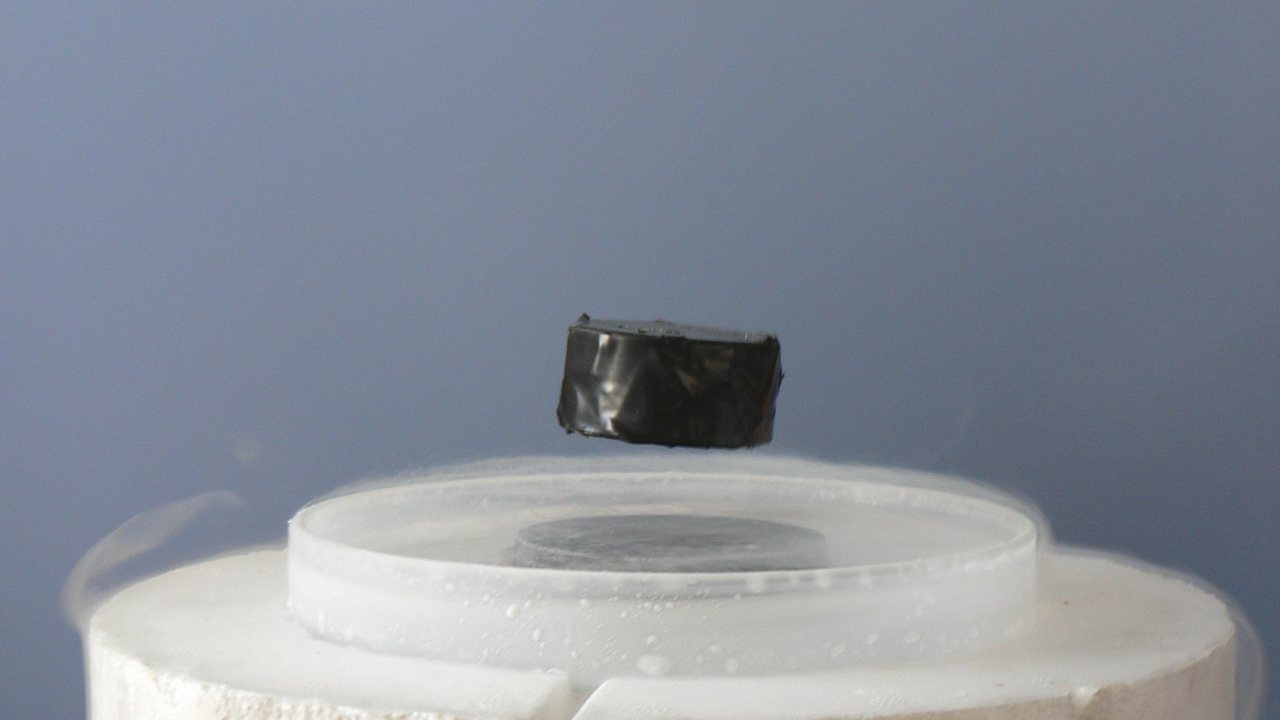
A superconductor exhibiting magnetic levitation. Image: Wikimedia Commons[/caption]
Superconductors aren't new
Superconductors are material that can conduct electricity with zero to negligible resistance and loss of energy. This essentially means that any device made using superconductors will be more efficient and have larger savings in cost and energy than the conductors used today.So far, all the superconductors in use work only at artificial, sub-zero temperatures. This makes regular superconductors not just expensive, but also impractical and essentially useless for use on a larger scale.The pair of IISC scientists that came out with the new research studied nanostructured materials as potential superconductors. When seen under a microscope, nanomaterials have a structure that is only a few nanometers (nm) is size, typically under 10 nanometres. The researchers used nanomaterial in the form of pellets and films made from silver particles that are embedded into matrix of gold atoms. This material, as it turns out, is a "superconducter" of electricity at ambient or room temperature.A breakthrough in physics
Regular, sub-zero superconductors are very useful today in research and medicine. In MRI machines, massive coils made from superconducting material are used to generate a powerful magnetic field, which makes tiny molecules visible in body scans.If the study's findings are verified and found to be true, room-temperature superconductivity could be very beneficial in more ways that one. It could make technology like magnetic-levitation trains more cost-effective and regular appliances like refrigerators and electronics a lot more energy-efficient.The controversy
The reason the study came under fire when first published in 2018 was a pattern of "noise" that appeared in their data. All experiments have some degree (even if negligible) of noise, which is discounted if the data largely support what the research claims. But in the case of the current study, the noise also appeared in controls (the set-up for the experiment itself). The researchers argue that the noise appeared randomly, and was nearly impossible to duplicate by changing a parameter here and there.A physicist from the Massachusetts Institute of Technology in Boston, Dr Brian Skinner, picked up on this pattern of noise, which repeats in the present paper as well and the 2018 paper. Skinner took to Twitter with his comments, which later drew a lot of attention from the physics community, including the researchers themselves.The researchers stand by their claim that the noise was of an unknown origin and without any explanation. (There's also an enormous amount of drama involving support, criticism and some questionable actions by Indian physicists, all of which have been neatly summarized by Skinner in his 53-part, 10-month long Twitter thread.)While they previously used 33 silver-gold units in their sample size in the earlier trials, they remedied that small size with 128 in the current study and discovered the "vanishing resistance" (superconductivity) at room temperature in a just ten of the 128 samples.The claims made by the researchers are being verified by peers in the science community. For now, suffice it to say that the discussion on the possibility of a superconductor at room temperature will continue for a few weeks.In the meanwhile, all that's left to answer is this: did two Indian physicists just make one of the biggest physics discoveries to have ever come out of India, or didn't they?First Published:May 27, 2019, 20:50:40 IST
Advertisement
Advertisement

Careless Whispers: Scientists discover that plants can 'talk' to each other using smells
Japanese scientists have recorded a video that shows plants, in certain conditions, communicate with each other using mists that carry smells. The discovery, reveals that plants release a fine mist of airborne compounds, to warn nearby plants of potential dangers
Life on Mars? European Space Agency’s Orbiter discovers ice water deposits at equator
European Space Agency's Mars Express Orbiter has identified massive ice and ice water deposits beneath the surface of Mars. The Mars Express orbiter was also the first to confirmed the presence of ice on Mars in 2004
Microsoft briefly overtakes Apple as the most valuable company, Apple back on top again
At its peak during the session, Microsoft's value reached $2.903 trillion, with a 2% surge. As of writing this article, Apple closed at $2.89 trillion, whereas Microsoft closed at $2.86 trillion
Even NASA is facing a tough time, starts layoffs following major budget cuts
NASA is facing some massive budget cuts, because of which, it has been forced to postpone some upcoming missions. NASA's Jet Propulsion Laboratory has been hit hard by recent federal budget cuts, resulting in the layoff of 100 contractors last week
ISRO, NASA's NISAR satellite to get ready by Jan-end, will monitor Earth's snow-covered regions
The NISAR satellite which has been developed jointly ISRO and NASA, should be ready for launch by the end of January 2024. The collaboration between NASA and ISRO on NISAR is the first time the two agencies have cooperated on hardware development for an Earth-observing mission
Advertisement
Advertisement