
Advertisement


Sections
Blood Moon 2018: Century's longest total lunar eclipse to be seen on 27-28 July
The eclipse, which will last one hour and 43 minutes, will also feature a "blood moon"

Stargazers — and even those excited about their new telephoto lenses — unite!Next month, the world will witness the longest total lunar eclipse of the 21st century, according to reports. The eclipse, which will last one hour and 43 minutes, will also feature a "blood moon" — which is a non-scientific term used to refer to the red tinge on a fully eclipsed Moon.The event on the intervening night between 27 and 28 July will also outlast the Super Blue Blood Moon that occurred in January by nearly three-quarters of an hour, The Express reported. "A partial eclipse precedes and follows the century's longest total lunar eclipse, each time lasting one hour and six minutes. So, from start to finish, the moon takes nearly four hours to cross the Earth's dark umbral shadow," the report quoted astronomer Bruce McClure as saying.[caption id="attachment_4587201" align="alignnone" width="1280"]![The 'Super Blue Blood Moon' on 31 January. Reuters]() On 27 July, Mars will be in opposition to the Sun, meaning it will be opposite the Sun in Earth's sky, just 51 days before it passes through perihelion, which is its closest point relative to the Sun in its orbit. As a result, as Space points out, the minimum distance between Mars and Earth will shrink to about 57.58 million kilometres on 30 July.On that day, the Red Planet will shine brightly at magnitude -2.8, which means that it will blaze twice as bright as Jupiter, but dimmer than Venus. In other terms, Mars will easily be visible to the unaided eye under a clear sky. The last time the Red Planet was so close to the Earth was in 2003.Now with the onset of monsoon across India, one can only hope the skies will be clear between 27 and 30 July so that we can observe the rare cosmic circus.
On 27 July, Mars will be in opposition to the Sun, meaning it will be opposite the Sun in Earth's sky, just 51 days before it passes through perihelion, which is its closest point relative to the Sun in its orbit. As a result, as Space points out, the minimum distance between Mars and Earth will shrink to about 57.58 million kilometres on 30 July.On that day, the Red Planet will shine brightly at magnitude -2.8, which means that it will blaze twice as bright as Jupiter, but dimmer than Venus. In other terms, Mars will easily be visible to the unaided eye under a clear sky. The last time the Red Planet was so close to the Earth was in 2003.Now with the onset of monsoon across India, one can only hope the skies will be clear between 27 and 30 July so that we can observe the rare cosmic circus.
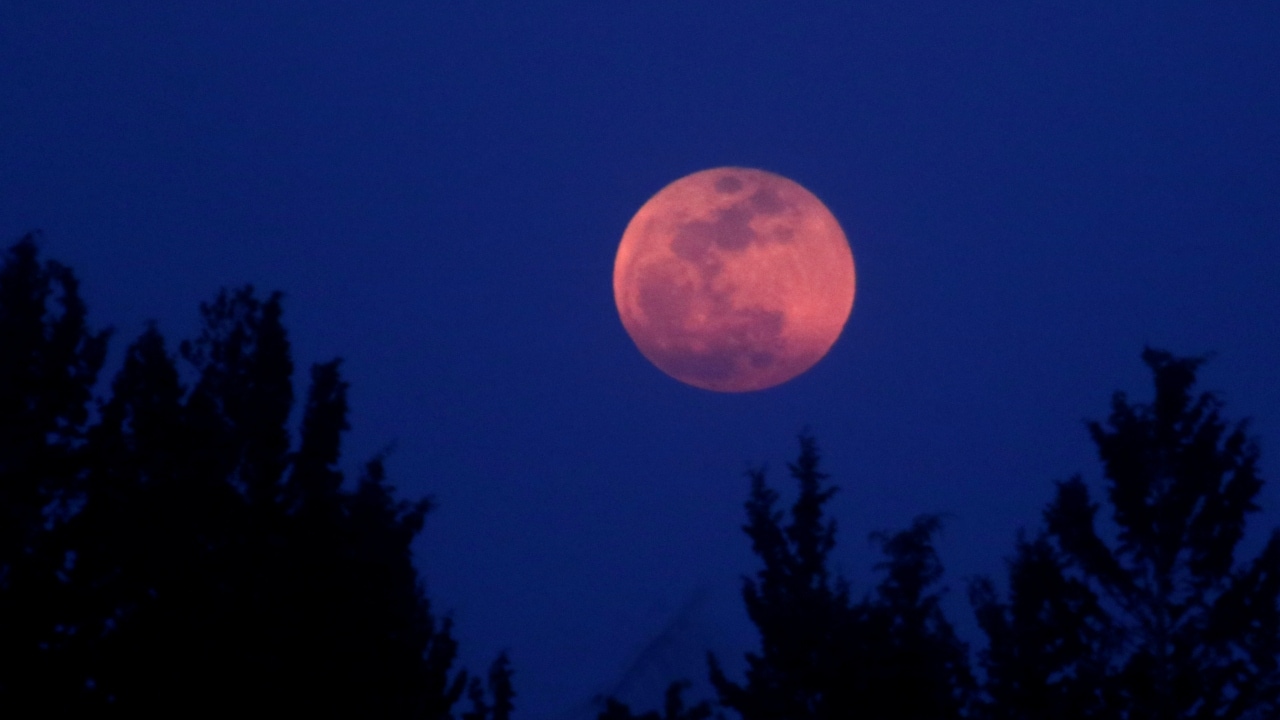
The 'Super Blue Blood Moon' on 31 January. Reuters[/caption]However, instead of completely disappearing from sight, the Moon this year will wear a red tinge during the total eclipse due to sunlight being scattered by the Earth’s atmosphere.In what seems like a bizarre coincidence, Mars will also observe the closest distance from Earth in 15 years during the July lunar eclipse.
First Published:Jun 25, 2018, 10:23:58 IST
Advertisement
Advertisement

Careless Whispers: Scientists discover that plants can 'talk' to each other using smells
Japanese scientists have recorded a video that shows plants, in certain conditions, communicate with each other using mists that carry smells. The discovery, reveals that plants release a fine mist of airborne compounds, to warn nearby plants of potential dangers
Life on Mars? European Space Agency’s Orbiter discovers ice water deposits at equator
European Space Agency's Mars Express Orbiter has identified massive ice and ice water deposits beneath the surface of Mars. The Mars Express orbiter was also the first to confirmed the presence of ice on Mars in 2004
Microsoft briefly overtakes Apple as the most valuable company, Apple back on top again
At its peak during the session, Microsoft's value reached $2.903 trillion, with a 2% surge. As of writing this article, Apple closed at $2.89 trillion, whereas Microsoft closed at $2.86 trillion
Even NASA is facing a tough time, starts layoffs following major budget cuts
NASA is facing some massive budget cuts, because of which, it has been forced to postpone some upcoming missions. NASA's Jet Propulsion Laboratory has been hit hard by recent federal budget cuts, resulting in the layoff of 100 contractors last week
ISRO, NASA's NISAR satellite to get ready by Jan-end, will monitor Earth's snow-covered regions
The NISAR satellite which has been developed jointly ISRO and NASA, should be ready for launch by the end of January 2024. The collaboration between NASA and ISRO on NISAR is the first time the two agencies have cooperated on hardware development for an Earth-observing mission
Advertisement
Advertisement