


Black holes do not move around sucking in objects like a vacuum cleaners, say scientist
He said if the Sun became a black hole, it wouldn't suck other planets; the Earth would still revolve around it, except there wouldn't light and the planet would be very cold.

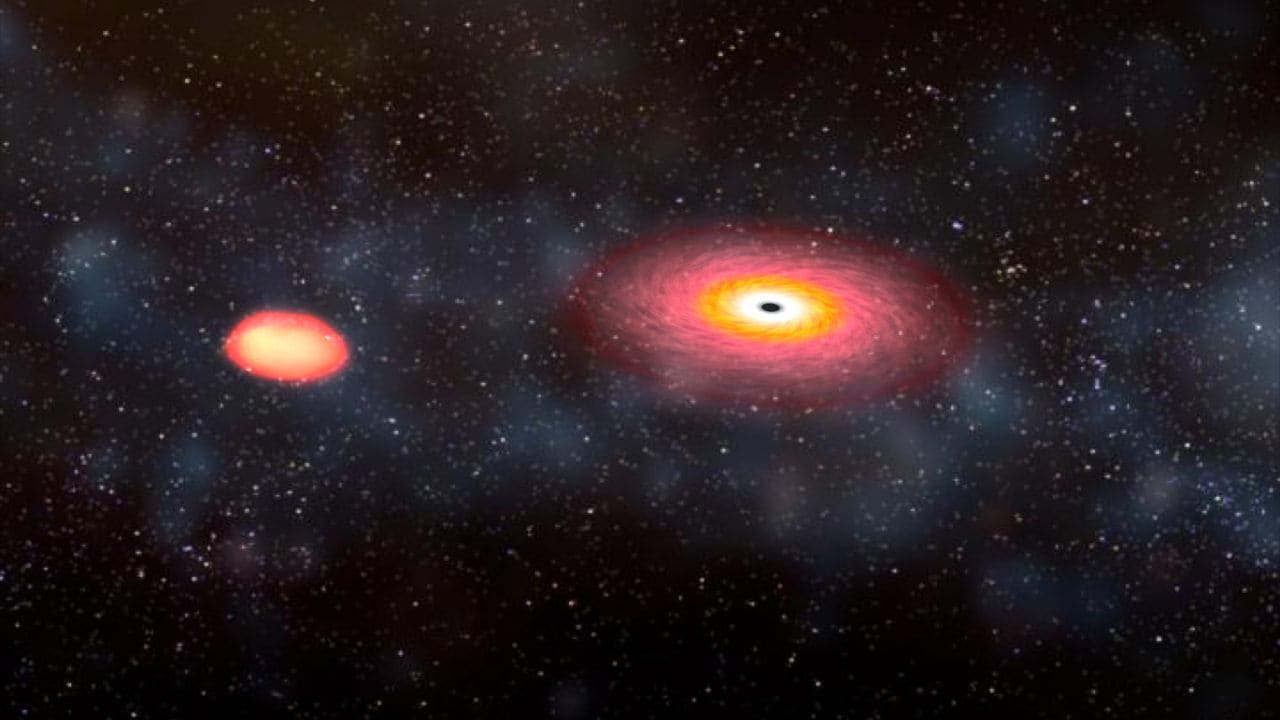
A black hole devours another celestial object. Representational Image. Image credit: Dana Berry/NASA[/caption]Raychaudhury went on to focus in how the contribution of different scientists over different periods of time, including that of Isaac Newton have resulted in a better understanding of black holes.Raychaudhury also pointed out how there is a 'Calcutta connection' of Nobel Prize for black holes.According to him, both Stephen Hawking and Roger Penrose, in their study about black holes have used the formalism laid down by Amalkumar Raychaudhuri, a professor of physics at Calcutta University’s Ashutosh College in 1955.As per Raychaudhury, whole the paper says nothing about black holes, it is a concept of 'differential geometry' which Hawking used to define how a spinning star with angular momentum collapses and distorts space-time to finally end up in a singularity.He added that a black hole has two basic parts — the singularity and the event horizon. According to the researcher, the singularity is at the centre and is where the mass resides and it was Stephen Hawking and R. Penrose who wrote the first paper on Singularities.According to an article in The Times of India, the Raychaudhuri Equation is in the spotlight after the Royal Swedish Academy of Science awarded one half of the 2020 Physics Nobel to Roger Penrose for throwing light on Black Holes. The other half of the Nobel was jointly given to Reinhard Genzel and Andrea Ghez.

Careless Whispers: Scientists discover that plants can 'talk' to each other using smells
Life on Mars? European Space Agency’s Orbiter discovers ice water deposits at equator
Microsoft briefly overtakes Apple as the most valuable company, Apple back on top again
Even NASA is facing a tough time, starts layoffs following major budget cuts
ISRO, NASA's NISAR satellite to get ready by Jan-end, will monitor Earth's snow-covered regions