


Black hole rips apart a star, scientists managed to snag a look at the violent event
NASA's TESS showed that the star was eventually sucked into oblivion in a rare cosmic occurrence.

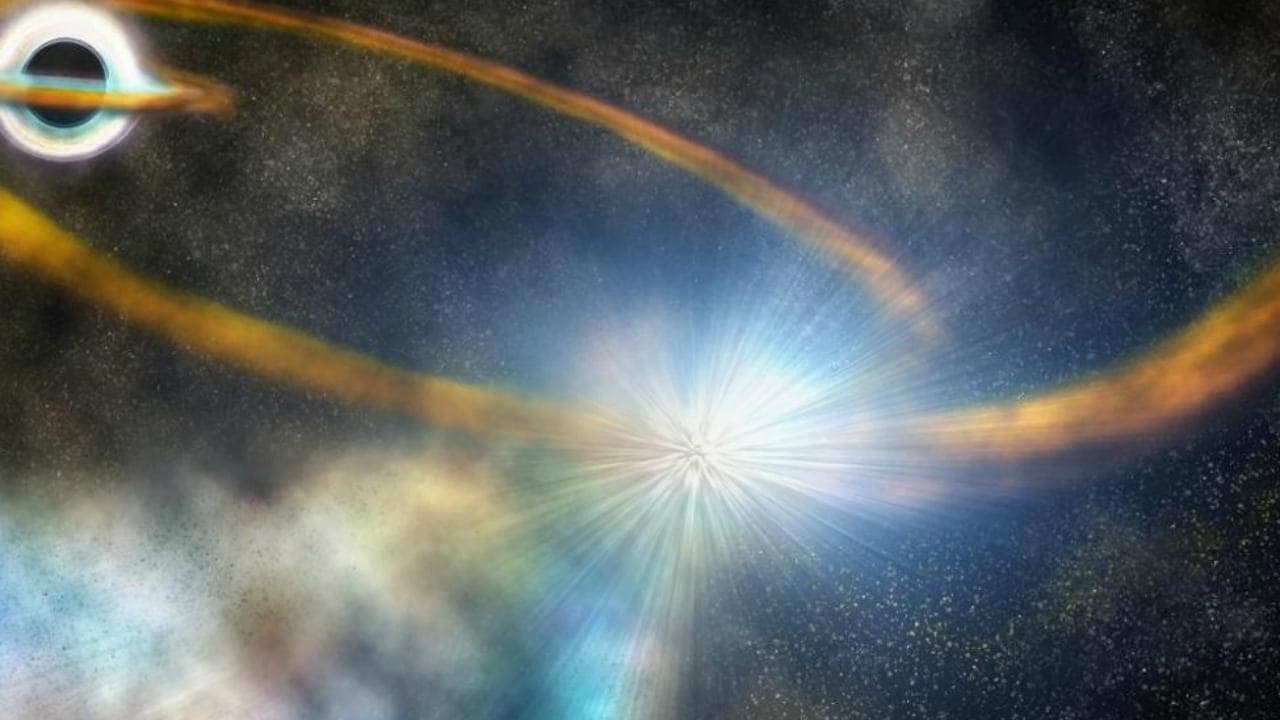
An illustration of the cosmic event where a star got sucked into a black hole. image credit: Carnegie Institution for Science[/caption]Astronomers used an international network of telescopes to detect the phenomenon before turning to TESS, whose permanent viewing zones designed to hunt distant planets caught the beginning of the violent event, proving effective its unique method of surveilling the cosmos.“This was really a combination of both being good and being lucky, and sometimes that’s what you need to push the science forward,” said astronomer Thomas Holoien of the Carnegie Institution for Science, who led the research published in the Astrophysical Journal.Such phenomena happen when a star ventures too close to a supermassive black hole, objects that reside at the centre of most large galaxies including our Milky Way. The black hole’s tremendous gravitational forces tear the star to shreds, with some of its material tossed into space and the rest plunging into the black hole, forming a disk of hot, bright gas as it is swallowed.“Specifically, we are able to measure the rate at which it gets brighter after it starts brightening, and we also observed a drop in its temperature and brightness that is unique,” Holoien said.Observing the oscillation of light as the black hole gobbles the star and spews stellar material in an outward spiral could help astronomers understand the black hole’s behaviour, a scientific mystery since physicist Albert Einstein’s work more than a century ago examined gravity’s influence on light in motion.

Careless Whispers: Scientists discover that plants can 'talk' to each other using smells
Life on Mars? European Space Agency’s Orbiter discovers ice water deposits at equator
Microsoft briefly overtakes Apple as the most valuable company, Apple back on top again
Even NASA is facing a tough time, starts layoffs following major budget cuts
ISRO, NASA's NISAR satellite to get ready by Jan-end, will monitor Earth's snow-covered regions