
Advertisement


Sections
Astroscale successfully demonstrated its space junk collection satellite can clear orbital debris
ELSA-d must reattempt the capture-and-release process three more times successfully before Astroscale can consider the mission accomplished.

On 25 August, Japan-UK-based aerospace company Astroscale achieved a major milestone — its space junk removal demo satellite successfully used a magnetic system to capture and release a client spacecraft.Space debris, or the unused man-made junk revolving in the Earth’s orbit, poses a risk of collision with other satellites.[caption id="attachment_9446631" align="alignnone" width="1280"]![Elsa-d ESA says approximately 9,200 tonnes of debris in orbit. Image: Astroscale/PA]()
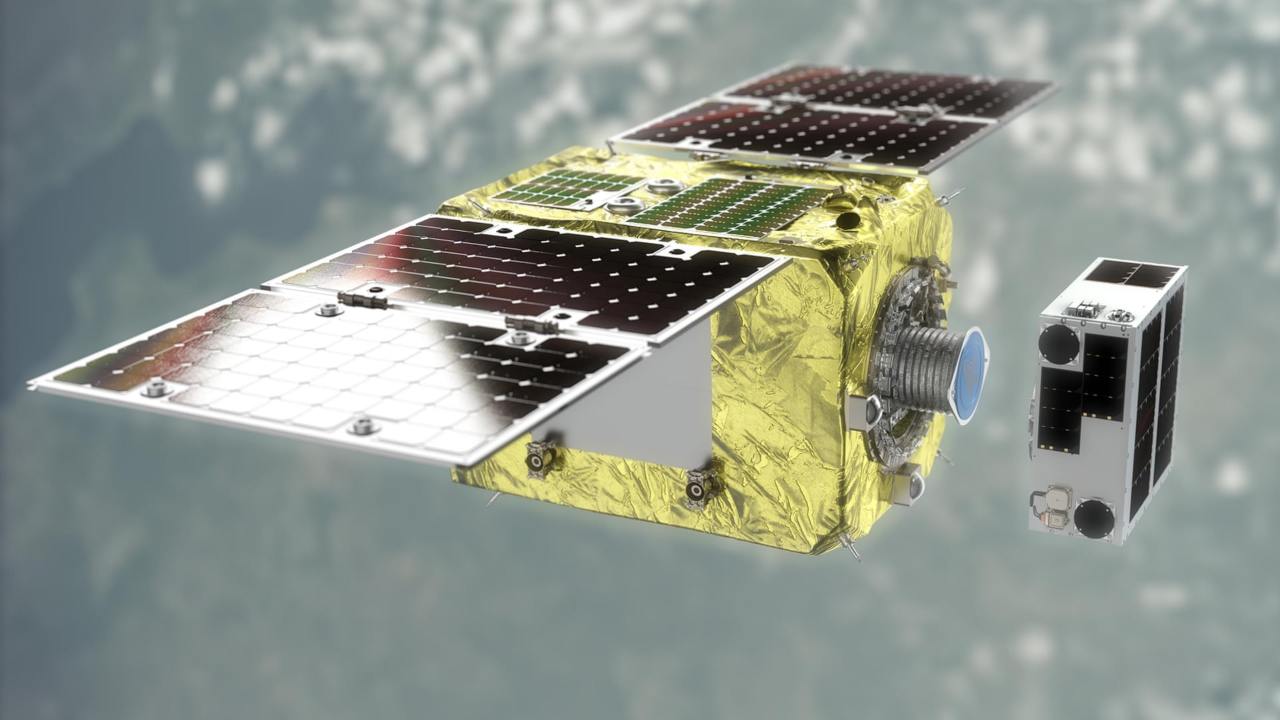
Elsa-d ESA says approximately 9,200 tonnes of debris in orbit. Image: Astroscale/PA[/caption]The End-of-Life Services by Astroscale-demonstration (ELSA-d) mission was launched in March this year with the aim of being the world's first commercial mission for the demonstration of the space debris removal system. Launched from the Baikonur Cosmodrome in Kazakhstan, the satellite consisted of a 175-kg service spacecraft and a 17-kg client satellite.The ELSA-d mission included two separate spacecraft: a “client” that poses as space debris and a “servicer” designed to remove said debris.
The demonstration was proof that the servicer can manage to capture and release other spacecraft, according to a statement by Astroscale. The company explained that the major challenge of space debris removal — docking with, or capturing, a client object — can be managed by the servicer.But the mission isn’t complete yet. The ELSA-d must reattempt the capture-and-release process three more times successfully before Astroscale can consider the mission accomplished.The servicer must capture and release the provider from a greater distance for the second attempt. After that, the process will be replicated with the provider simulating a tumbling, uncontrolled object. The final demonstration will be a “diagnosis and client search,” with the servicer inspecting the provider from a close distance, moving away, and then re-capturing it.Astroscale is one of several companies working on the issue of space debris. NASA has estimated that over 27,000 pieces of debris are floating in the Earth’s orbit as per the global Space Surveillance Network of the Department of Defense. The amount is expected to grow as launching a spacecraft grows less expensive.First Published:Aug 27, 2021, 18:02:40 IST
Advertisement
Advertisement

Careless Whispers: Scientists discover that plants can 'talk' to each other using smells
Japanese scientists have recorded a video that shows plants, in certain conditions, communicate with each other using mists that carry smells. The discovery, reveals that plants release a fine mist of airborne compounds, to warn nearby plants of potential dangers
Life on Mars? European Space Agency’s Orbiter discovers ice water deposits at equator
European Space Agency's Mars Express Orbiter has identified massive ice and ice water deposits beneath the surface of Mars. The Mars Express orbiter was also the first to confirmed the presence of ice on Mars in 2004
Microsoft briefly overtakes Apple as the most valuable company, Apple back on top again
At its peak during the session, Microsoft's value reached $2.903 trillion, with a 2% surge. As of writing this article, Apple closed at $2.89 trillion, whereas Microsoft closed at $2.86 trillion
Even NASA is facing a tough time, starts layoffs following major budget cuts
NASA is facing some massive budget cuts, because of which, it has been forced to postpone some upcoming missions. NASA's Jet Propulsion Laboratory has been hit hard by recent federal budget cuts, resulting in the layoff of 100 contractors last week
ISRO, NASA's NISAR satellite to get ready by Jan-end, will monitor Earth's snow-covered regions
The NISAR satellite which has been developed jointly ISRO and NASA, should be ready for launch by the end of January 2024. The collaboration between NASA and ISRO on NISAR is the first time the two agencies have cooperated on hardware development for an Earth-observing mission
Advertisement
Advertisement