


Astronomers classify the mysterious interstellar object ‘Oumuamua as a comet
Oumuamua was first detected last October by the University of Hawaii’s Pan-STARRS1 telescope.

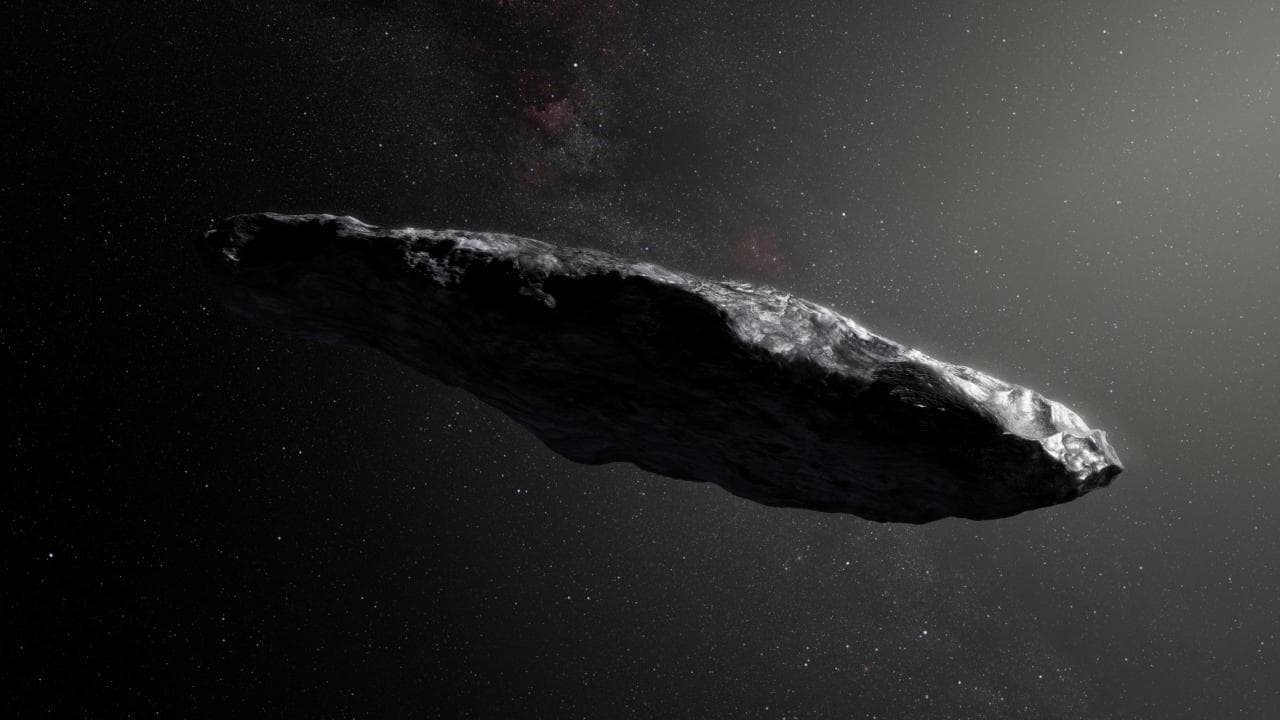
This artist’s impression shows the first interstellar asteroid, `Oumuamua as it passes through the solar system after its discovery in October 2017. Image: Reuters[/caption]‘Oumuamua (pronounced oh-MOO-uh-MOO-uh) initially was pegged as a comet, but it lacks the tail of gas and dust characteristic of many comets, and some scientists argued that it was perhaps a dry asteroid.“It does not display any tail in any observation we obtained,” said astronomer Marco Micheli of the European Space Agency’s SSA-NEO Coordination Centre in Italy, who led the study, published in the journal Nature.“However, our analysis shows that the amount of emitted gas that is needed to generate this extra force we see would have been so small as to be invisible in our observations,” he said in an email.This “extra force” acting on the object’s trajectory amounts to only about 0.1 percent of the Sun’s gravitational attraction.‘Oumuamua was first detected last October by the University of Hawaii’s Pan-STARRS1 telescope. Its name refers to the native Hawaiian language to a messenger arriving from a great distance.It previously slingshot past the Sun travelling at roughly 196,000 miles per hour (315,000 km per hour) and is heading out of the solar system in the direction of the constellation Pegasus. ‘Oumuamua as of last month was roughly the same distance from the Sun as Jupiter.Astronomers suspect that more visitors from other star systems will be discovered passing through our solar system.“The discovery of ‘Oumuamua is an absolute first in the field, and it provided our first opportunity to study an object coming from another star and planetary system,” Micheli said. “The existence of these objects was expected, but seeing one for the first time, and being able to study it in detail, is a unique chance to know more on these distant systems, and how they formed.”

Careless Whispers: Scientists discover that plants can 'talk' to each other using smells
Life on Mars? European Space Agency’s Orbiter discovers ice water deposits at equator
Microsoft briefly overtakes Apple as the most valuable company, Apple back on top again
Even NASA is facing a tough time, starts layoffs following major budget cuts
ISRO, NASA's NISAR satellite to get ready by Jan-end, will monitor Earth's snow-covered regions