
Advertisement


Sections
Arianespace's Vega rocket failure after lift-off caused by faulty wiring that changed its trajectory
It broke up in the atmosphere before falling into the Atlantic Ocean, destroying the two satellites it was carrying.

The failure of a European rocket just minutes after lift-off was caused by a production mistake that led to a wiring mix-up and altered the trajectory, its operator said on Tuesday.The Vega, the lightest of Arianespace's three payload rockets, malfunctioned about eight minutes after launch from the space centre at Kourou, in French Guiana in South America, on Monday.It broke up in the atmosphere before falling into the Atlantic Ocean, destroying the two satellites it was carrying, including one that would have placed Spain's first into orbit.[caption id="attachment_8784201" align="alignnone" width="1280"]![The ESA-Arianespace Vega rocket launched from French Guinea Image credit: ESA/Twitter]()
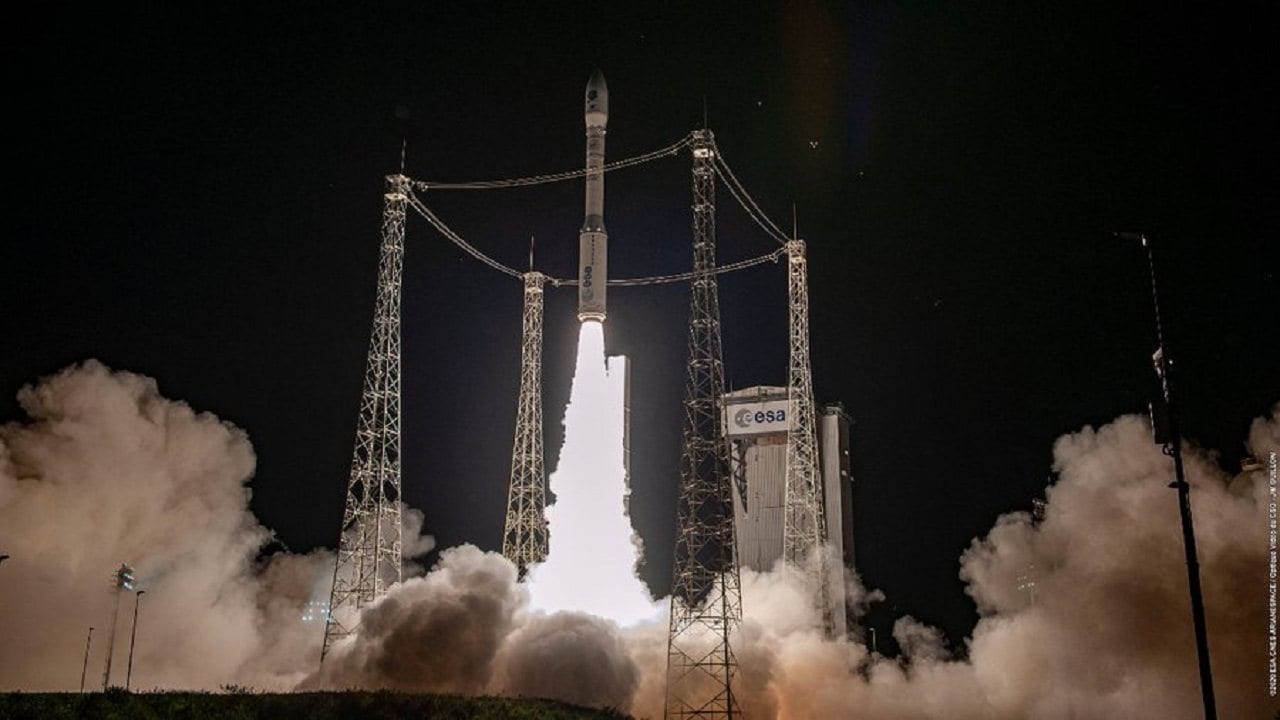
The ESA-Arianespace Vega rocket launched from French Guinea Image credit: ESA/Twitter[/caption]Arianespace CEO Stephane Israel said the wire mix-up was made while the launcher was being built by Avio in Italy."It's not a design problem," he told a press conference, as was the case with a previous Vega failure in July 2019."Everything was going as planned during the first part of the flight, but we lost control after the ignition of the fourth rocket stage," said Roland Lagier, Arianespace's technical director.
Arianespace and the European Space Agency plan to set up an independent commission to investigate the cause of the failure and determine why any mistakes were not discovered sooner."We'll fix it, and we'll be back even stronger," Israel said, adding that future launch schedules would be maintained.He nonetheless apologised for the loss of the two satellites: Spain had planned to put up its first Earth observation satellite for the European Space Agency (ESA).The mission would also have placed into orbit Taranis, a French satellite designed to observe extremely bright electrical phenomena in the planet's upper atmosphere.First Published:Nov 19, 2020, 14:58:39 IST
Advertisement
Advertisement

Careless Whispers: Scientists discover that plants can 'talk' to each other using smells
Japanese scientists have recorded a video that shows plants, in certain conditions, communicate with each other using mists that carry smells. The discovery, reveals that plants release a fine mist of airborne compounds, to warn nearby plants of potential dangers
Life on Mars? European Space Agency’s Orbiter discovers ice water deposits at equator
European Space Agency's Mars Express Orbiter has identified massive ice and ice water deposits beneath the surface of Mars. The Mars Express orbiter was also the first to confirmed the presence of ice on Mars in 2004
Microsoft briefly overtakes Apple as the most valuable company, Apple back on top again
At its peak during the session, Microsoft's value reached $2.903 trillion, with a 2% surge. As of writing this article, Apple closed at $2.89 trillion, whereas Microsoft closed at $2.86 trillion
Even NASA is facing a tough time, starts layoffs following major budget cuts
NASA is facing some massive budget cuts, because of which, it has been forced to postpone some upcoming missions. NASA's Jet Propulsion Laboratory has been hit hard by recent federal budget cuts, resulting in the layoff of 100 contractors last week
ISRO, NASA's NISAR satellite to get ready by Jan-end, will monitor Earth's snow-covered regions
The NISAR satellite which has been developed jointly ISRO and NASA, should be ready for launch by the end of January 2024. The collaboration between NASA and ISRO on NISAR is the first time the two agencies have cooperated on hardware development for an Earth-observing mission
Advertisement
Advertisement