
Advertisement


Sections
Ancient 430 million-year-old fossil points to how sea cucumbers lost their armour
The paleontologists have named the critter Sollasina Cthulhu, inspired by HP Lovecraft’s fictional cosmic entity.

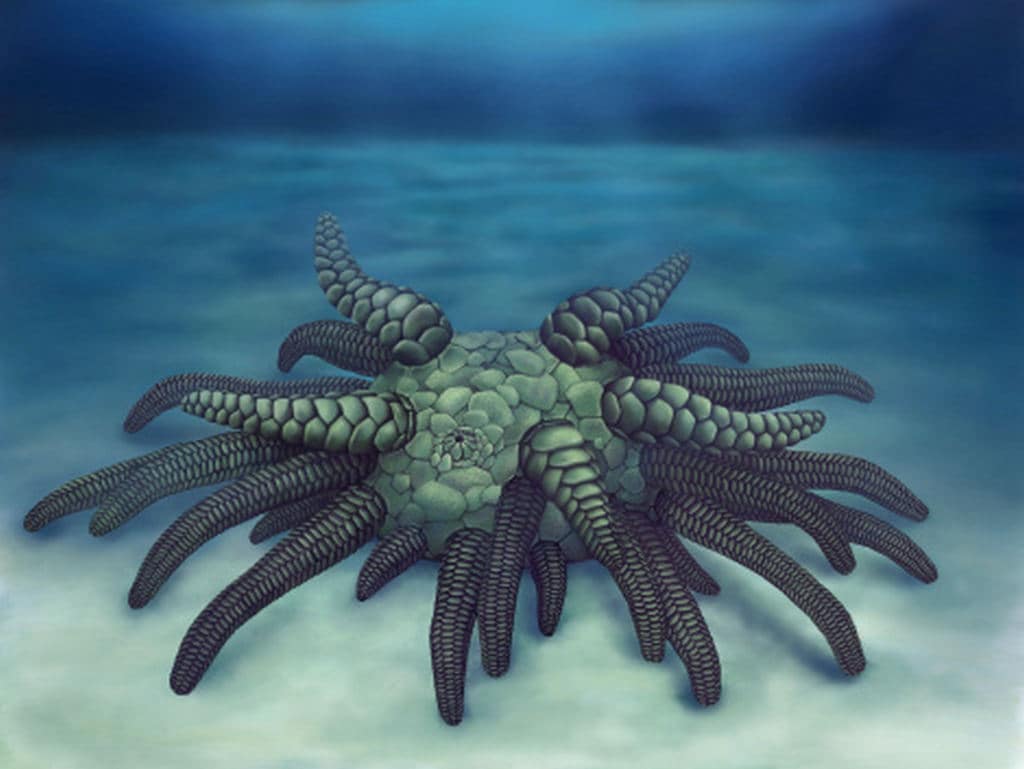 Image: More Than a Dodo[/caption]Sollasina Cthulhu's discovery was first announced in a study published in Proceedings of the Royal Society B on 10 April. Paleontologists give insight on how the fossil can help understand the early evolution of sea cucumbers in the study.
Sollasina cthulhuby Oxford University Museum of Natural Historyon SketchfabThe fossil was about the size of a large spider — tiny, really — and had 45 tentacle-like tube feet, a press released by Yale University said. The creature may not have been as big as Lovecraft’s creepy tentacle-clad monster, but other sea creatures might have kept their distance the many years ago it lived, Forbes reported.While the creature itself was tiny, its many tentacles might have made given it a big, monstrous look, another release by the University of Oxford said. The same report finds that Sollasina and its relatives are the most closely related to modern sea cucumbers, instead of sea urchins, indicating a different evolutionary markup.The fossil wasn't a picnic to study. The rock it fossilized in had the same chemical composition as the fossil and modern imaging techniques like CT scanning simply didn't do the trick. It had to be studied in a delicate yet painstaking process of grinding away the fossil — millimetres at a time — while snapping photographs every step of the way.These photos were used to reconstruct a model of the fossil in 3D, which opened the doors to a sea of similarities between the Cthulhu and its modern cousins."Our study demonstrates this was a story of loss, with fossil sea cucumbers becoming progressively less armoured as they evolved into modern forms," Imran Rahman, an Oxford research fellow, writes in the blog.Sea cucumbers have lost more than just their armour over the millennia. Modern sea cucumbers are also toothless animals, which is something the researchers hope to explain in their future research.
First Published:Apr 11, 2019, 13:26:48 IST
Advertisement
Advertisement

Careless Whispers: Scientists discover that plants can 'talk' to each other using smells
Japanese scientists have recorded a video that shows plants, in certain conditions, communicate with each other using mists that carry smells. The discovery, reveals that plants release a fine mist of airborne compounds, to warn nearby plants of potential dangers
Life on Mars? European Space Agency’s Orbiter discovers ice water deposits at equator
European Space Agency's Mars Express Orbiter has identified massive ice and ice water deposits beneath the surface of Mars. The Mars Express orbiter was also the first to confirmed the presence of ice on Mars in 2004
Microsoft briefly overtakes Apple as the most valuable company, Apple back on top again
At its peak during the session, Microsoft's value reached $2.903 trillion, with a 2% surge. As of writing this article, Apple closed at $2.89 trillion, whereas Microsoft closed at $2.86 trillion
Even NASA is facing a tough time, starts layoffs following major budget cuts
NASA is facing some massive budget cuts, because of which, it has been forced to postpone some upcoming missions. NASA's Jet Propulsion Laboratory has been hit hard by recent federal budget cuts, resulting in the layoff of 100 contractors last week
ISRO, NASA's NISAR satellite to get ready by Jan-end, will monitor Earth's snow-covered regions
The NISAR satellite which has been developed jointly ISRO and NASA, should be ready for launch by the end of January 2024. The collaboration between NASA and ISRO on NISAR is the first time the two agencies have cooperated on hardware development for an Earth-observing mission
Advertisement
Advertisement