
Advertisement


Sections
2I/Borisov comet was formed in another planetary system that might be similar to ours
The comet is expected to reach its closest point to the Sun on 8 December and closest point to the Earth soon after.

The second interstellar object ever spotted passing through the solar system is a comet that appears quite like those formed in our neighbourhood of the cosmos, providing fresh evidence that other planetary systems may be very similar to our own.Astronomers on Monday provided some of the first details about the comet now hurtling toward the sun, saying it has a solid nucleus with a radius of about six-tenths of a mile (1 km), a cloud-like structure of dust and gas emitted by the nucleus, the telltale tail of a comet and a reddish colour.[caption id="attachment_7502061" align="alignnone" width="1280"]![This is a comet that appears to have come from outside our solar system had been spotted from Earth. image credit: Gemini Observatory/NSF/AURA]() This is a comet that appears to have come from outside our solar system had been spotted from Earth. image credit: Gemini Observatory/NSF/AURA[/caption]First detected in August by an amateur astronomer named Gennady Borisov, it is called 2I/Borisov. The only previous interstellar visitor discovered in our solar system was a cigar-shaped rocky object called ‘Oumuamua' found in 2017.The comet was studied using telescopes in Hawaii and Spain.“Its properties determined so far - morphology, color, estimated size - are remarkably similar to the native solar system comets. This is important because it shows that comets exist in interstellar space, confirming long-standing predictions, and it tells us that comets similar to the ones we know from this solar system also form around other stars,” said astronomer Michal Drahus of Jagiellonian University in Poland.[caption id="attachment_7502081" align="alignnone" width="700"]
This is a comet that appears to have come from outside our solar system had been spotted from Earth. image credit: Gemini Observatory/NSF/AURA[/caption]First detected in August by an amateur astronomer named Gennady Borisov, it is called 2I/Borisov. The only previous interstellar visitor discovered in our solar system was a cigar-shaped rocky object called ‘Oumuamua' found in 2017.The comet was studied using telescopes in Hawaii and Spain.“Its properties determined so far - morphology, color, estimated size - are remarkably similar to the native solar system comets. This is important because it shows that comets exist in interstellar space, confirming long-standing predictions, and it tells us that comets similar to the ones we know from this solar system also form around other stars,” said astronomer Michal Drahus of Jagiellonian University in Poland.[caption id="attachment_7502081" align="alignnone" width="700"]![Two-colour composite image taken using Gemini North. image credit: Gemini Observatory/NSF/AURA]() Two-colour composite image taken using Gemini North. image credit: Gemini Observatory/NSF/AURA[/caption]Both 2I/Borisov and ‘Oumuamua formed in other planetary systems and were ejected by gravitational perturbations into interstellar space as orphans wandering the cosmos.“Our Solar System is regularly visited by escapees from other planetary systems, and it has always been this way. It’s just that we haven’t been able to detect them until recently,” Drahus said.[caption id="" align="alignnone" width="1024"]
Two-colour composite image taken using Gemini North. image credit: Gemini Observatory/NSF/AURA[/caption]Both 2I/Borisov and ‘Oumuamua formed in other planetary systems and were ejected by gravitational perturbations into interstellar space as orphans wandering the cosmos.“Our Solar System is regularly visited by escapees from other planetary systems, and it has always been this way. It’s just that we haven’t been able to detect them until recently,” Drahus said.[caption id="" align="alignnone" width="1024"]![]() image credit: NASA[/caption]The speed of 2I/Borisov and the nature of its orbital path demonstrated that it did not originate in our solar system, Jagiellonian University astronomer Piotr Guzik said. Guzik added that he expects that within a decade or so a space probe will be sent from Earth to visit an interstellar object.“I think this is the most important and transformative moment for planetary astronomy since the discovery of the first exoplanets (planets in other star systems) in the early 1990s and a milestone for astronomy in general. Interstellar minor bodies are this long-sought bridge between other planetary systems and our own solar system. I like to think of them as miniature exoplanets in our own cosmic backyard,” Drahus said.The comet is expected to reach its closest point to the Sun on 8 December and its closest point to the Earth soon thereafter, coming within about 186 million miles (300 million km) of our planet. By way of comparison, the moon orbits about 240,000 miles (386,000 km) from Earth.The research was published in the journal Nature Astronomy.
image credit: NASA[/caption]The speed of 2I/Borisov and the nature of its orbital path demonstrated that it did not originate in our solar system, Jagiellonian University astronomer Piotr Guzik said. Guzik added that he expects that within a decade or so a space probe will be sent from Earth to visit an interstellar object.“I think this is the most important and transformative moment for planetary astronomy since the discovery of the first exoplanets (planets in other star systems) in the early 1990s and a milestone for astronomy in general. Interstellar minor bodies are this long-sought bridge between other planetary systems and our own solar system. I like to think of them as miniature exoplanets in our own cosmic backyard,” Drahus said.The comet is expected to reach its closest point to the Sun on 8 December and its closest point to the Earth soon thereafter, coming within about 186 million miles (300 million km) of our planet. By way of comparison, the moon orbits about 240,000 miles (386,000 km) from Earth.The research was published in the journal Nature Astronomy.
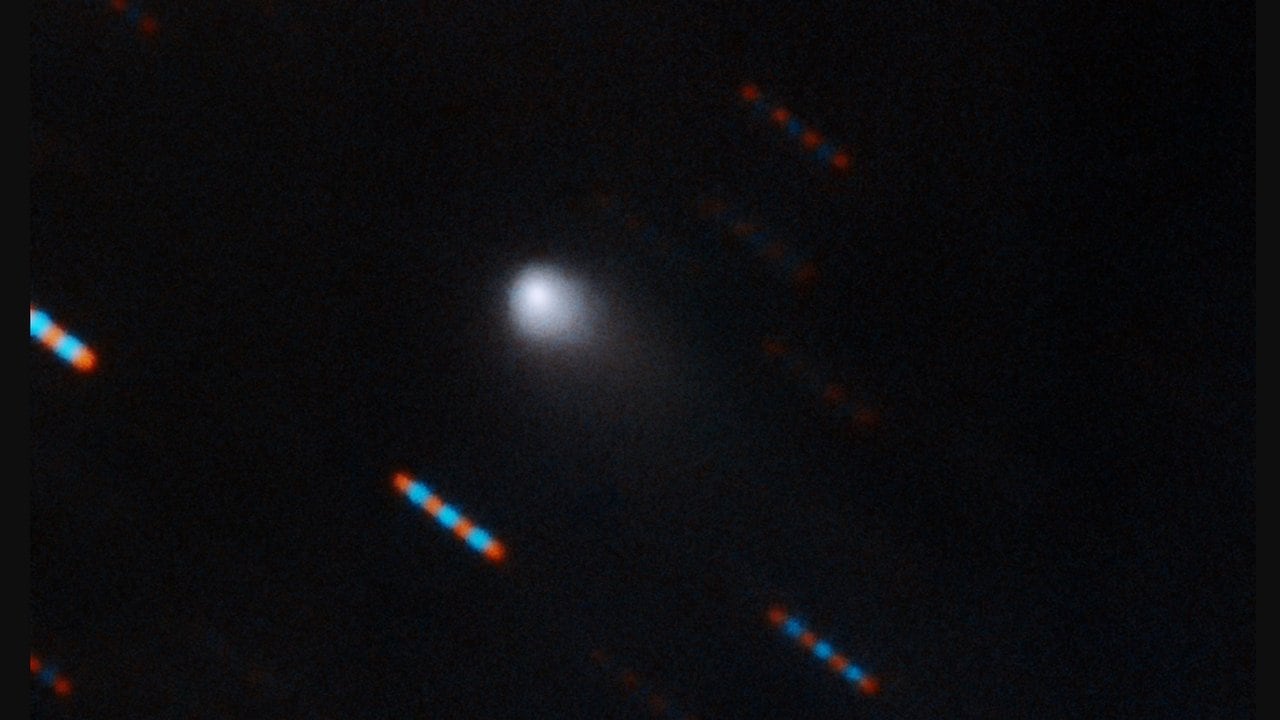 This is a comet that appears to have come from outside our solar system had been spotted from Earth. image credit: Gemini Observatory/NSF/AURA[/caption]First detected in August by an amateur astronomer named Gennady Borisov, it is called 2I/Borisov. The only previous interstellar visitor discovered in our solar system was a cigar-shaped rocky object called ‘Oumuamua' found in 2017.The comet was studied using telescopes in Hawaii and Spain.“Its properties determined so far - morphology, color, estimated size - are remarkably similar to the native solar system comets. This is important because it shows that comets exist in interstellar space, confirming long-standing predictions, and it tells us that comets similar to the ones we know from this solar system also form around other stars,” said astronomer Michal Drahus of Jagiellonian University in Poland.[caption id="attachment_7502081" align="alignnone" width="700"]
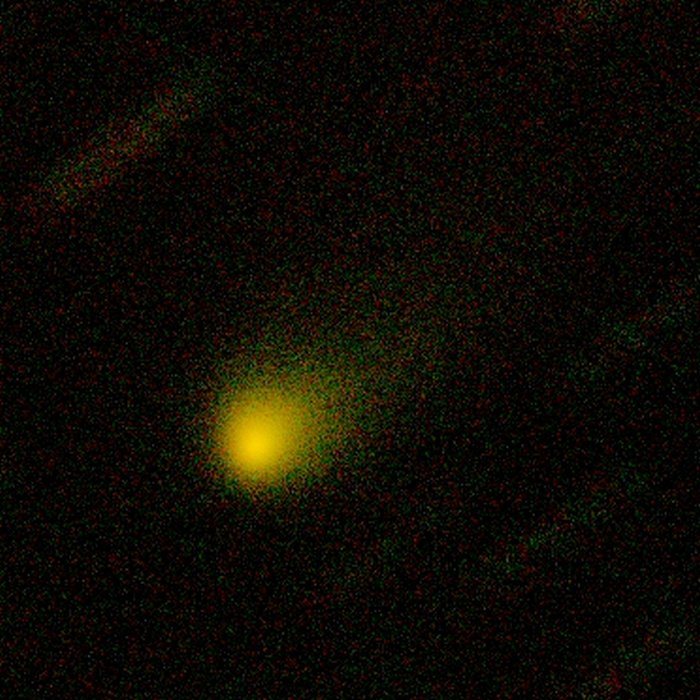 Two-colour composite image taken using Gemini North. image credit: Gemini Observatory/NSF/AURA[/caption]Both 2I/Borisov and ‘Oumuamua formed in other planetary systems and were ejected by gravitational perturbations into interstellar space as orphans wandering the cosmos.“Our Solar System is regularly visited by escapees from other planetary systems, and it has always been this way. It’s just that we haven’t been able to detect them until recently,” Drahus said.[caption id="" align="alignnone" width="1024"]
 image credit: NASA[/caption]The speed of 2I/Borisov and the nature of its orbital path demonstrated that it did not originate in our solar system, Jagiellonian University astronomer Piotr Guzik said. Guzik added that he expects that within a decade or so a space probe will be sent from Earth to visit an interstellar object.“I think this is the most important and transformative moment for planetary astronomy since the discovery of the first exoplanets (planets in other star systems) in the early 1990s and a milestone for astronomy in general. Interstellar minor bodies are this long-sought bridge between other planetary systems and our own solar system. I like to think of them as miniature exoplanets in our own cosmic backyard,” Drahus said.The comet is expected to reach its closest point to the Sun on 8 December and its closest point to the Earth soon thereafter, coming within about 186 million miles (300 million km) of our planet. By way of comparison, the moon orbits about 240,000 miles (386,000 km) from Earth.The research was published in the journal Nature Astronomy.
First Published:Oct 15, 2019, 15:03:52 IST
Advertisement
Advertisement

Careless Whispers: Scientists discover that plants can 'talk' to each other using smells
Japanese scientists have recorded a video that shows plants, in certain conditions, communicate with each other using mists that carry smells. The discovery, reveals that plants release a fine mist of airborne compounds, to warn nearby plants of potential dangers
Life on Mars? European Space Agency’s Orbiter discovers ice water deposits at equator
European Space Agency's Mars Express Orbiter has identified massive ice and ice water deposits beneath the surface of Mars. The Mars Express orbiter was also the first to confirmed the presence of ice on Mars in 2004
Microsoft briefly overtakes Apple as the most valuable company, Apple back on top again
At its peak during the session, Microsoft's value reached $2.903 trillion, with a 2% surge. As of writing this article, Apple closed at $2.89 trillion, whereas Microsoft closed at $2.86 trillion
Even NASA is facing a tough time, starts layoffs following major budget cuts
NASA is facing some massive budget cuts, because of which, it has been forced to postpone some upcoming missions. NASA's Jet Propulsion Laboratory has been hit hard by recent federal budget cuts, resulting in the layoff of 100 contractors last week
ISRO, NASA's NISAR satellite to get ready by Jan-end, will monitor Earth's snow-covered regions
The NISAR satellite which has been developed jointly ISRO and NASA, should be ready for launch by the end of January 2024. The collaboration between NASA and ISRO on NISAR is the first time the two agencies have cooperated on hardware development for an Earth-observing mission
Advertisement
Advertisement