
Advertisement


Sections
WhatsApp is working with Reliance Jio to spread awareness about fake messages
All new users of JioPhone get educational material about spotting a forwarded WhatsApp message.

Facebook’s WhatsApp is working closely with Reliance Jio to spread awareness of false messages, weeks after the Indian telecom operator opened up the messaging service to tens of millions of customers using its cheap internet-enabled phone.Jio this month gave it's more than 25 million JioPhone customers, many of them first-time internet users, access to WhatsApp at a time when the messaging service is battling false and incendiary texts and videos circulating on its platform.Reliance Chairman Mukesh Ambani, India’s richest man, launched the JioPhone last year at a refundable deposit of 1,500 rupees ($20.60). The device is internet enabled but didn’t initially allow the use of WhatsApp or have several popular smartphone features.All new users of the JioPhone get educational material that tells them about spotting a forwarded WhatsApp message and encourages them to share messages thoughtfully, WhatsApp spokesman Carl Woog told Reuters.[caption id="attachment_5022761" align="alignnone" width="1024"]![WhatsApp for Android. Image: tech2/ Shomik Sen Bhattacharjee]() WhatsApp for Android. Image: tech2/ Shomik Sen Bhattacharjee[/caption]“We are working closely with Jio to continue our education campaign for WhatsApp users,” Woog said.In India’s smaller towns and villages, deep-seated prejudices, often based on caste and religion, and cut-price mobile data can aggravate the so-called fake news problem. Such regions are a key market for cheap devices such as the JioPhone.More than 30 people have died this year in mob violence triggered by vitriolic messages on social media and WhatsApp, according to unofficial estimates, and police have previously told Reuters that minorities have been targeted in some remote and rural regions.That has prompted New Delhi to call on WhatsApp to take immediate action to “end this menace”.WhatsApp has already taken some steps to quell the rise of fake news. It has launched print and radio ad campaigns to educate users and introduced new features on the app including limiting message forwards as well as the labeling of forwarded messages.It has also partnered with Digital Empowerment Foundation (DEF), a New Delhi-based non-profit organization, to spread digital literacy in India’s towns and cities. DEF will host a workshop in the eastern Indian city of Ranchi this week, WhatsApp’s Woog said.WhatsApp also plans to expand its outreach program to existing JioPhone users.Reliance Jio did not immediately respond to an email seeking comment.With more than 200 million users, India is a key market for WhatsApp but one where it has had to delay the official launch of its payments services due to the country’s push on data localisation.WhatsApp is currently looking for an India chief and a policy head for the country.It last month appointed a grievance officer for Indian users at its Menlo Park, California headquarters, like other global tech firms whose grievance officers sit outside of India.India has, however, said it will toughen up its laws including pushing U.S. tech giants to have their grievance officers in India.(Disclosure: Reliance Industries Ltd is the sole beneficiary of Independent Media Trust which controls Network18 Media & Investments Ltd)
WhatsApp for Android. Image: tech2/ Shomik Sen Bhattacharjee[/caption]“We are working closely with Jio to continue our education campaign for WhatsApp users,” Woog said.In India’s smaller towns and villages, deep-seated prejudices, often based on caste and religion, and cut-price mobile data can aggravate the so-called fake news problem. Such regions are a key market for cheap devices such as the JioPhone.More than 30 people have died this year in mob violence triggered by vitriolic messages on social media and WhatsApp, according to unofficial estimates, and police have previously told Reuters that minorities have been targeted in some remote and rural regions.That has prompted New Delhi to call on WhatsApp to take immediate action to “end this menace”.WhatsApp has already taken some steps to quell the rise of fake news. It has launched print and radio ad campaigns to educate users and introduced new features on the app including limiting message forwards as well as the labeling of forwarded messages.It has also partnered with Digital Empowerment Foundation (DEF), a New Delhi-based non-profit organization, to spread digital literacy in India’s towns and cities. DEF will host a workshop in the eastern Indian city of Ranchi this week, WhatsApp’s Woog said.WhatsApp also plans to expand its outreach program to existing JioPhone users.Reliance Jio did not immediately respond to an email seeking comment.With more than 200 million users, India is a key market for WhatsApp but one where it has had to delay the official launch of its payments services due to the country’s push on data localisation.WhatsApp is currently looking for an India chief and a policy head for the country.It last month appointed a grievance officer for Indian users at its Menlo Park, California headquarters, like other global tech firms whose grievance officers sit outside of India.India has, however, said it will toughen up its laws including pushing U.S. tech giants to have their grievance officers in India.(Disclosure: Reliance Industries Ltd is the sole beneficiary of Independent Media Trust which controls Network18 Media & Investments Ltd)
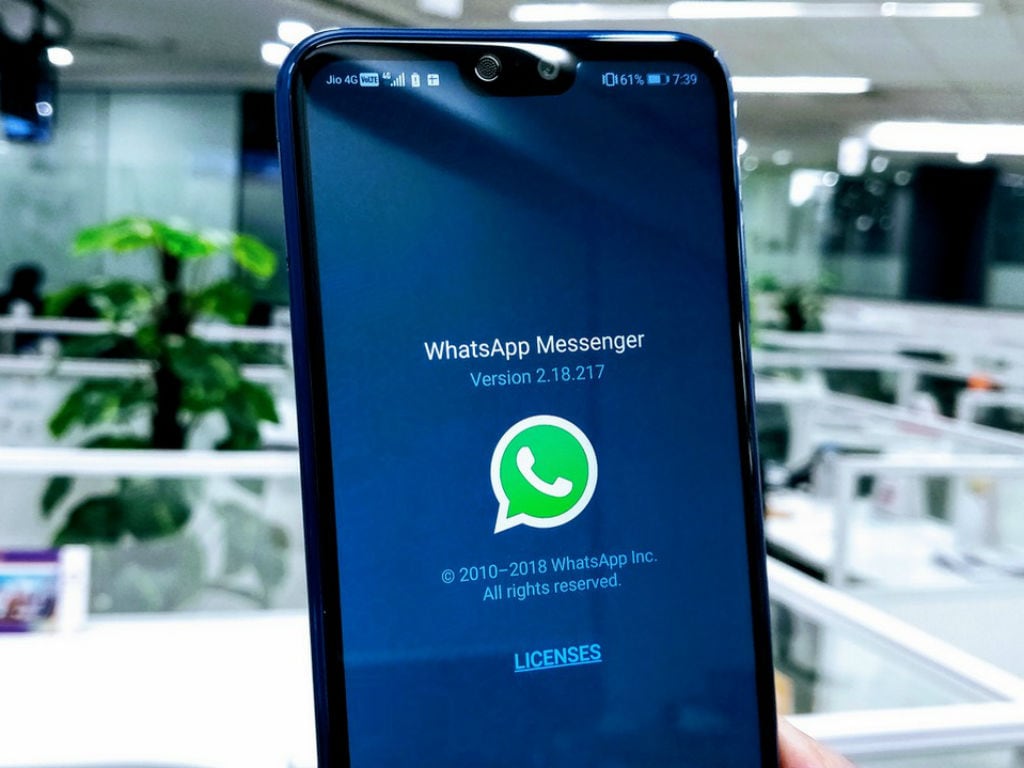 WhatsApp for Android. Image: tech2/ Shomik Sen Bhattacharjee[/caption]“We are working closely with Jio to continue our education campaign for WhatsApp users,” Woog said.In India’s smaller towns and villages, deep-seated prejudices, often based on caste and religion, and cut-price mobile data can aggravate the so-called fake news problem. Such regions are a key market for cheap devices such as the JioPhone.More than 30 people have died this year in mob violence triggered by vitriolic messages on social media and WhatsApp, according to unofficial estimates, and police have previously told Reuters that minorities have been targeted in some remote and rural regions.That has prompted New Delhi to call on WhatsApp to take immediate action to “end this menace”.WhatsApp has already taken some steps to quell the rise of fake news. It has launched print and radio ad campaigns to educate users and introduced new features on the app including limiting message forwards as well as the labeling of forwarded messages.It has also partnered with Digital Empowerment Foundation (DEF), a New Delhi-based non-profit organization, to spread digital literacy in India’s towns and cities. DEF will host a workshop in the eastern Indian city of Ranchi this week, WhatsApp’s Woog said.
First Published:Sep 26, 2018, 08:55:30 IST
Advertisement
Advertisement

Why AI notetakers are raising serious privacy and security concerns
AI notetakers promise effortless meeting summaries, but experts warn they could expose confidential conversations, corporate secrets and personal voiceprints. As businesses increasingly adopt AI-powered meeting assistants, questions over data storage, privacy, consent and legal risks are becoming impossible to ignore
5 min read
China's low-cost AI models are changing the global AI race. Here's why Silicon Valley is worried
As Chinese firms continue to improve performance while keeping prices low, the AI race is no longer just about building the smartest model—it is increasingly becoming a battle over who can deliver the best value
2 min read
China's Kimi K3 challenges US AI leaders with frontier-level performance at lower cost
Chinese artificial intelligence startup Moonshot AI has unveiled its latest open-weight AI model, Kimi K3, with early results suggesting it could compete with some of the world's most advanced AI systems developed by leading US companies
2 min read
How did Instagram run ads promoting child abuse in India?
India has issued a notice to Meta after an investigation alleged that Instagram displayed paid advertisements promoting child sexual abuse material. MeitY ordered Meta to remove such Instagram ads and explain within seven days how they were approved
8 min read
Why has India halted WhatsApp’s username feature before launch?
India has halted WhatsApp’s planned username feature, citing concerns about cybercrime, impersonation, and law enforcement challenges. As Meta races to address security concerns, here’s why MeitY has paused the rollout, what the feature does, and how it could influence privacy and online safety in India
3 min read
Advertisement
Advertisement