
Advertisement


Sections
Unlike the US, TRAI asserts that net neutrality is the "right way" forward for India
TRAI Chairman RS Sharma said TRAI was of the view that net neutrality is the "right way" for India.

Telecom regulator TRAI has strongly defended its stance on net neutrality, asserting that keeping the internet open and free is the "right way" forward for India.[caption id="attachment_4231485" align="alignleft" width="380"]![Representational image. Reuters.]() Representational image. Reuters.[/caption]The comments come in the backdrop of US regulator rolling back net neutrality regulations adopted by the Obama administration on 14 December.The US Federal Communications Commission (FCC) passed the order by a three-to-two vote, scrapping the rules that were targeted at treating all internet services equally.According to reports, it felt that rolling back the net neutrality rules would restore the internet to light touch regulation.Telecom Regulatory Authority of India (TRAI), on the other hand, has proposed restricting service providers from entering into agreements which lead to discriminatory treatment of content on the internet.TRAI, late last month, gave its recommendations to the Telecom Department, which will take the final call."We will certainly stick to our stance. Every country is a sovereign country and every country is free to determine what its stance on net neutrality is," TRAI Chairman RS Sharma said on the sidelines of an open house discussion on another issue.Sharma said TRAI was of the view that net neutrality is the "right way" for India."I will not like to comment on what the US has done. But in Indian context, this is the right way....because a lot is riding on the internet and therefore it is important that it is kept as an open platform," Sharma said.To drive home the point, Sharma cited the example of a toll road where the toll operator cannot dictate which destination or route a consumer should take ultimately."His concern is only to charge toll from me. And thereafter, I am free to go anywhere I want to go. Similarly, net neutrality says you charge for the data and thereafter on the internet what I visit, what site I access, is my choice," he said.Net neutrality is "all about consumer choice", he said, adding it ensures that every site or innovator gets same amount of access."That is broad principal and I think it's a naturally correct principal," he added.TRAI, he said, would also come out with guidelines to clamp down on pesky calls by 15 January.The telecom regulator held an open house discussion with stakeholders on the issue of 'Unsolicited Commercial Communication'."We will take 20-25 days, till 15 January, to bring the guidelines. We have got a lot of responses, especially from technology companies. If technology is used, we will be able to control the problem to a large extent," Sharma said.
Representational image. Reuters.[/caption]The comments come in the backdrop of US regulator rolling back net neutrality regulations adopted by the Obama administration on 14 December.The US Federal Communications Commission (FCC) passed the order by a three-to-two vote, scrapping the rules that were targeted at treating all internet services equally.According to reports, it felt that rolling back the net neutrality rules would restore the internet to light touch regulation.Telecom Regulatory Authority of India (TRAI), on the other hand, has proposed restricting service providers from entering into agreements which lead to discriminatory treatment of content on the internet.TRAI, late last month, gave its recommendations to the Telecom Department, which will take the final call."We will certainly stick to our stance. Every country is a sovereign country and every country is free to determine what its stance on net neutrality is," TRAI Chairman RS Sharma said on the sidelines of an open house discussion on another issue.Sharma said TRAI was of the view that net neutrality is the "right way" for India."I will not like to comment on what the US has done. But in Indian context, this is the right way....because a lot is riding on the internet and therefore it is important that it is kept as an open platform," Sharma said.To drive home the point, Sharma cited the example of a toll road where the toll operator cannot dictate which destination or route a consumer should take ultimately."His concern is only to charge toll from me. And thereafter, I am free to go anywhere I want to go. Similarly, net neutrality says you charge for the data and thereafter on the internet what I visit, what site I access, is my choice," he said.Net neutrality is "all about consumer choice", he said, adding it ensures that every site or innovator gets same amount of access."That is broad principal and I think it's a naturally correct principal," he added.TRAI, he said, would also come out with guidelines to clamp down on pesky calls by 15 January.The telecom regulator held an open house discussion with stakeholders on the issue of 'Unsolicited Commercial Communication'."We will take 20-25 days, till 15 January, to bring the guidelines. We have got a lot of responses, especially from technology companies. If technology is used, we will be able to control the problem to a large extent," Sharma said.
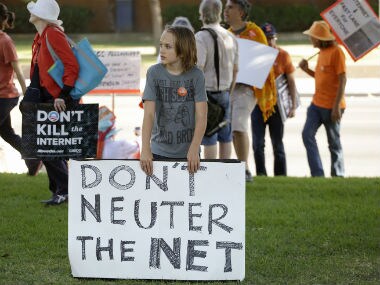 Representational image. Reuters.[/caption]The comments come in the backdrop of US regulator rolling back net neutrality regulations adopted by the Obama administration on 14 December.The US Federal Communications Commission (FCC) passed the order by a three-to-two vote, scrapping the rules that were targeted at treating all internet services equally.According to reports, it felt that rolling back the net neutrality rules would restore the internet to light touch regulation.Telecom Regulatory Authority of India (TRAI), on the other hand, has proposed restricting service providers from entering into agreements which lead to discriminatory treatment of content on the internet.TRAI, late last month, gave its recommendations to the Telecom Department, which will take the final call."We will certainly stick to our stance. Every country is a sovereign country and every country is free to determine what its stance on net neutrality is," TRAI Chairman RS Sharma said on the sidelines of an open house discussion on another issue.Sharma said TRAI was of the view that net neutrality is the "right way" for India."I will not like to comment on what the US has done. But in Indian context, this is the right way....because a lot is riding on the internet and therefore it is important that it is kept as an open platform," Sharma said.To drive home the point, Sharma cited the example of a toll road where the toll operator cannot dictate which destination or route a consumer should take ultimately."His concern is only to charge toll from me. And thereafter, I am free to go anywhere I want to go. Similarly, net neutrality says you charge for the data and thereafter on the internet what I visit, what site I access, is my choice," he said.Net neutrality is "all about consumer choice", he said, adding it ensures that every site or innovator gets same amount of access."That is broad principal and I think it's a naturally correct principal," he added.TRAI, he said, would also come out with guidelines to clamp down on pesky calls by 15 January.The telecom regulator held an open house discussion with stakeholders on the issue of 'Unsolicited Commercial Communication'."We will take 20-25 days, till 15 January, to bring the guidelines. We have got a lot of responses, especially from technology companies. If technology is used, we will be able to control the problem to a large extent," Sharma said.
First Published:Dec 15, 2017, 22:29:43 IST
Advertisement
Advertisement

Why AI notetakers are raising serious privacy and security concerns
AI notetakers promise effortless meeting summaries, but experts warn they could expose confidential conversations, corporate secrets and personal voiceprints. As businesses increasingly adopt AI-powered meeting assistants, questions over data storage, privacy, consent and legal risks are becoming impossible to ignore
5 min read
China's low-cost AI models are changing the global AI race. Here's why Silicon Valley is worried
As Chinese firms continue to improve performance while keeping prices low, the AI race is no longer just about building the smartest model—it is increasingly becoming a battle over who can deliver the best value
2 min read
China's Kimi K3 challenges US AI leaders with frontier-level performance at lower cost
Chinese artificial intelligence startup Moonshot AI has unveiled its latest open-weight AI model, Kimi K3, with early results suggesting it could compete with some of the world's most advanced AI systems developed by leading US companies
2 min read
How did Instagram run ads promoting child abuse in India?
India has issued a notice to Meta after an investigation alleged that Instagram displayed paid advertisements promoting child sexual abuse material. MeitY ordered Meta to remove such Instagram ads and explain within seven days how they were approved
8 min read
Why has India halted WhatsApp’s username feature before launch?
India has halted WhatsApp’s planned username feature, citing concerns about cybercrime, impersonation, and law enforcement challenges. As Meta races to address security concerns, here’s why MeitY has paused the rollout, what the feature does, and how it could influence privacy and online safety in India
3 min read
Advertisement
Advertisement