


TweetReality, an AR app, which brings Twitter into the real world
The app is the brainchild of developer Oscar Falmer, who created it using Apple's ARKit as a prototype for future AR headset-based apps.

A new app called "TweetReality" now allows iOS users to take microblogging app Twitter with them into the real world, courtesy of augmented reality (AR) technology.[caption id="attachment_4248929" align="alignleft" width="380"]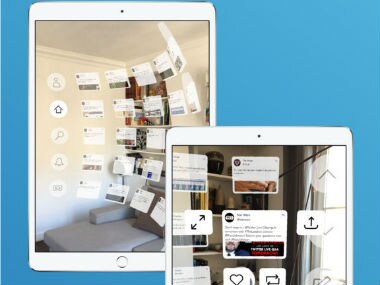 TweetReality. iTunes.[/caption]"The AR app, based on Apple's ARKit brings tweets, search, mentions, profiles and all your favourite features and displays them neatly on a virtual screen that overlays your iPhone or iPad display," The Next Web reported on 8 December.The app turns an ordinary Twitter feed into a grid of cards that float in a half-sphere ahead of the user. It can be downloaded now from the Apple App Store.It doesn't feel like it's designed specifically around Twitter, according to The Verge.Twitter is information-dense, designed to let the user scroll a high volume of fast-flowing information at a glance."'TweetReality', by contrast, is a giant board with a lot of white space. It disrupts Twitter's news-ticker feel, a framework that heavily shapes how people read and write tweets, and one of its most unique elements," the report added.The app is the brainchild of developer Oscar Falmer, who created it using Apple's ARKit as a prototype for future AR headset-based apps.ARKit is a framework that allows the user to create unparalleled augmented reality experiences for the iPhone and iPad.

Why AI notetakers are raising serious privacy and security concerns
China's low-cost AI models are changing the global AI race. Here's why Silicon Valley is worried
China's Kimi K3 challenges US AI leaders with frontier-level performance at lower cost
How did Instagram run ads promoting child abuse in India?
Why has India halted WhatsApp’s username feature before launch?