
Advertisement


Sections
Troubles with Tesla's automated parking feature summon safety regulators
Tesla says it has delivered 97,000 vehicles in the third quarter, fewer than some analysts had expected.

US regulators are looking into parking lot crashes involving Tesla Inc cars driving themselves to their owners using the company's Smart Summon feature, the National Highway Traffic Safety Administration (NHTSA) said on Wednesday.Several users have posted videos on social media of Tesla vehicles that appear to have been in near accidents. One posted a video of a Tesla striking a garage wall and another of a Tesla being struck by a vehicle backing up.A Tesla software update last week added its Smart Summon feature for some customers. When the car is within 200 feet and in their line of sight, they use a phone app to summon the vehicle in a parking lot.[caption id="attachment_7444741" align="alignnone" width="1280"]![Tesla Smart Summon. Image: YouTube]() Tesla Smart Summon. Image: YouTube[/caption]On its website, Tesla's description of Summon reads: "Your parked car will come find you anywhere in a parking lot. Really."Asked about reports of crashes, NHTSA said it "is aware of reports related to Tesla’s Summon feature. We are in ongoing contact with the company and we continue to gather information. Safety is NHTSA’s top priority and the agency will not hesitate to act if it finds evidence of a safety-related defect."Tesla did not respond to a request for comment, but Chief Executive Elon Musk on Wednesday tweeted that there were more than 550,000 Smart Summon uses in the first few days.Tesla says users of Smart Summon should have a clear line of sight and check the surroundings. It said the vehicle "will manoeuvre around or stop for objects and notify you when detected."Users can stop the car from driving by releasing the app's button, it says, adding, "You are still responsible for your car and must monitor it and its surroundings at all times and be within your line of sight because it may not detect all obstacles. Be especially careful around quick moving people, bicycles and cars."While Tesla said Summon is to be used only in private parking lots and driveways, the feature breaks new ground by allowing operation of a vehicle without a driver behind the wheel. Federal vehicle safety regulations were written decades ago, before such technology existed.Tesla reported Wednesday that it delivered 97,000 vehicles in the third quarter, fewer than some analysts had expected.In addition to the crashes depicted on social media, there are also videos of several near misses.In one Twitter video, a Tesla exits a parking space and starts to cross a driveway when an SUV nearly collides with the driverless car. A voice is heard gasping and exclaiming, "Oh my God!"The poster, Dallas-based solutions architect Roddie Hasan, commented that his "first test of Smart Summon didn't go so well.""..A car pulled in from the road and around the corner into the lot, and I expected the Tesla to 'see' it and stop, however I had to take my finger off the (app) button when I saw that my Tesla wasn't slowing down," Hasan told Reuters.Another Twitter user, Mark Solomon, also posted a video that showed his car was not able to park itself properly using the feature."Not sure what the problem was but I think an older map of the parking lot was being used," he said.
Tesla Smart Summon. Image: YouTube[/caption]On its website, Tesla's description of Summon reads: "Your parked car will come find you anywhere in a parking lot. Really."Asked about reports of crashes, NHTSA said it "is aware of reports related to Tesla’s Summon feature. We are in ongoing contact with the company and we continue to gather information. Safety is NHTSA’s top priority and the agency will not hesitate to act if it finds evidence of a safety-related defect."Tesla did not respond to a request for comment, but Chief Executive Elon Musk on Wednesday tweeted that there were more than 550,000 Smart Summon uses in the first few days.Tesla says users of Smart Summon should have a clear line of sight and check the surroundings. It said the vehicle "will manoeuvre around or stop for objects and notify you when detected."Users can stop the car from driving by releasing the app's button, it says, adding, "You are still responsible for your car and must monitor it and its surroundings at all times and be within your line of sight because it may not detect all obstacles. Be especially careful around quick moving people, bicycles and cars."While Tesla said Summon is to be used only in private parking lots and driveways, the feature breaks new ground by allowing operation of a vehicle without a driver behind the wheel. Federal vehicle safety regulations were written decades ago, before such technology existed.Tesla reported Wednesday that it delivered 97,000 vehicles in the third quarter, fewer than some analysts had expected.In addition to the crashes depicted on social media, there are also videos of several near misses.In one Twitter video, a Tesla exits a parking space and starts to cross a driveway when an SUV nearly collides with the driverless car. A voice is heard gasping and exclaiming, "Oh my God!"The poster, Dallas-based solutions architect Roddie Hasan, commented that his "first test of Smart Summon didn't go so well.""..A car pulled in from the road and around the corner into the lot, and I expected the Tesla to 'see' it and stop, however I had to take my finger off the (app) button when I saw that my Tesla wasn't slowing down," Hasan told Reuters.Another Twitter user, Mark Solomon, also posted a video that showed his car was not able to park itself properly using the feature."Not sure what the problem was but I think an older map of the parking lot was being used," he said.
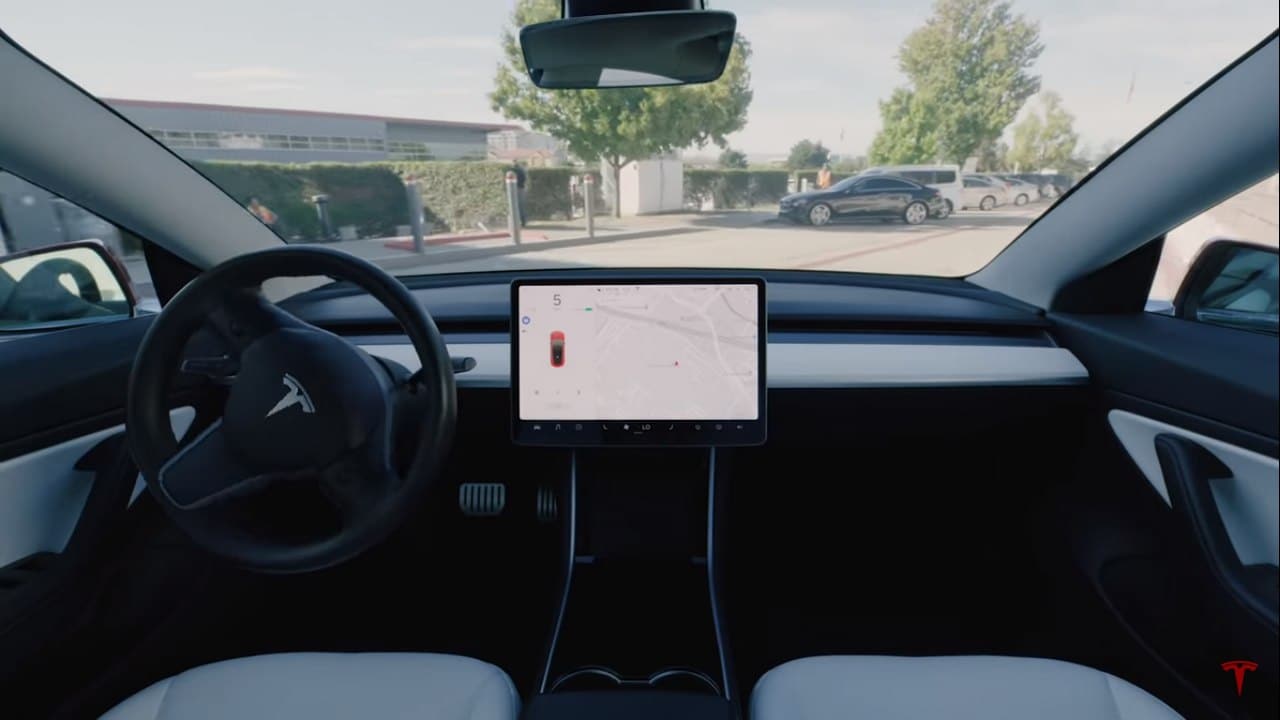 Tesla Smart Summon. Image: YouTube[/caption]On its website, Tesla's description of Summon reads: "Your parked car will come find you anywhere in a parking lot. Really."Asked about reports of crashes, NHTSA said it "is aware of reports related to Tesla’s Summon feature. We are in ongoing contact with the company and we continue to gather information. Safety is NHTSA’s top priority and the agency will not hesitate to act if it finds evidence of a safety-related defect."Tesla did not respond to a request for comment, but Chief Executive Elon Musk on Wednesday tweeted that there were more than 550,000 Smart Summon uses in the first few days.Tesla says users of Smart Summon should have a clear line of sight and check the surroundings. It said the vehicle "will manoeuvre around or stop for objects and notify you when detected."Users can stop the car from driving by releasing the app's button, it says, adding, "You are still responsible for your car and must monitor it and its surroundings at all times and be within your line of sight because it may not detect all obstacles. Be especially careful around quick moving people, bicycles and cars."While Tesla said Summon is to be used only in private parking lots and driveways, the feature breaks new ground by allowing operation of a vehicle without a driver behind the wheel. Federal vehicle safety regulations were written decades ago, before such technology existed.Tesla reported Wednesday that it delivered 97,000 vehicles in the third quarter, fewer than some analysts had expected.In addition to the crashes depicted on social media, there are also videos of several near misses.In one Twitter video, a Tesla exits a parking space and starts to cross a driveway when an SUV nearly collides with the driverless car. A voice is heard gasping and exclaiming, "Oh my God!"
Profound moment
Tesla's website warns that drivers "are still responsible for your car and must monitor it and its surroundings at all times and be within your line of sight because it may not detect all obstacles. Be especially careful around quick moving people, bicycles and cars."Other users had positive reviews. One posted a video of a white Tesla that slowly manoeuvred around a parking lot for over a minute, ultimately arriving safely next to where the operator was standing."It was a very profound moment to see this technology live! People don’t understand the depths and multitude of challenges to make this happen," the Twitter user, @problematique79, told Reuters.The summon feature is one of a suite of automated driving features that Musk has promised customers who have paid $6,000 for optional "Full Self Driving" packages of hardware and software.Automated driving features are one way Tesla hopes to stay ahead of traditional automakers, which have been more conservative about enabling vehicles to operate without drivers.
First Published:Oct 03, 2019, 05:15:16 IST
Advertisement
Advertisement

Why AI notetakers are raising serious privacy and security concerns
AI notetakers promise effortless meeting summaries, but experts warn they could expose confidential conversations, corporate secrets and personal voiceprints. As businesses increasingly adopt AI-powered meeting assistants, questions over data storage, privacy, consent and legal risks are becoming impossible to ignore
5 min read
China's low-cost AI models are changing the global AI race. Here's why Silicon Valley is worried
As Chinese firms continue to improve performance while keeping prices low, the AI race is no longer just about building the smartest model—it is increasingly becoming a battle over who can deliver the best value
2 min read
China's Kimi K3 challenges US AI leaders with frontier-level performance at lower cost
Chinese artificial intelligence startup Moonshot AI has unveiled its latest open-weight AI model, Kimi K3, with early results suggesting it could compete with some of the world's most advanced AI systems developed by leading US companies
2 min read
How did Instagram run ads promoting child abuse in India?
India has issued a notice to Meta after an investigation alleged that Instagram displayed paid advertisements promoting child sexual abuse material. MeitY ordered Meta to remove such Instagram ads and explain within seven days how they were approved
8 min read
Why has India halted WhatsApp’s username feature before launch?
India has halted WhatsApp’s planned username feature, citing concerns about cybercrime, impersonation, and law enforcement challenges. As Meta races to address security concerns, here’s why MeitY has paused the rollout, what the feature does, and how it could influence privacy and online safety in India
3 min read
Advertisement
Advertisement