
Advertisement


Sections
Solar activity can electrically charge the moons of Mars, making it difficult for future missions
Phobos, one of the moons of Mars is considered a strong candidate as a staging area for future missions to Mars. T

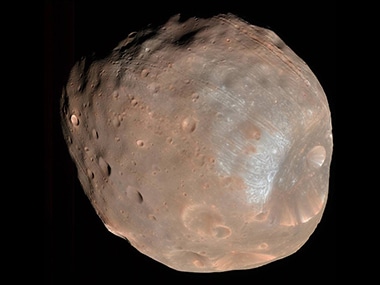
Phobos, one of the moons of Mars is considered a strong candidate as a staging area for future missions to Mars. The significantly lower gravity on Phobos as compared to the Red Planet makes it easier for spacecraft to land and take off. Spacefarers on Phobos could control robotic probes and rovers on the Martian surface, without the significant delay of transmitting signals back and forth from Earth. New research by NASA suggests that powerful outbursts from the Sun could electrically charge the moons of Phobos, introducing complexities to any future planned missions.[caption id="attachment_4169817" align="alignleft" width="380"]![Phobos as imaged by the MRO. Image: NASA.]() Phobos as imaged by the MRO. Image: NASA.[/caption]The charge would build up on the night side of Phobos, facing the surface of the Red Planet, a potential site for future manned missions to establish a command and control center for robotic exploration of the Martian surface. The charge is expected to build up during regular solar activity, but is expected to be particularly severe after excessive solar activity such as coronal mass ejections. The study was a follow up on previous researchers into the build up of electric charges in the craters of the Earth's Moon, as well as the dark areas on asteroids.William Farrell, from NASA’s Goddard Space Flight Center and lead author of the study says, "We found that astronauts or rovers could accumulate significant electric charges when traversing the night side of Phobos – the side facing Mars during the Martian day. While we don’t expect these charges to be large enough to injure an astronaut, they are potentially large enough to affect sensitive equipment, so we would need to design spacesuits and equipment that minimizes any charging hazard." The research has been published in Advances in Space Research.The study focused on Phobos, but the same conditions are expected to affect the other moon of Mars, Deimos in a similar manner. Calculations showed that in teflon spacesuits such as the ones used by NASA astronauts on the Apollo missions to the Moon, the buildup of static charge can reach ten thousand volts. After the charge has been accumulated, it can discharge into any electrical instruments touched by the astronaut, leading to damage of the equipment.
Phobos as imaged by the MRO. Image: NASA.[/caption]The charge would build up on the night side of Phobos, facing the surface of the Red Planet, a potential site for future manned missions to establish a command and control center for robotic exploration of the Martian surface. The charge is expected to build up during regular solar activity, but is expected to be particularly severe after excessive solar activity such as coronal mass ejections. The study was a follow up on previous researchers into the build up of electric charges in the craters of the Earth's Moon, as well as the dark areas on asteroids.William Farrell, from NASA’s Goddard Space Flight Center and lead author of the study says, "We found that astronauts or rovers could accumulate significant electric charges when traversing the night side of Phobos – the side facing Mars during the Martian day. While we don’t expect these charges to be large enough to injure an astronaut, they are potentially large enough to affect sensitive equipment, so we would need to design spacesuits and equipment that minimizes any charging hazard." The research has been published in Advances in Space Research.The study focused on Phobos, but the same conditions are expected to affect the other moon of Mars, Deimos in a similar manner. Calculations showed that in teflon spacesuits such as the ones used by NASA astronauts on the Apollo missions to the Moon, the buildup of static charge can reach ten thousand volts. After the charge has been accumulated, it can discharge into any electrical instruments touched by the astronaut, leading to damage of the equipment.
 Phobos as imaged by the MRO. Image: NASA.[/caption]The charge would build up on the night side of Phobos, facing the surface of the Red Planet, a potential site for future manned missions to establish a command and control center for robotic exploration of the Martian surface. The charge is expected to build up during regular solar activity, but is expected to be particularly severe after excessive solar activity such as coronal mass ejections. The study was a follow up on previous researchers into the build up of electric charges in the craters of the Earth's Moon, as well as the dark areas on asteroids.William Farrell, from NASA’s Goddard Space Flight Center and lead author of the study says, "We found that astronauts or rovers could accumulate significant electric charges when traversing the night side of Phobos – the side facing Mars during the Martian day. While we don’t expect these charges to be large enough to injure an astronaut, they are potentially large enough to affect sensitive equipment, so we would need to design spacesuits and equipment that minimizes any charging hazard." The research has been published in Advances in Space Research.The study focused on Phobos, but the same conditions are expected to affect the other moon of Mars, Deimos in a similar manner. Calculations showed that in teflon spacesuits such as the ones used by NASA astronauts on the Apollo missions to the Moon, the buildup of static charge can reach ten thousand volts. After the charge has been accumulated, it can discharge into any electrical instruments touched by the astronaut, leading to damage of the equipment.
First Published:Oct 24, 2017, 10:26:30 IST
Advertisement
Advertisement

Why AI notetakers are raising serious privacy and security concerns
AI notetakers promise effortless meeting summaries, but experts warn they could expose confidential conversations, corporate secrets and personal voiceprints. As businesses increasingly adopt AI-powered meeting assistants, questions over data storage, privacy, consent and legal risks are becoming impossible to ignore
5 min read
China's low-cost AI models are changing the global AI race. Here's why Silicon Valley is worried
As Chinese firms continue to improve performance while keeping prices low, the AI race is no longer just about building the smartest model—it is increasingly becoming a battle over who can deliver the best value
2 min read
China's Kimi K3 challenges US AI leaders with frontier-level performance at lower cost
Chinese artificial intelligence startup Moonshot AI has unveiled its latest open-weight AI model, Kimi K3, with early results suggesting it could compete with some of the world's most advanced AI systems developed by leading US companies
2 min read
How did Instagram run ads promoting child abuse in India?
India has issued a notice to Meta after an investigation alleged that Instagram displayed paid advertisements promoting child sexual abuse material. MeitY ordered Meta to remove such Instagram ads and explain within seven days how they were approved
8 min read
Why has India halted WhatsApp’s username feature before launch?
India has halted WhatsApp’s planned username feature, citing concerns about cybercrime, impersonation, and law enforcement challenges. As Meta races to address security concerns, here’s why MeitY has paused the rollout, what the feature does, and how it could influence privacy and online safety in India
3 min read
Advertisement
Advertisement